
At about 6:40 a.m., the house is quiet and everyone is still half-asleep.
You hear the furnace click softly, the air moving through the vents, and a few minutes later the hallway doesn’t feel so cold anymore.
You get out of bed and don’t do that cold-house shuffle to the coffee machine for once.
The heat didn’t just “magically” turn on.
It was your thermostat that followed a schedule like a good train follows its schedule.
And while you were stretching in bed, it was already saving you money on your next energy bill.
A lot of HVAC engineers swear by a very specific rhythm for a reason.
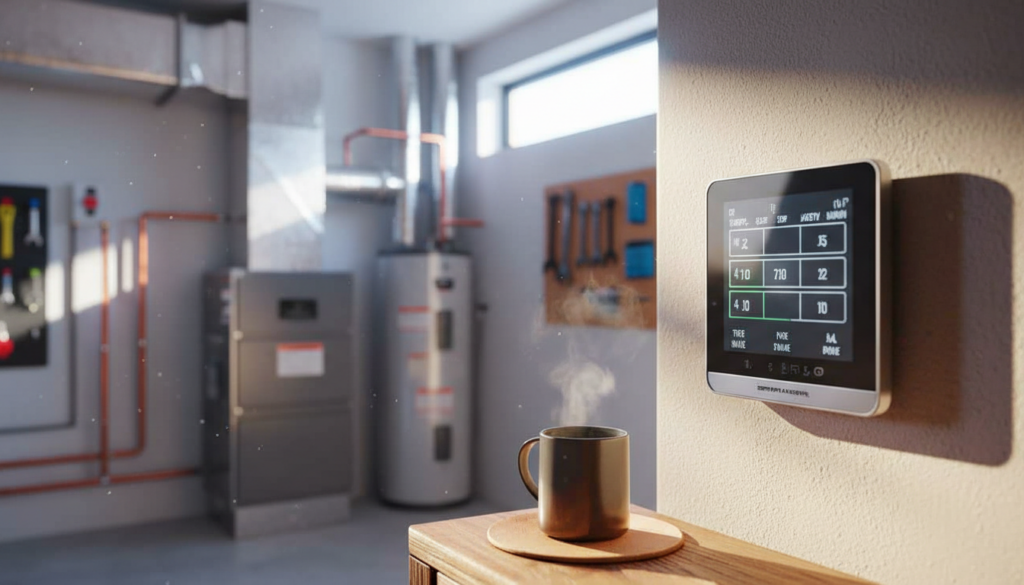
The schedule that HVAC engineers really use at home
If you ask three HVAC engineers what the “right” temperature is, you’ll get five different answers.
If you ask them about a daily schedule for comfort and savings, the answers will suddenly make sense.
Most of them say the same thing: a warm-up before you wake up, a setback when you leave, a steady comfort band in the evening and a cooler night.
There aren’t any wild swings or constant changes; it’s just a quiet background script that plays every day.
The savings are hidden in that script.
Think about a normal winter weekday.
A Minneapolis engineer sets their thermostat to start warming the house to about 68°F (20°C) at 6 a.m. and then lets it cool down to 62–64°F when everyone leaves.
It starts to rise again around 4 p.m., and by the time the kids drop their backpacks on the floor, the living room is a cosy 68°F.
It goes back down to sleep around 10 or 11 p.m.
The house never has time to become a freezer, but the heating system doesn’t have to work all day to keep empty rooms warm.
 Starlink introduces portable satellite internet service: no setup or new handset necessary
Energy agencies support this rhythm with real numbers.
They say that for every degree you lower (or raise, in the summer) your thermostat over eight hours, you can save about 1% on heating or cooling.
Engineers make that real by breaking the day into four parts: wake, away, evening, and sleep.
Each block has its own setpoint, which is based on how people feel at the time, not on a theoretical comfort chart.*The thermostat stops being a wall gadget and starts to look like a daily planner for how much energy you use.*
Engineers suggest the “4-block” thermostat template
This is what many HVAC pros quietly program for their friends and family in the winter:
Wake up 30 to 60 minutes before you get up and heat the room to 67 to 70 degrees Fahrenheit.
After you leave, let it cool down to 60–65°F.
Bring it back to 67–70°F about an hour before you come back in the evening.
Sleep: Set it to 62–66°F before bed.
In the summer, the opposite happens: let the house warm up while you’re gone, cool it down a little before you get back, and sleep with a slightly warmer setting if you can.
Most people make the mistake of either never touching the thermostat or moving it back and forth like a pendulum.
It seems easy to leave it at 72°F all year, but your system runs for comfort that you aren’t even home to enjoy.
On the other hand, turning it up 10 degrees all at once just makes the equipment work longer without making you more comfortable faster.
Let’s be honest: no one really does this every day with perfect discipline.
That’s why engineers like programmable or smart thermostats so much: they do the boring, repetitive work for you so you don’t have to.
An HVAC consultant from Ohio told me,
“When you set the thermostat, most people think “my house,” but your furnace only sees time and temperature.” Play with those two in a calm and predictable way, and it will reward you quietly.
Then he drew a small box on a notepad and wrote the words “Wake,” “Away,” “Home,” and “Sleep.”
He said that everything he suggests fits inside that box.
Here is the short version that a lot of professionals share with their families:
Wake: Set the heater or air conditioner to turn on 30 to 60 minutes before you get up.
Away: When no one is home, set the temperature 4 to 8 degrees higher than the outside temperature.
Evening: Go back to your comfort zone for 4 to 6 hours.
Sleep: In the winter, make it 2–4°F cooler; in the summer, make it 2–4°F warmer.
Not perfection, but repetition is the key.
Living by a schedule instead of fighting the thermostat
After a week or two of following a schedule like this, you will start to see small, almost boring changes.
The house doesn’t feel like a ride anymore.
You don’t have to go to the thermostat every time you feel a draft on your neck.
The system itself sounds calmer: fewer frantic starts, more steady runs, and less of that “blast-on, blast-off” feeling that makes older furnaces so loud.
Your next bill might only go down by 5–10%, but over the course of a winter or a long summer, that pattern quietly adds up in your bank account.
Engineers talk a lot about a mental shift, but they don’t often put it in the brochure.
Once you have a schedule, you stop blaming the thermostat for every little thing that bothers you.
You start making small, careful changes instead of big, emotional ones.
Is it too cold at 11 p.m.? Turn the sleep setting up two degrees and let it run for a few nights.
Too hot on Saturday and Sunday afternoons? Add a “weekend” block that has a different temperature.
We’ve all been there: standing in front of the thermostat in your socks and tapping buttons out of frustration.
That moment is the opposite of a schedule.
Of course, there isn’t one perfect number for every home.
An old brick house, a new tight condo, a dry climate, and a humid area all react differently to the same settings.
That’s why a lot of HVAC engineers talk less about “the perfect temperature” and more about how important it is to look over your schedule at the start of each season.
One residential engineer says, “Treat your thermostat like you do your phone settings.” “You set it up once, live with it for a while, and then you fix the parts that bother you.”
A quick check-in once a season could mean:

Moving your wake-up time 15 minutes earlier as the days get shorter.
If everyone is out longer in the summer, make the “away” setback bigger.
Cutting down on the time kids can be comfortable at night when they stay up late on school breaks.
If your routine changes completely, you can add a separate weekend profile.
The truth is that the best schedule is the one you will actually stick to.
Important points to remember
When you stop thinking of the thermostat as having one “right” temperature and start thinking of it as having daily blocks, it becomes a quiet friend.
You don’t save money by sitting in a freezing living room or sweating in the dark; you save money by not paying to keep empty rooms at full comfort levels.
An engineer’s perfect schedule isn’t strict; it’s just consistent. It also leaves room for things that people do, like watching movies late at night, taking sick days, and surprise heat waves.
Some people share their thermostat tips like family recipes, half proud and half amused at how much a few degrees and a timer can change things.
Maybe the real question to ask is not “What temperature should I live at?” but “What rhythm would make my home feel like it’s working with me instead of against me?”
| Main Point | Detail: What the Reader Gets Out of It |
|---|---|
| 4-block temperature schedule | Divide the day into Wake, Away, Evening, and Sleep with small temperature adjustments—gives you a ready-to-use template without guesswork |
| Use setbacks strategically | Adjust 4–8 degrees when away and 2–4 degrees during sleep—saves money while maintaining comfort |
| Automate and fine-tune | Program settings once, then tweak slightly each season—reduces energy bills with less effort and thermostat stress |
Frequently Asked Questions:
Question 1: What temperature do HVAC engineers suggest you set your thermostat to at night?
As long as everyone in the house is comfortable and healthy, many people say to set the thermostat to 62–66°F in the winter and 2–4°F warmer than it is during the day in the summer.
Question 2: Is it better to keep the temperature the same or set a schedule?
Most engineers prefer a schedule with small setbacks, which usually saves energy and keeps your comfort level steady while you’re home.
Question 3: How many degrees should I change when I’m not home?
If you’re going to be gone for eight hours, a 4–8°F drop from your usual comfort setting is a good way to save money without having to wait long to get back to normal.
Question 4: Does turning the heat way up make the house warm up faster?
No, turning up the thermostat doesn’t make the system work faster; it just makes it run longer and can make you too hot.
Question 5: Do I need a smart thermostat to stick to this schedule?
No, a simple programmable model works just fine. Smart thermostats just make it easier to change schedules and see patterns from your phone.