
The woman in front of me at the store looked to be about 65 years old. She folded the receipt three times, put it in her purse like it was important, and gave that little nod that older people do when they’ve done the maths in their heads. No app, no calculator, just years of “You don’t waste money; you live with it.” A teen behind her was scrolling through his phone with earbuds in and paying with his watch. Two different worlds in one queue to pay. Also, two nervous systems. One that was shaped by rotary phones, latchkey afternoons, and the saying “children should be seen and not heard.” The other grew up listening to gentle parenting podcasts and getting trigger warnings.
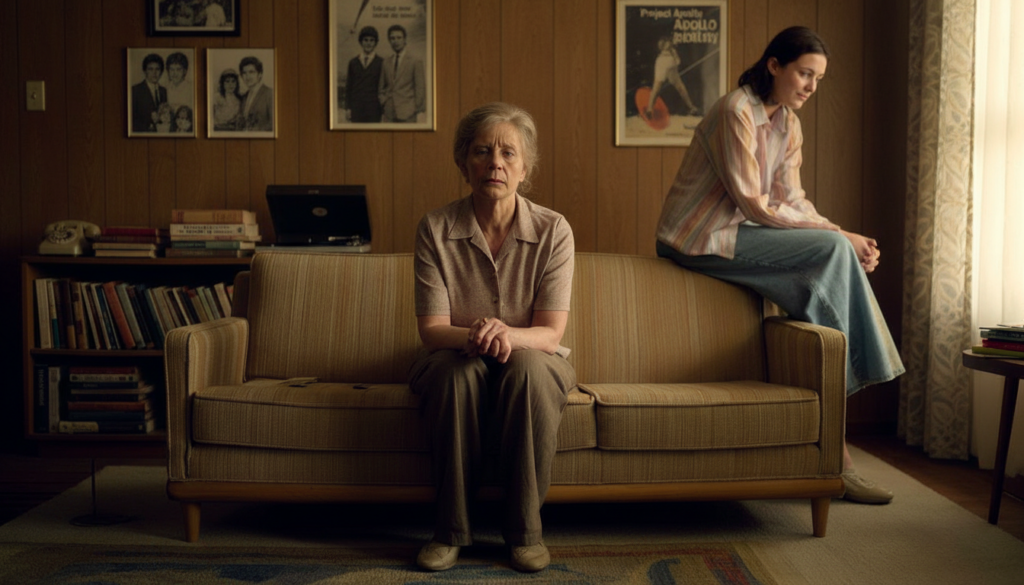
The seven “strengths” that Boomers built in silence
People who grew up in the 1960s and 1970s often talk about their childhood like it was a boot camp they didn’t want to go to. You came home from school, dropped your bag, and the unspoken rule was to deal with it. You didn’t get therapy or learn how to talk about your feelings; you were praised for having thick skin. Back then, psychology thought that being tough was the best thing. People said that a mature child was one who didn’t cry, “got over it,” and kept going after a slap or a harsh word. Many adults wore that badge of honour for the next 50 years. For instance, emotional silence. A father comes home from work in a factory in 1973. His son wants to talk about being picked on. The father, who grew up in the same culture, says the classic, “That’s life.” “Get tougher.” No questions. No follow-up. The boy learns that feelings are not something everyone has to deal with. Those kids became adults who have storms inside them. Many people raised families, built careers, and stayed “strong,” but they slowly forgot what it was like to be comforted instead of corrected. Psychology now calls that pattern emotional suppression. Not being stoic. Not grown up. A way to deal with things that came from places where being vulnerable felt unsafe or useless. It may seem strong, and it can be, but it also puts too much stress on the nervous system. This is also true for other “strengths” of that time, like being too independent (“I don’t need anyone”), being too responsible (“If something goes wrong, it’s my fault”), trying to please people (“Don’t rock the boat”), and having a near-allergic reaction to asking for help.
From “that’s just how it was” to “this is what it did to me”
A simple internal pause is the first step in a change that a lot of kids from the 1960s and 1970s are making. Instead of just saying “I’m fine” or “others had it worse,” they ask themselves, “What did little me learn from that?” That little question opens a door that older generations rarely opened. The way it works sounds like something a child would do. You take a specific memory from your childhood, like being left alone all night, being made fun of for crying, or being told to eat everything on your plate, and you play it back like you were watching a stranger’s story. Then you tell in simple words what that kid had to do to stay alive at that moment. A lot of people are shocked by the difference between the story they always told (“My parents were strict, that’s all”) and what their body remembers. A man in his early 60s told a therapist that he didn’t think about his past very often. But every time his wife was late, his chest tightened and his jaw locked. It wasn’t until he remembered being left behind at creche several times in the 1970s that the pattern made sense.

This is where the new language of trauma and the old culture of toughness come together.
Acknowledging trauma does not negate the competencies developed by those generations. It tells you how much it costs. The adult who can handle a lot of stress learned how to do it as a child by dealing with chaos on their own. The woman who never cries in public taught herself not to cry in public after being made fun of for it in 1968. Their strengths are real. The bruises underneath are also there.
Hyper-independence looks like it works, but it often hides a fear of depending on others.
Avoiding conflict keeps the peace but stops real closeness.
Over-adaptation means being “easy” so that no one gets mad at you.
Workaholism: praised by bosses, fuelled by feelings of never being good enough
Emotional numbness kept you safe then, but now it keeps you alone.
Reframing toughness without forgetting how much it cost
“Both/and remembering” is a gentle practice that helps a lot of people in their 60s and 70s. They don’t change the past to make it all bad or all good; instead, they accept both truths at the same time. “My parents loved me, but they scared me.” “I learned how to be strong, but I also felt very alone.” This isn’t about blaming anyone. It’s about letting your younger self know that you weren’t weak for having problems. Saying what hurts doesn’t make the love go away. It just puts the weight where it should be. One mistake people make here is to forgive too quickly without feeling anything. People say “They did their best” to get around feeling bad. Empathy is a great thing, but when it comes too soon, it becomes a way to avoid things. You ignore your own pain to protect the system that made it. To be honest, no one really does this every single day. A linear project plan with bullet points and perfect journaling habits is not how healing usually goes. You remember three things some weeks. Some months you close the door all the way. That’s still moving.
Many people find it helpful to keep a “reframe box” in their heads to help them get through this:
Change “I was dramatic” to “I was alone with it and overwhelmed.”
Change “I’m so needy” to “I’m finally aware of my needs.”
Change “I should be over this” to “Part of me is still there, wanting to be seen.”
Change “My childhood was normal” to “My childhood was common, but not always healthy.”
Change “I’m broken” to “I had to deal with things that no child should have to deal with.”
What if being strong meant more than just staying alive?
People who grew up in the 1960s and 1970s have mixed feelings about the way people talk about trauma today. Some people feel like they are being told that their endurance is suddenly being tested. Others feel a quiet sense of relief: “So that’s what it was.” I wasn’t just bad at being a kid. Both responses are valid. The more important question is not whether that time was “good” or “bad.” It made a certain kind of adult. Seven main habits—emotional silence, hyper-independence, people-pleasing, over-responsibility, conflict avoidance, work-as-identity, and numbness—gave a whole generation the strength to get through almost anything. They also made it much harder than it should be to rest, trust, and accept love. This new way of looking at things doesn’t make anyone less tough. It just asks, “Do you still want to carry all of it all the time?” You might be able to keep some of those strengths on your own terms. Being able to stay calm in a crisis, being good at solving problems, and having a realistic view of the world are all gifts. You can gently retire some of them. The instinct to never ask for help. The pride in suffering in silence. The idea that needing comfort is a sign of being a child. This is where today’s trauma language can make yesterday’s armour less strong without taking away how it used to protect you. That could be the quiet revolution of this time. Kids from the 1960s and 1970s who used to walk home alone with a key around their neck are finally finding their way back to themselves. This time, slower. Not as scared of what they’ll remember.
They’re learning that being strong isn’t just getting through what happened. Strength is also having the guts to say, “It happened, and it changed me, but it doesn’t define every part of my story anymore.”
| Key point | Detail | Value for the reader |
|---|---|---|
| Old “strengths” were survival strategies | Silence, hyper-independence and over-responsibility protected kids in emotionally scarce homes | Helps you stop blaming yourself and see your patterns as adaptations, not defects |
| Psychology changed the language | What was praised as toughness is now understood through trauma and toxic stress research | Gives a modern framework to re-read your past without rewriting it as all bad |
| Reframing can be done gently | Using “both/and remembering” and simple mental swaps softens shame and defensiveness | Offers concrete ways to heal while honoring the real resilience you built |
Questions and Answers:
Is it disrespectful to call these patterns “trauma” for people who have been through severe abuse or war?
No. There is no competition when it comes to trauma. The word just means that your nervous system was too much for you to handle. Different experiences can have the same effect on people inside, but they don’t take away anyone else’s pain.
 Heating a lemon in the microwave: a straightforward kitchen technique you’ll keep repeating
Question 2: How can I tell if my “toughness” is actually trauma?
If you are always numb, never ask for help, panic when others are mad at you, work too hard to feel worthy, or feel bad when you rest, these are all signs that old survival strategies are in charge.
Question 3: Is it possible for me to do this on my own, without therapy?
You can start by writing in a journal, reading books, and thinking about yourself in a gentle way. A trauma therapist can help you feel safer if memories are too much for you or if your relationships are suffering.
Question 4How can I talk to my parents about this without making them feel bad?
Say things like, “I’ve realised that as a kid I learned to shut down my feelings, and I’m trying to do things differently now.” Focus on what you’ve been through, not what they meant to do, and know that they may never fully understand.
Question 5: Is it too late to make changes if I’m in my 50s, 60s, or 70s?
No. The brain stays flexible for the rest of your life. Small changes, like letting yourself feel comfortable, asking for help once, or saying a feeling out loud, can slowly change how safe you feel in the world and in your own skin.