
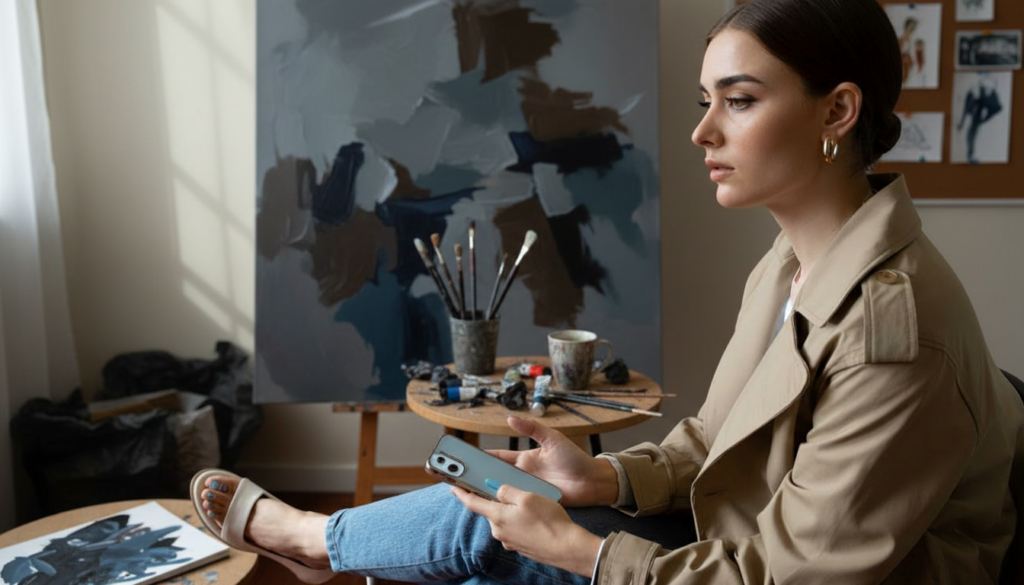
The woman in the waiting room looked great. She wore a beige trench coat, small gold earrings, and her nails were painted a light powder blue. She looked at her phone with a straight face, but her leg bounced so quickly that the chair almost shook. When the psychologist called her name, she hesitated for half a second before standing up, as if she were afraid to take up space. That same powder blue colour flashed again as she held her phone. You can see this pattern everywhere if you start watching. The coworker who always wears the same colour to calm down. The friend who hides in black like armour. The shy teen who is wearing too big of a grey shirt.
The unspoken language of our favourite colours
A lot of people say they “just like” a colour. That’s all there is to it. But therapists who pay attention to clothes, phone cases, trainers and bedroom walls notice something else. When self-esteem goes down, three colours keep coming back: light blue, flat grey, and deep black. These colours create a kind of emotional shelter, a way to live without being in the spotlight. We’re not talking about what’s in style or what’s popular. We’re talking about doing the same thing over and over. That colour you always pick when you’re tired, anxious, or secretly feel like you’re not good enough. Lucas, who is 28 and a graphic designer, is one example. His Instagram is full of bright work, neon colours, and fun logos. But in real life, his clothes look like a storm cloud. Hoodie in grey. Jeans that are grey. Sneakers in grey. Every day. His therapist asked him why, and he shrugged and said, “I don’t want people to see me.” Colours don’t look good on me. He later said he felt like “the least talented guy” in the office. The grey helped him blend in so that no one would expect too much. Research on colour psychology reveals analogous trends. People who are socially anxious or insecure tend to stay away from bright, attention-grabbing colours and instead choose neutral, low-contrast colours. When your inner critic is yelling, quiet tones make you feel safer. Psychologists say this happens because of a very simple process. When you don’t feel good about yourself, being seen feels dangerous. Red says “Look at me,” while soft blue, grey, and black say “I’m here, but don’t stare too long.” These three colours help keep your feelings to yourself. Light blue makes you feel better. Grey makes things less strong. Black keeps you safe. They work like filters between you and the world on a subconscious level.
The three colours that low self-esteem quietly picks
The first colour that comes up a lot in therapy sessions with people who are anxious and doubt themselves is that soft, faded blue. Think about the sky at 7 a.m. or a T-shirt that has faded over the years. It looks calm, like it doesn’t know what it’s doing. People who choose it over and over again are often looking for peace of mind, less noise, less drama, and fewer expectations. They don’t want to go away completely; they just want to make the edges around them less sharp. Light blue seems polite. Not very risky. It’s like saying, “I’m here, but I won’t bother anyone.” Then comes grey, the colour that says “don’t notice me.” Not silver, not charcoal in a bold and stylish way. That flat, middle grey colour of sweatpants, plain T-shirts, and hoodies worn three days in a row. We’ve all been there: when jeans seem like too much work and grey seems like the safest choice. For a lot of people with low self-esteem, this “temporary phase” lasts for months or even years. A young woman told her therapist, “Grey makes me feel invisible, and being invisible means being safe.” She was bullied in high school. Her brain had quietly learned that it was safer to fit in than to stand out. Black is the third colour that people get wrong the most. It looks great in fashion. Stylists say it’s classy, slim, and never goes out of style. But therapists hear a different side of the story. People who have low self-esteem often say that black is a shield. “I feel safe.” “I don’t feel so naked.” “I don’t look as big or awkward.” Black makes lines disappear. It hides stains, shapes, and even moods. Let’s be honest: no one really wears all black every day just for “style.” When black is worn as a uniform, it often hides a voice that says, “If I stay neutral, no one will reject me too hard.” That’s not style. That’s fear talking in colour.

Using your colour habits to boost your self-esteem
A “colour diary” is a simple thing that a lot of psychologists recommend. For a week, write down what you wear, what you like, and how you feel that day without judging yourself. Things like clothes, accessories, nail polish, and even notebook covers count. After that, go back and circle the days that had the most light blue, grey, or black. You should also circle the days when you felt small, scared, or ashamed. Patterns often stand out in a way that is surprisingly clear. The point isn’t to get rid of your favourite hoodie. The point is to be aware of when your colour choice makes you feel better and when it slowly makes you feel worse. If you notice that your colour palette gets smaller every time you feel bad about yourself, try doing small experiments instead of a big change. On a “low” day, add one coloured detail, like a soft terracotta scarf, a muted green scarf, or a tiny coral hair clip. Don’t make yourself wear fluorescent yellow every day. That usually doesn’t work and feels like wearing a costume. When it comes to self-worth, gentle change is better than violent change. When you reach for black or grey again, be nice to yourself. You are not failing. Right now, you’re doing the best you can to protect yourself. You can need armour.
A clinical psychologist in Paris says,
Colours are often the first thing a person changes when they start to feel more real in the world.” “All of a sudden, they don’t wear black anymore. They don’t just hide behind black anymore.
On days when you’re tired or anxious, pay attention to your “default” colour.
Ask yourself, “Is this calming me down or making me disappear?”
Add one item that is a little warmer or brighter each week.
Save your protective colours for when you really need them.
Change the colour of the link when you do something small to show yourself respect, like drinking water, saying no, or taking a break.
What your colours say about you without saying anything
Take a three-second break the next time you open your wardrobe. Don’t think about it. Just feel it. Does this wall of fabric make you feel welcome or tired? Does it show who you are or who you don’t want to upset? Colours won’t make your self-esteem better on their own. But they can be a soft compass, showing you what you’re avoiding, what you’re calming down, and what you’re ready to change. Sometimes it’s easier to say one hard sentence out loud than to add a new colour. As you learn to set limits, stop saying sorry for being there, and talk a little louder, you may notice that your palette changes on its own. That old black jumper stays in the drawer a little longer. There is a shirt in dusty rose. Navy takes the place of flat grey. Little signs that your inner script is being changed. Maybe the real invitation here is to see your favourite colours as messages instead of flaws or diagnoses. And to respond to them with more curiosity than judgement.
| Key point | Detail | Value for the reader |
|---|---|---|
| Light blue soothes | Often chosen to calm anxiety and soften visibility | Helps you see when you’re seeking peace versus erasing yourself |
| Grey hides | Used as a “neutral fog” by people who fear standing out | Makes you aware of avoidance patterns in your style |
| Black protects | Functions like emotional armor when self-worth is low | Lets you differentiate between style… and self-defense |
Questions and answers:
Question 1: Does loving black people mean I don’t like myself?
Not at all. Repetition and context are important. Black becomes a clue when you wear it a lot and feel naked or “too much” in anything else.

Question 2: Can my favourite colour change as I get more confident?
Yes. When people feel more real and less afraid of taking up space, they often notice that they add warmer or brighter tones.
Question 3: Do these colours affect men and women in the same way?
The emotional mechanisms are comparable, yet social pressure varies. Men often hide behind dark neutrals, while women may feel judged more when they wear colours other than black that don’t look good on them.
Question 4: Should I make myself stop wearing black or grey?
No. That usually doesn’t work. Instead of banning colours, think about adding more to your palette. Your “protective” shades can stay, but they can’t be in charge of everything.
Is colour psychology based on science?
Some effects are supported by research, while others arise from clinical observation. It’s not a strict science, but it can help you see how you fit into the world better.