
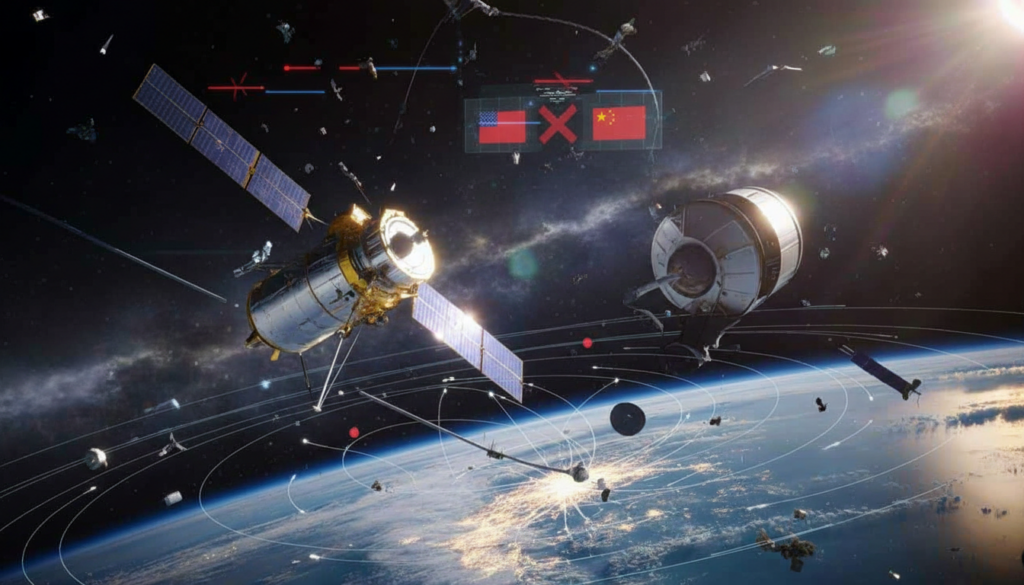
A Starlink satellite linked to US strategic interests and a newly launched Chinese spacecraft almost collided, raising fears that crowded orbits could lead to the first serious space fight between Beijing and Washington.
A 200-meter miss that made people nervous
On December 9, two small pieces of metal and circuitry flew past each other at orbital speed, far above any commercial flight path. They got within about 200 meters of each other, which is very close in space terms. One was STARLINK‑6079, which is part of SpaceX’s huge internet constellation that is legal and supported by the government in the US. The other had just been sent into space by a Chinese Kinetica-1 rocket that took off from the Jiuquan Satellite Launch Center in northwestern China. There was no explosion, no debris, and nothing that could be seen in the night sky. Later, on social media, Starlink vice president Michael Nicolls publicly warned that operators were flying blind with each other. The complaint was clear, even though it didn’t directly accuse China of bad faith. It said that China hadn’t worked with SpaceX to plan the satellites’ paths, and that important positional data for the Chinese satellites wasn’t easily accessible.
Inside the Chinese launch that made the sky more complicated
The launch of Kinetica-1 was seen as a success for China’s commercial space industry. The rocket took nine satellites into low Earth orbit. It had a mixed manifest with clear political overtones.

Six Chinese satellites that can do a lot of different things, probably for both tech demonstration and business purposes
One satellite that looks at the UAE
One scientific satellite for Egypt
One educational satellite for Nepal
That mix of customers showed how Beijing was becoming a more important low-cost launch site for new space nations. It also made managing orbital traffic more difficult because satellites that were going to different tasks and orbits were released in quick succession. Adding anything new to low Earth orbit makes it more likely that it will interfere with existing constellations. When one rocket sends out several spacecraft along similar paths, analysts have to keep an eye on each one and compare its orbit to thousands of others that are already circling Earth.
China’s response and a shaky peace
When people criticised them, Chinese launch company CAS Space chose to speak in a calm way. The company said it uses ground-based surveillance to keep an eye on known objects and avoid collisions. It also said it had started an investigation with SpaceX. That last point is important. In recent years, it has been rare for a Chinese launcher and a US operator to work together because of export controls, a lack of trust, and the fact that there is no formal bilateral framework for space traffic safety. People on both sides know that if US and Chinese satellites crashed into each other, it could quickly turn from a technical problem into a political crisis, especially if one side blamed the other for being careless or reckless.
An orbit that looks more like the M25 during rush hour
Low Earth orbit, which is about 2,000 kilometres above the surface of the Earth, used to be home to only a few hundred spacecraft. That time is over. There are more than 13,000 satellites in space right now, and Starlink owns about 9,300 of them. The result is a thick shell of military, scientific, and commercial hardware. There are two distinct groups of objects in the radar images: a ring of objects in geostationary orbit high above the equator and a thick cloud of satellites and debris in low Earth orbit. It already feels less like free flight and more like threading through lanes of traffic that are crossing each other.
There is no universal code of the road that everyone must follow. Businesses and agencies depend on a mix of rules, voluntary data sharing, and automated alerts. Usually, each operator keeps track of its own fleet, runs conjunction assessments, and decides when to fire thrusters. That system works pretty well when a few players who think the same way are in orbit. When dozens of private companies and state-backed actors, some of whom are competitors or enemies, push thousands of satellites into similar altitudes, it gets hard.
The Kessler domino: a nightmare that both generals and climatologists have to deal with
The Kessler syndrome is a quietly terrifying risk that is behind the diplomatic problems. This idea, which was first put forward in the late 1970s, talks about a chain reaction of effects in orbit.
Two satellites hit each other and break into thousands of pieces.
Those pieces make it more likely that you’ll hit other satellites.
Every new impact makes more debris, which makes the risk of a collision even higher.
Eventually, some orbital bands become so dangerous that sending anything through them is dangerous for decades.
The effects would go far beyond streaming speeds. It could be impossible for satellite internet constellations to work or they might have to change orbits. Earth observation, which is used for things like tracking climate change, responding to disasters, and farming, would be very hard to do. Forecasts of the weather would be less accurate. There may be problems or outages with GPS and other navigation systems. Military planners find the Kessler scenario to be a strategic headache. Both the US and China are using satellites more and more for missile warning, targeting, communication, and navigation. A debris-filled orbit would make those abilities weaker and leave both sides unsure of who to blame for the original trigger.
From almost missing to almost having a crisis between China and the US
The 200-meter distance on February 9 didn’t lead to a diplomatic incident, but it could have. One side, which was linked to US business and strategic interests, said that the other side sent up satellites without sharing the right data. The other person replied with reassurances, not admissions. If the spacecraft had actually crashed, each government would have had to deal with pressure from its own citizens to take responsibility. People in the US might have said that China wasn’t working together. Chinese officials may have pointed out how Starlink is the clear leader in low Earth orbit and asked if its growth was too fast. The US and China are both already worried that the other could use space systems to spy on or force them to do things. A bad accident would make those suspicions even stronger. It could stop technical cooperation at the UN, stop rare information exchanges, and make people want to make satellites harder to attack.
Why coordination is so hit-or-miss
There are a number of things that make it hard to share data honestly and on time:
Security concerns: States are reluctant to disclose the exact capabilities or manoeuvring patterns of sensitive satellites.
Business secrecy: Some private companies keep parts of their tracking and operations data secret.
Different technical standards: Companies use different formats and models, which makes it hard to coordinate automatically.
Legal ambiguity: The 1967 Outer Space Treaty lays out some general rules, but it doesn’t say much about how to manage space traffic.
In real life, a lot of people depend on orbital data from the US military, which keeps an eye on things and sends out alerts. China has its own surveillance systems and is sharing more and more information with its partners. It is still hard to find a way to connect those two ecosystems politically and technically.

What could really stop the next close call?
Experts often use the term “space traffic management,” which comes from aviation. That idea includes a few different tools:
All active satellites must share basic orbital data with each other.
Standard technical formats and alert protocols
Rules about which operator has the right to move first in a near-collision situation
Minimum requirements for propulsion and disposal at the end of life
Sanctions or fines for careless actions that leave trash behind
None of this has to completely take away national sovereignty. Countries could still keep an eye on their private information. A basic level of openness, on the other hand, would help keep accidents from happening where neither party fully understood the risk until it was almost too late.
Some analysts say that the best place to start is with a civilian, international center for coordinating space traffic, similar to global aviation organisations. Some people prefer regional agreements, where groups of countries first agree on how to do things and then put them all together.
| Category | Approximate number in orbit |
|---|---|
| Active satellites | 13,000+ |
| Starlink satellites | ~9,300 |
| Trackable debris (>10 cm) | Over 36,000 |
| Estimated smaller fragments | Millions |
Important words that shape the debate without being loud
There are two ideas that come up a lot in technical talks that are worth breaking down.
Ephemeris: This is the predicted location of a satellite at certain times, based on its orbit and any planned changes. When operators share ephemeris data in formats that work with each other, the calculations for collision risk get more accurate.
Conjunction: This is the word for when two objects in space are expected to come very close to each other. Not every conjunction needs action. Operators look at the chance of a collision and the possible effects before deciding whether to do an avoidance manoeuvre.
What a bad day in orbit might look like
To get an idea of how high the stakes are, think of a series of events that begin with one launch that isn’t planned. A cube-sat that was sent into a crowded area of space passes very close to a communications satellite. A tiny piece that is too small to track hits one of the solar panels. The impact sends a spray of debris flying that crosses the paths of several other spacecraft within hours.
A satellite that watches the weather loses a sensor. A commercial imaging satellite falls. A broken satellite that doesn’t respond is smashed up completely, sending thousands of pieces into similar orbits. Within weeks, operators have to burn fuel to avoid pieces that weren’t there a month ago. This shortens mission lifetimes and raises insurance costs.
No one can point to one intentional act of aggression. But the overall effect is a worse, more dangerous orbital environment that will have long-term financial and strategic effects on China, the US, and every country that relies on space services.
Why this is important for people on the ground
The close call between the Starlink satellite and the Chinese-launched spacecraft may seem far away, but it affects daily life. Satellite broadband projects promise to connect schools and clinics in rural areas and remote areas. Data from observing the Earth helps with crop monitoring and flood warnings. Satellite navigation and weather data are very important for planes.
Every near miss is a reminder that this hidden infrastructure is weak. In Washington, Beijing, Brussels, and other places, regulators are making decisions right now about launch licenses, data sharing, and debris mitigation. These decisions will affect how safe or dangerous Earth’s orbits feel ten years from now.