
The street got weird right before noon. Birds stopped singing, car engines slowed down and people who were only supposed to be ‘quickly popping out’ of the office found themselves standing still on the pavement with their heads tilted up to the sky. It was like someone had dragged a dimmer switch over the whole city and made the light a flat, creepy silver. As adults struggled with cardboard eclipse glasses that looked like they belonged in a cereal box, one kid whispered, “Is this it?”
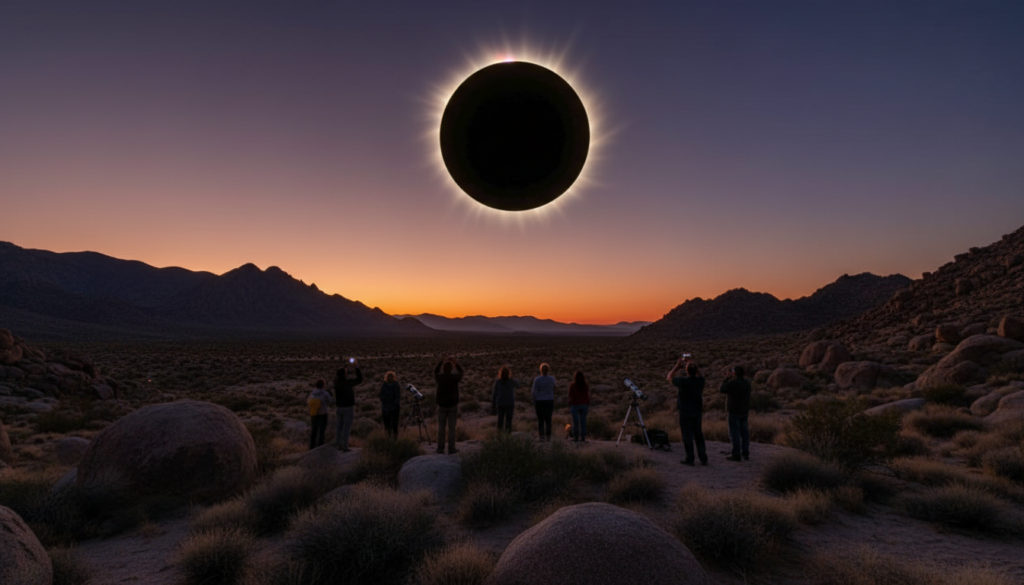
The longest solar eclipse of the century is on its way.
Astronomers are already buzzing about a total solar eclipse that will make parts of Earth dark for almost six minutes. The sun goes behind the moon for six whole minutes, the air cools, and day feels like night for a short time. The event, which is set to happen in early August 2027, will cover a path of totality across North Africa and the Middle East, as well as Egypt, Saudi Arabia, and parts of southern Europe. People in that small area will see the sun’s corona shine like a ghostly crown. People who are just outside it will see the world get darker and be angry that they are so close to the “full show.” Imagine this: it’s late afternoon and you’re standing near Luxor, Egypt, in the heat.
The call to prayer is in the air, and cameras are already pointing up. Then, slowly, the sun gets hotter. The shadows get sharper, the temperature drops, and the crowd goes quiet in a stunned way.The moon perfectly locks into place for 6 minutes and 23 seconds, making the sun look like a black disc with fire around it. Some people gasp, some cry, and some just stare in complete silence. When totality ends, it feels like someone turned the universe off mute, and the light comes back. This one is so long because the timing and geometry are almost perfect. The moon will be close to the point in its orbit that is closest to Earth, which makes it look a little bigger in the sky.

The sun will also look a little smaller because the Earth will be close to its farthest point from the sun. That mix lets the moon cover the sun’s disc for longer than usual, making totality last longer than the usual 2–3 minutes. Astronomers have been keeping track of this rare, record-breaking eclipse in their software for years. The way the shadow moves across the planet adds to its rarity. The universe just fell into place.
When, where, and how to really experience it
You need to be smart if you want to get under that shadow. The path of totality for this eclipse will go through southern Spain, then skim North Africa through Morocco, Algeria, Tunisia, and Egypt, and finally go through Saudi Arabia and Yemen. People are already talking about cities like Luxor and Aswan in Egypt as great places to see clear skies and long totality. Astronomers have marked August 2, 2027, in red on their calendars. Local times will be different, but Egypt is expected to have the longest totality in the late afternoon. This is not a last-minute weekend getaway; it’s more like “book your trip way earlier than you think.” We’ve all done it: you see a headline about an eclipse, think, “Wow, that sounds amazing,” and then forget about it until the next day when everyone posts pictures of it on social media.
This time, it will hurt to miss it. Total solar eclipses happen very rarely at any one place on Earth, and this one is even rarer. Hotels along the way often fill up months or even years in advance. Flights go up, strange “eclipse festivals” start up, and getting around town can get crazy. Your peaceful, almost spiritual vision might not match up with reality: there are traffic jams, prices that are too high, and people frantically trading extra eclipse glasses in parking lots. There is also the hard truth that no one wants to think about: safety while watching. If you look straight at the sun during any part of an eclipse, it can burn your retinas.
That doesn’t hurt right now, which is why so many people think they’re fine when they’re not. Let’s be honest: no one reads the entire safety guide every time. But this is one of those times when you want to be the person who did. It is not up for debate that you need certified eclipse glasses, filters for cameras and telescopes, and a plan for when to take them off during totality (when the sun is completely covered). The damage and the picture could last forever.
 Outer space narrowly avoided its first major diplomatic conflict between China and the United States
How to get ready without going crazy
Put the date and rough time zone in your calendar today, and set reminders for six months, three months, and one month before the event. That one habit changes “oh wow, someday” to “I am going to see this.” Then choose what’s most important to you: the length of the totality, how easy it is to get there, or the atmosphere. Egypt is the word you need to know if you want the longest darkness. Southern Spain might be the best place for you to mix it with a European summer, even though the totality is a little shorter. From there, make plans for lodging near the path, a backup viewing spot in case of clouds, and a travel schedule that is realistic and doesn’t depend on everything going perfectly. The biggest mistake people make when it comes to eclipses is thinking they can “just wing it.” That’s fine for a random walk on the weekend, but not for an event that the whole world is watching. Another common mistake is not realising how emotional it will be. Some people think they’ll have a good time with science, but they end up shaking, crying, or being strangely quiet for hours afterward. Give yourself some room around the event. Don’t fill your day with meetings, activities, or checkouts that happen one after the other. Set aside time to find a quiet place to watch, check your gear and just sit with the experience. An eclipse isn’t just about the sky; it’s also about seeing how people react when the universe does something that doesn’t fit with what we expect.
One eclipse chaser from 2017 remembers, “
As the shadow passed over us, the crowd just… changed.” “People who had never met before were hugging each other.” It was strange when the sun came back, like we had all shared a secret that we couldn’t put into words.
Book inside the path of totality, not “nearby.” If you go even a few dozen kilometres off the line, your jaw-dropping total eclipse will turn into a partial one.
Get your certified eclipse glasses early. Look for ISO 12312-2 safety certification and stay away from online deals that you find at the last minute and aren’t verified.
Get ready for the heat and the crowds. If you’re with a group, bring a hat, water, offline maps, and a place to meet.
Make a backup in the cloud. Find at least one other town where you can see the eclipse that you can get to by car on the morning of the event.
Choose whether to take a picture of it or just watch. If you try to do both, you often don’t fully experience either.
Why this eclipse could stay with you for the rest of your life
Eclipses can change how you see the world around you. You check your phone for a second, and then you see a black sun with a ring of fire and realise that the Earth, moon, and stars are all perfectly aligned. Some people cross oceans over and over again just to stand under that shadow for a few minutes. This one, which lasts almost six and a half minutes at its longest, is long enough for the experience to sink in. Long enough to look around and see the strange colours of twilight on the horizon, how animals act, and how quiet the crowd is. Long enough to make you feel both very small and strangely connected. Maybe that’s the real gift: a reminder that we can still stop in our tracks and look at the same impossible sky together.
| Key point | Detail | Value for the reader |
|---|---|---|
| Record-breaking duration | Up to about 6 minutes 23 seconds of totality on August 2, 2027 | Helps you understand why this eclipse stands out from typical events |
| Path of totality | Southern Spain, North Africa (including Egypt), Middle East (Saudi Arabia, Yemen) | Shows you exactly where you’d need to travel for the full blackout experience |
| Preparation essentials | Early bookings, certified eclipse glasses, backup locations and realistic timing | Gives you a clear roadmap to turn curiosity into a real, safe viewing plan |