
You open the fridge after a long day and can already taste what you’re going to eat for dinner. The light comes on. There are jars, half-finished sauces, an old yoghurt, and three kinds of mustard on the shelves. In a technical sense, it’s full. It feels like a desert inside. You stand there, door open, cold air on your legs, staring at food that somehow doesn’t connect into an actual meal. You close it, pick up your phone, and order food to go. Again. It could be that the problem isn’t what you buy. Maybe your fridge is quietly messing with your brain.
One small change makes a big difference.
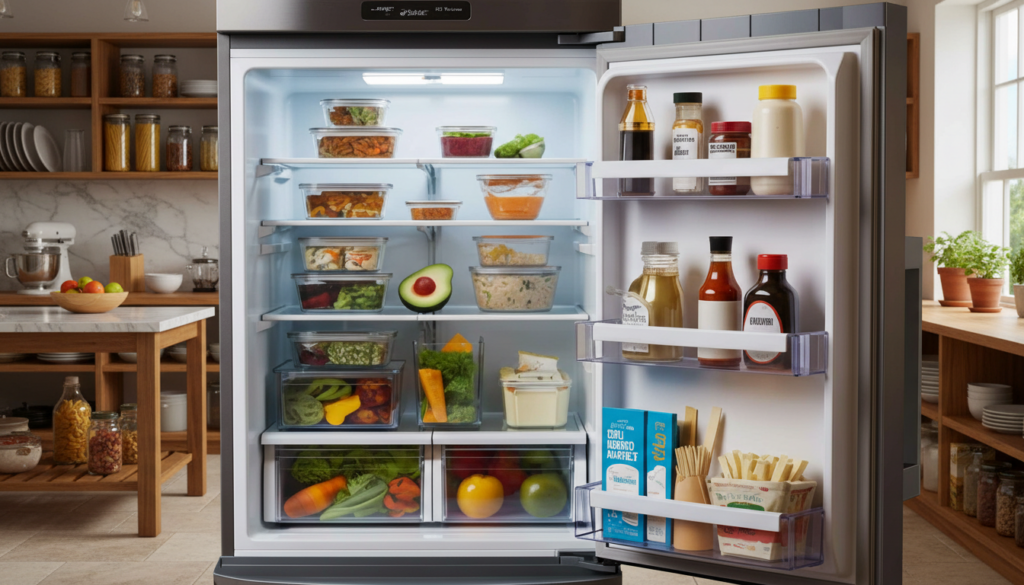
The weird psychology of a refrigerator that is “full but empty”
We don’t have a food problem; we have a visibility problem. You think your fridge is full because every shelf looks busy. But the food you really need tonight? It’s hiding behind the jam and under the leftovers you don’t trust anymore. Your brain quickly scans the area, doesn’t find a full meal in five seconds, and puts the scene in the “nothing to eat” folder.
So you feel strangely deprived in the middle of plenty. That space is tiring. Imagine this. You just got back from a big shopping trip on Sunday night. You take the bags out, put things where they fit, slam the door, and feel a little proud. Two days later, the spinach is wilting in the back, the strawberries have grown a white fuzz costume, and you’re having toast for dinner. One study in the US says that the average household throws away about 30% of the food it buys. Not because we’re bad people. Because we really do forget what’s in there.
Things that are out of sight quickly become out of mind and then go in the trash. This happens for a simple reason. Our brains like things to be clear and dislike having too many choices. A messy fridge is like a full email inbox: your eyes dart around, you feel a little stressed, and your brain says, “nope.” So you default to the quickest, easiest, most familiar option: pasta, frozen pizza, or delivery. The way your fridge is set up tells you what to eat without you even knowing it. When you change the structure, your daily choices change quietly with it. That’s where one quick fix for an organization changes everything.
The only way to fix it is to make your fridge a “meal map.”
The quick fix is to stop organising by product type and start organising by *how you actually eat*. You can turn your fridge into a visual map of ready-to-use items instead of having a dairy shelf, a vegetable shelf, and a random chaos shelf. “Eat this first” is on the top shelf. Middle: “meal builders.” Drawers: “raw materials.” Door: “flavour boosters.” You aren’t making a Pinterest-style fridge. You’re making a system that doesn’t take much work and lets your tired brain find dinner in five seconds.

Instead of being a place to store food, your fridge becomes a menu.
Try this for the first time for less than 20 minutes. Get rid of only what is clearly dead or dying. Clean one shelf, not the whole thing. Then, in your mind, choose one area to relabel. For example, you could call the middle shelf “this week’s meals only.” Put all the open packs, chopped vegetables, cooked grains, and leftovers there. In the middle of the mess, there is now a small stage that has been set up. When you open the door, you aren’t looking at every corner; you’re just looking at one shelf. Less tired of making decisions.
We’ve all been there: the moment you realise you had everything you needed for tacos. Three days too late.
This is why it makes sense. Your future self isn’t more disciplined; they just have more support or feel more trapped. When you put food into groups like “use soon” and “ingredient storage,” you don’t have to make as many small decisions. You push yourself toward things that are already in progress, open, or half-finished. A “meal map” fridge makes you more likely to cook something instead of scrolling, just like a clean desk makes you more likely to write. One simple truth: no one really does this every day.
The point is not to be perfect. It’s making the right choice the easy choice.

How to quickly reset your fridge in 20 minutes
Begin with what your tired self sees first. Usually, that’s at eye level. Take everything out of that middle section and quickly sort it into three piles on the counter: “eat in 2 days,” “fine for later,” and “nope.” Don’t feel bad about throwing away the obvious science projects. Put only the “eat in 2 days” pile on that middle shelf, which is now clear. This is now your hot zone. Put leftovers in clear containers here, not on shelves that are not in use. Also, put cut fruit, opened cheese, and half-used sauces here.
Anything you want to get rid of soon lives in the spotlight. Next, save your ingredients from getting messed up. Whole vegetables, unopened packs, and fruit go into the bottom drawers as “raw ingredients.” Don’t think too much about it. One small clear box for “snack stuff” and another for “lunch bases,” which can be boiled eggs, cooked grains, or salad that has been washed. There are no longer 17 condiments in the fridge door. Soy sauce, mustards, hot sauce and dressings are all in your ‘flavour bar’. This way, your brain will know right away how to turn something from the hot zone into a real meal. It sounds like a little helper in the kitchen saying, “Use this first, then add that.”
Sometimes the problem isn’t that you don’t like to cook; it’s that your fridge makes you think in terms of ingredients when your brain wants to think in terms of meals.
The middle shelf is the “eat first” zone.
Leftovers, cut-up fruit, opened packs, and cooked grains.
Bottom drawers = raw materials
Whole fruits and vegetables, as well as things that haven’t been opened.
Door = taste station
Dressings, sauces, condiments, and small jars. One small box for snacks
Cheese sticks, hummus, sliced veggies, and yoghurts.
Check-in for 5 minutes once a week
Take out the “eat first” shelf, make changes, and move things up from the drawers.
When your fridge finally starts to work for you
At first, nothing big happens after this small reset. You still open the fridge without thinking about it and look inside for a second. But when you look at that middle shelf, you see last night’s roasted vegetables, a container of cooked rice, and half an avocado. Your brain does the math in the background: dinner in five minutes. You realise that nothing slimed into nothingness in the back two days later. You ate what you bought. The fridge feels strangely calmer, like a room that can breathe again.
And you feel a little more in control, but you haven’t turned into a robot that makes meals.
| Key point | Detail | Value for the reader |
|---|---|---|
| Turn your fridge into a “meal map” | Organize by how you eat (eat-first, meal builders, raw, flavor) | Makes dinner ideas instantly visible and less stressful |
| Use a visible “eat first” shelf | Middle shelf holds all open, ready-to-use items | Cuts food waste and encourages quick home-cooked meals |
| Keep a 5-minute weekly reset | Fast check of the hot zone, move items up, toss what’s truly gone | Maintains order without unrealistic daily effort |