
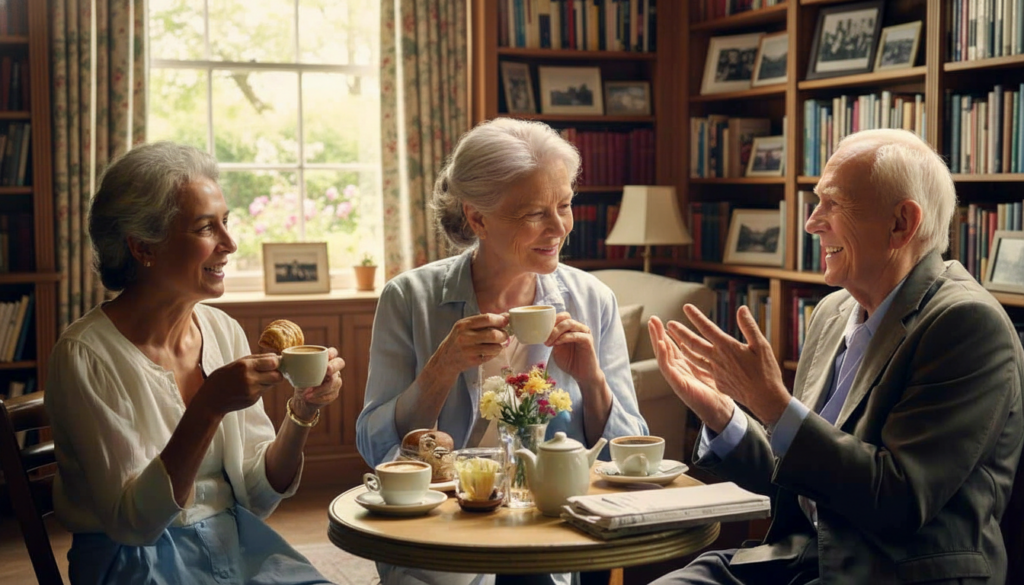
People in their twenties and thirties used to own the café on Saturday mornings. They brought their laptops and noise-cancelling headphones. Take a look around now. A woman with grey hair is slowly dipping her croissant in coffee, taking her time. A man in his seventies is laughing loudly at his own story, waving his hands in the air and not having a phone in sight. The younger customers look up, as if they are interested. Like they’re seeing a different way of life right now. People we used to think were “old-fashioned” were secretly doing a long-term experiment on how to be human. And lately, a lot of us are starting to think they were right. More than we want to admit.
1. Taking it easy isn’t being lazy; it’s how you really hear your own life.
People in their 60s and 70s will probably all say the same thing when you ask them what changed after 50: time started to feel different. They take their time, but they live more fully. Instead of power-walking to reach 10,000 steps, they will sit on a bench and feel the sun on their face. They let the soup cook, the talk go on, and the quiet go on.
They aren’t being unproductive. They’re protecting something that younger people are burning like cheap fuel: their attention. And with it, their ability to feel like they are in their own story.

A friend in her late 20s told me about going to see her grandmother on a Sunday. She came with a mental list of things to do: answer work emails, sort photos, and scroll through TikTok while “chatting.” But her grandmother had other ideas. She brewed tea. Sat. Saw the steam rise. I asked one question and then really waited for the answer.
My friend got a little scared after an hour. No background noise, no multitasking, just being there. Then something weird happened. She began to talk about the breakup she hadn’t dealt with in weeks. Her grandma didn’t give her advice; she just listened. She said, “I feel like I really existed for two hours.” That’s the quiet rebellion that older people have been doing for years.
What seems like laziness from the outside is often wisdom from the nervous system. When you’re 25, you feel like you can go on forever. At 65, you know that if you rush through everything, you don’t really experience anything. Your body starts to ask for things that your younger mind didn’t pay attention to: breaks, deep breaths, and face-to-face contact with other people.
The study is getting closer. Eating more slowly helps your body digest food better. Walking without music can help with anxiety. Doing one thing at a time makes you more creative. Older people were doing all of this long before it made it to wellness blogs. They didn’t use the word “mindfulness.” They said they were “going for a walk” or “having a proper lunch.” Same medicine. A different time.
2. Every time, relationships are better than achievements.
People in their 60s and 70s tend to have a smaller group of friends, but they protect it like it’s gold. If someone they love needs them, they’ll skip a big launch, a trendy restaurant, or even a vacation. They change their plans to visit a friend in the hospital. Instead of sending a “thinking of you” text and calling it a day, they pick up the phone.
The older you get, the more you realise that the people who are there for you when things go wrong are more important than the logo on your LinkedIn.
One man I talked to, who was 72 years old, had worked as a successful sales director his whole life. Lots of money, lots of stress, and always on the move. He told me what happened at his retirement party. “They gave me a watch and a nice speech,” he said. Two months later, half of them barely answered my emails.
After that, his voice got softer. “When my wife got sick, it wasn’t my old bosses who came to help. He shook his head. “It was my neighbour of 30 years, the guy who helped me fix my fence, and the woman from the book club.” “I spent decades chasing numbers.” The time I spent making soup for a friend was the most profitable thing I’ve ever done.
We’ve all been there: a crisis hits and our résumé’s shine disappears in a flash. Older people have been through more of those cycles. Layoffs, sickness, divorce, and death. They’ve learned the hard way that when something goes wrong, you don’t rely on what you’ve done; you rely on your friends.
The longest-running studies on happiness keep saying the same thing: having strong relationships is the best way to be happy and even live longer. Deep down, we already know this. But we keep putting off the coffee, the visit, and the call. A lot of people in their 60s and 70s have stopped putting things off. They come. They stay. They make the casserole and bring it to you themselves. That’s not being out of date. That’s being rich in the only money that will still be worth something when things go wrong.
3. Money is not a scoreboard; it’s freedom.
If you listen to older people talk about money, you’ll notice a small difference. The bragging is over. The important thing is, “Can I sleep at night?” Can I give my kids a hand? Is it okay for me to say no?”They’ll turn down a nicer car to keep a simple emergency fund.” Make new clothes out of old ones. Instead of always getting takeaway, cook at home.
They don’t hate pleasure. They know what it’s like to be scared about money, and they don’t want to feel that way again. The game of status fades, but the game of freedom stays.
A 68-year-old woman who worked in a grocery store for most of her life is one of them. Not a glamorous job, and no viral career story. But her father told her, “You always pay yourself first, even if it’s only five euros.” For forty years, she put a small amount of money from each pay cheque into savings. When she said no to expensive vacations, her friends laughed.
She retired last year with a small but solid nest egg and no debt. She said, “I’m not rich, but nobody owns my time now.” She buys fresh flowers every Friday. When his grandchildren are having a hard time, he sends them 50 euros here and there. That quiet safety? That’s the kind of “wealth” that doesn’t look good on social media but changes your whole nervous system.
The truth is that many of us spend money to deal with a life that wears us out. Fancy coffee to get through the day. We’re too tired to cook, so we got takeaway. Subscriptions that we hardly ever use. People from older generations, especially those who lived through economic crises, have a different story. Use what you have to the fullest. Try not to get into debt. Treat your future self like a real person you love and save for them.
Financial experts now say what grandparents have been saying for years: small, steady savings are better than big, heroic efforts. Waiting for something to happen pays off. **Stability is sexier than spectacle. It just doesn’t look as good in pictures. But if you ask a 70-year-old who doesn’t stay up at night worrying about money, they’ll tell you that peace of mind is the best thing they’ve ever bought.
4. Your body is not a project; it is a partner you grow old with.
You may have seen an older person doing gentle stretches in the park or walking the same loop every morning. This is one of their quiet superpowers: they are consistent instead of dramatic. They don’t want six-packs or “summer bodies.” They just want to be able to get off the floor, carry groceries, and reach the top shelf without being afraid.
If you ask them, a lot of them will say something like, “I move so I can keep moving.” It’s simple, almost boring. And oddly enough, this is exactly what modern longevity experts say to do.
There is an 80-year-old man who lives near me who does the same thing every day. Ten minutes of light stretching. Walk for twenty minutes. Some balance exercises while holding onto the back of a bench. He began in his fifties after a small health scare. No gym membership, no trackers, and no perfect outfit. Just doing it over and over.
He said, “I decided I wanted to be the kind of old man who can still get on the bus by himself.” That picture helped him more than any “before and after” photo could. His doctor now calls him “unremarkable” in the best way possible: his blood pressure is stable, his legs are strong, and his lungs are clear. No miracles. Just a partnership with his own body that started too soon.
To be honest, no one really does this every day. Older people will be the first to say they skipped, fell off, came back, and tried again. But they no longer think in terms of all or nothing. A 15-minute walk is a big deal for them. Three stretches before bed are good. It counts if you say no to a third glass of wine.
Many will quietly say things we don’t often hear in glossy wellness articles: “Be nice to your body now so you don’t have to fight it later.” Not out of fear, but out of respect. They know what happens when you don’t pay attention to warning signs. They’ve also seen how much small habits can change things when you’re 70.
“I stopped trying to look young,” a 66-year-old woman said. “I started trying to be honest with myself.”
 If the refrigerator appears stocked but feels empty, this organizing solution works quickly
Moving around a little every day is better than doing extreme workouts that you give up.
Going to the doctor regularly is better than trying to figure out what’s wrong with yourself online at 2 a.m.
Walking and sleeping often do more than taking another supplement.
Stretching today is good for your joints in the future.
It’s easier to accept wrinkles than to fight a war you can never win.
5. You never waste time on small rituals.
If you ask an older person about their day, they’ll probably tell you about small things that happen every day, like watering plants at 7 a.m., reading the paper with toast, and calling a sibling every Sunday night. Nothing special on the surface. But those little rituals are like quiet lighthouses that keep their week on track. The routine stays the same even when everything else changes.
We’re learning this again. Wellness culture has changed what grandparents used to do: repeat simple, grounding actions that shape your days. For example, “morning routines” and “digital sunsets.”
Think of the grandfather who shines his shoes every Friday, even though no one sees him do it. Or the 70-year-old who makes the same cake for every birthday in the family. You could say it’s habit or stubbornness, but that’s not very nice. If you look closely, you’ll see devotion. A choice: this moment is important enough to be done slowly, the same way, over and over.
A woman in her early 60s told me that doing her “Sunday reset” makes her whole week feel better. This includes doing laundry, making a pot of soup, changing the sheets, and writing down three things she wants to do in the next few days. No apps or hacks to boost productivity. Just taking care of things the old-fashioned way. She says, “Setting the stage so the week doesn’t attack me.”
Psychologists now say that “rituals” are things that can help you feel less anxious and more meaningful. People from older generations didn’t often use that language. They just did what worked. *If you do a small act of kindness often enough, it will become a part of who you are.*
In modern life, it’s easy to give up rituals for convenience. Instead of family meals, fast food. Instead of playing games together, people stream them. But people in their 60s and 70s don’t often remember the emails they answered on time. They remember the Sunday lunches, the evening walks, and the silly traditions that seemed pointless until someone was gone. Those “little” moments got better with time than almost anything else.
6. The best way to protect what matters is to say “no.”
One of the best things about older people is that they are getting better at saying no. No to events that wear them out. No to relationships that only go one way. No to invitations that feel like you have to go. They’ve lived long enough to know how much every yes costs.
Younger people often think of this as being grumpy or unwilling to change. But a lot of people in their 60s and 70s are just being careful about how they spend their last few years and energy.
A 69-year-old teacher told me that in her 40s, she said yes to every extra project, committee, and request from a family member. She was tired and angry by the time she was 60. She said, “I realised that every time I said yes just to be polite, I was saying no to the book I wanted to read, the walk I wanted to take, and the nap I really needed.”
She began with small things. “No, I can’t help that weekend.” “No, I won’t be joining that group.” “No, thank you, that doesn’t work for me.” People were surprised at first. Some people pushed back. Those who really cared made changes. People who only cared about her for what she could give them left. Things got quieter in her life. And a lot lighter.
From therapy podcasts to self-help threads, boundaries are finally a popular topic. Older people have been learning how to set boundaries in real life, often through painful trial and error. They’ll tell you that every “no” you say today will protect ten “yeses” tomorrow.
You can tell by the way they talk: they say “That doesn’t suit me” or “I won’t be attending” instead of “I’m sorry.” They’re not rude. They are clear. They’ve learned that you can’t always be available and still have your own life. Their quiet lesson to us was that your time is not a public resource. Take care of it before anger does it for you.
7. You don’t need a big reason to get up; you need small, ongoing ones.
Most older people won’t say a five-year plan when you ask them what keeps them going. They’ll say things like “My tomatoes,” “My choir,” or “I want to see my granddaughter graduate.” Their “purpose” is more like a list of small, changing reasons to stay interested. And that makes me feel better.
The modern need to find one big calling can make you feel stuck. People in their 60s and 70s quietly suggest another way: do small tasks. Allow them to change. Make them humble.
A retired bus driver told me that he got a little depressed after he stopped working. There was no schedule, no passengers, and no routine. One day, a neighbour asked if he could take her dog for a walk while she was at work. That little job became the most important thing in his life. He got out of bed, put on his clothes, and walked the same streets at the same time. He eventually added another thread: taking care of a small community garden.
When you ask him about “purpose,” he laughs. “I’m just trying to keep a few things alive,” he says. “The dog, the tomatoes, and me.” That’s smart. Not a TED Talk. Just a life made up of small tasks that are important to someone.
We’re starting to get what they’ve learned by living it: meaning doesn’t always come to you like a lightning bolt. It often grows around things you care about all the time. A person. A plant. A road. A tune.
Older generations show us that you don’t have to be special to have a good life. You can be good. Trustworthy. Interesting. You can help someone out, volunteer, call your siblings, or learn a new recipe at 72. That isn’t settling. That’s making a life that makes you want to get up every day, even when your knees hurt.
What people in their 60s and 70s are really showing us
If you look closely at the older people who seem happy, you’ll see a pattern. They’re not looking for intensity; they’re building warmth. They don’t worship youth; they live in the moment. Their lives aren’t perfect; they’ve buried dreams, made mistakes, lost people they loved. But they have also changed. Let go. Picked.
They’re not asking us to go backwards. They’re whispering, from just a bit further down the road, that we might want to carry less and care deeper.
Maybe that’s the deepest lesson: the good life isn’t something you unlock at 65 with a magic key. It’s the accumulation of all these small, stubborn choices they’ve been making for decades. To sit a little longer at the table. To check on a neighbor. To cook one more simple meal at home. To say no without guilt. To keep learning even when nobody’s grading them.
Their wisdom isn’t theoretical. It’s tested daily, on sore knees and in quiet kitchens. And if we’re paying attention, we might start stealing some of it now, while we still think we’re too busy to need it.
| Key point | Detail | Value for the reader |
|---|---|---|
| Slow living | Prioritizing attention, presence, and simple pauses | Reduces anxiety and helps you actually experience your days |
| Relationships first | Investing time and energy in a small, loyal circle | Builds a safety net for crises and deeper everyday happiness |
| Small habits | Rituals, movement, and saving done consistently | Creates long-term health, freedom, and a calmer future self |