
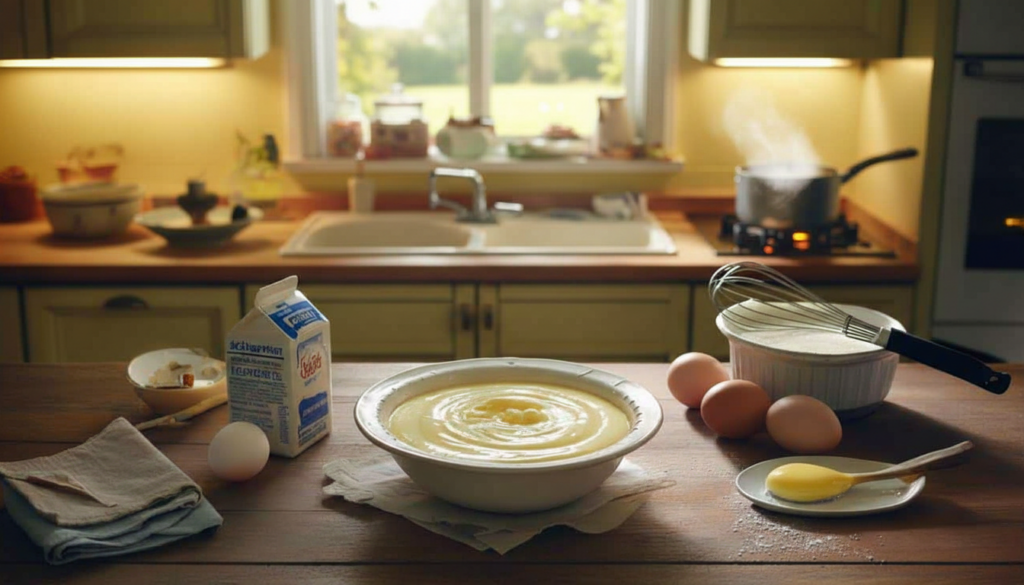
The pan was still warm from dinner, and the washbasin was already full when she opened the fridge and frowned. There is no dessert, no chocolate, and no yoghurt left. There are only four eggs, a carton of milk, and half a packet of sugar in the back of the cupboard. You sigh, close the door, and then open it again, hoping that something will magically appear. She took a saucepan instead. Sugar, eggs, and milk. The kitchen smelt just like her grandmother’s flat on Sunday nights. A soft, sweet steam with a hint of vanilla and a little bit of warmth that makes the window above the washbasin fog up.
Why eggs in milk make you feel like a kid again
When a dessert is this easy, the kitchen gets really quiet. No loud mixer, no preheating oven, and no need to scroll through a complicated recipe on your phone with sticky fingers. The only sound is the quiet sound of milk warming up and eggs being whisked with sugar in a bowl that has probably seen better days. This is the magic of eggs in milk: you don’t need much, but you get a lot in return. Comfort. Softness. That creamy spoonful that reminds you of holidays, sick days at home, evenings with grandparents, or the one aunt who always had “something in the fridge.” A recipe that doesn’t try to be fancy. It just does what it needs to do, softly. If you ask around, you’ll find that almost everyone has a story about a dessert like this. Some families call it “oeufs au lait.” Some people call it “lait aux œufs,” “flan maison,” or just “le dessert de mamie.” A friend told me that her dad used to make it in coffee cups that didn’t match because they didn’t have ramekins.
Another person remembers eating it straight from the saucepan while leaning on the kitchen counter when it was still warm. There is no one right way to do things. Just a memory of something that tasted like love. A dessert that wasn’t pretty, but made me feel better. For some, it was the least expensive thing on the table. For some, it was the only dessert they could have on weeknights. In any case, it quietly set the pace of daily life. In a practical sense, eggs in milk is almost the perfect dessert. You only need three basic things that most people have in their fridge at all times. It’s easy to understand why eggs give structure, milk makes things soft, and sugar ties everything together. The rest is done by heat. The best thing about this recipe is that it lets you make mistakes. A little more sugar? It still works. A dash of vanilla, a bit of citrus zest, and a spoonful of instant coffee? It changes without making a fuss. You don’t want a patisserie-level result. You’re looking for that wobble and melt-in-your-mouth texture that tells you to relax because dessert is ready. Sometimes, the recipes that are the quickest to make are the ones that stick with you the longest.
 No vinegar or baking soda required: the technique to clean vehicle seats and remove stubborn marks
How to quickly make eggs in milk without making a mess
Begin with the basics: For two people, about 2 eggs, 250 ml of milk, and 40–50 g of sugar should be enough. That’s all. Put the milk in a small pot, add half of the sugar, and let it warm up slowly over low heat. Not boiling, not bubbling angrily. Just a gentle heat that makes a little steam and tiny bubbles on the edge of the pan. Whisk the eggs with the rest of the sugar in a bowl. Don’t need to foam them like a cake. Just mix it up until it’s smooth and the sugar starts to dissolve. The most important thing to do now is to slowly pour the hot milk over the eggs while whisking them all the time. Not the other way around. You’re not shocking the eggs; you’re coaxing them. A few seconds of calm movement. That’s it. People often get stressed out and hurry here. They turn the heat up too much. They heat the milk to a boil. They put everything back in the pan and leave to get their phone. When they come back, the eggs are floating in sweet milk. And they believe they “can’t cook.” The truth is that this dessert doesn’t need any skill. It wants you to be there. No more than two or three minutes of attention. Stir the mixture over the flame until it thickens a little, just enough to coat the back of a spoon. The well-known custard test. You know you’re there if you can draw a line with your finger on the spoon and it stays clear. Get rid of it. Your eggs are now in milk and ready to eat hot or cold. To be honest, no one really does this every day. But when you finally do, you’ll wonder why you waited so long.
A friend told me recently, “Every time I make eggs in milk, I feel like I’m calling my childhood.” “It’s quick, it’s cheap, and for ten minutes the kitchen feels like it did when I was nine.”
Put the mixture into small ramekins and bake them in a water bath at a low temperature (about 150°C) until they are just set. Then chill.
For a café-style look, put a little vanilla, lemon zest, or a spoonful of caramel at the bottom of each dish.
For the very short version: When the sauce is creamy, stop cooking it and serve it like a warm custard with a cookie or a piece of fruit.
Adding a little salt brings out the flavour and makes the milk taste fuller and stronger.
For kids (or grown-ups who are tired): Serve it warm with a piece of bread to dip in. Dessert and a bedtime snack.
A simple dessert that means more than it looks like it does
Choosing a dessert that doesn’t try to go viral is almost radical these days. No molten center, no five layers, and no glaze that can’t be done. Just some eggs, milk, sugar, and time. A little act of defiance in a world that wants everything to be amazing. It doesn’t look good when you take a picture of eggs in milk. It doesn’t break apart very much when you hit it with a spoon. And still, forty years later, people remember how it tasted. That says something about what really sticks with us. The recipes that were there when money was tight. When someone was ill. When there wasn’t much else in the house, but you still wanted to say, “I see you.” Please sit down. “I made you something.” That’s probably why this dessert works for us again today. Full schedules, rising costs, and fridges that are strangely empty at the end of the week. You only need one pot and three ingredients. You don’t even need to turn on the oven if you don’t want to.
Eggs in milk fits right into your routine, whether you live alone in a studio or fill a family-sized table every night. You can eat it cold from the fridge on a Sunday afternoon or warm on a Tuesday night while you watch a show. You can change it as much as you want, or you can leave it as it is. You can serve it to guests in nice ramekins or in bowls that are chipped and no one else has to see. The recipe doesn’t care. You might notice things you missed as a kid if you try it again after a long time. The smell of the milk just before it gets too hot. The little bit of tension that comes from stirring, not wanting to go too far. The first spoonful, which is always a little too soon, burns your tongue a little but you keep going. You might find out that your version is different from your mother’s, your partner’s, or your neighbor’s. That’s okay. These simple recipes can be passed down from generation to generation and adapted to different kitchens. The goal isn’t to make a “real” taste that is perfect and museum-quality. It’s to put a simple, warm dessert on the table on a day when you almost gave up and said, “There’s nothing here.”
| Key point | Detail | Value for the reader |
|---|---|---|
| Everyday ingredients | Eggs, milk, sugar, plus optional flavorings like vanilla or citrus zest | Allows a last-minute dessert without shopping or planning |
| Quick, flexible method | Simple custard base made on the stove, with an option to bake for a firmer flan style | Adapts to time, tools, and energy levels while staying accessible |
| Emotional comfort | Links to childhood memories, family habits, and moments of care | Transforms a basic recipe into a small daily ritual of comfort and connection |
Questions and Answers:
Question 1: Is it okay to use plant-based milk instead of cow’s milk to make eggs in milk?
Yes, but pick options that are richer, like oat, soy, or almond with some fat. The texture might not be as creamy, but it’s still nice and comforting.

Question 2: Why did my eggs in milk get lumpy or grainy?
That usually happens when the heat is too high or the milk boils. Keep the flame low and stir the mixture all the time. Stop when it coats the spoon.
Question 3: Is it possible to make eggs in milk the day before?
Yes, for sure. You can cool it down in small bowls and store it in the fridge for 24 to 48 hours if you cover it. The taste gets even stronger by the next day.
Question 4: Is this dessert safe for kids?
Yes, as long as the eggs are cooked all the way through and the dessert isn’t too hot when you serve it. For toddlers, you can cut back on the sugar a little and use whole milk to make it taste better.
Question 5: How can I make this dessert feel more “special” for my guests?
Put a layer of caramel on the bottom, serve in individual ramekins, or add roasted nuts, fresh fruit, or a sprinkle of cinnamon right before serving.