
The sea appears calm from the pier in Pingtan, the wind-beaten island facing Taiwan. Fishing nets sway gently as they dry in the salty air. A fisherman narrows his eyes toward the hazy stretch of the Taiwan Strait. Then a muted explosion rolls across the water — deep enough to vibrate in the chest. Another missile test somewhere beyond the mist, in waters where he once cast his nets freely.
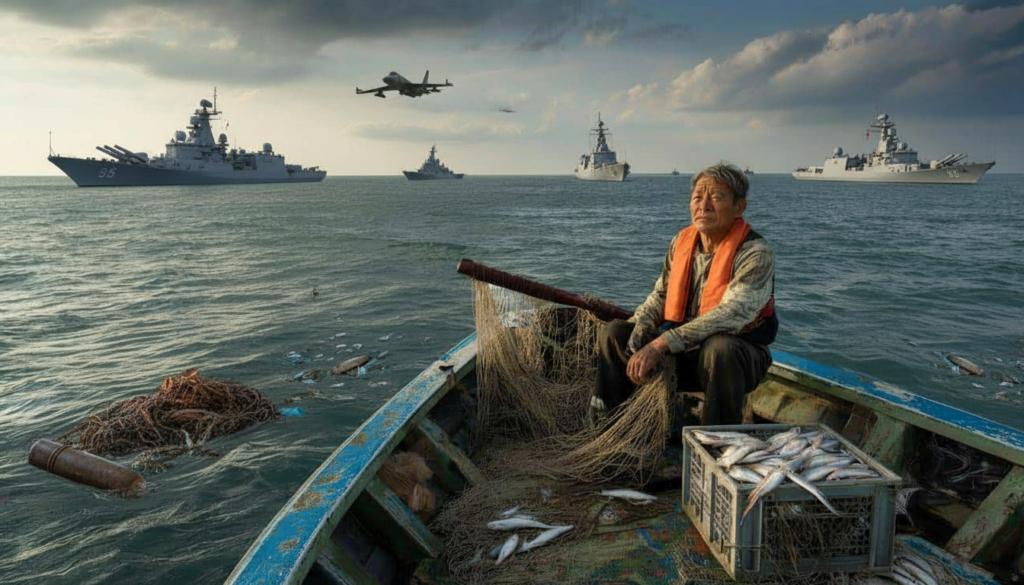
He barely reacts, but he keeps staring. The fish, he says, have shifted — or perhaps disappeared. The sea feels altered now, less familiar, as though it answers to someone else.
When the Frontline Slips Beneath the Waves
Across the South China Sea and around Taiwan, the concept of a frontline has transformed. It is no longer defined only by warships and aircraft. It cuts through coral reefs, seagrass beds, and long-established fishing grounds that once supported generations.

Military expansion has quietly turned living marine ecosystems into drill zones, missile corridors, and restricted waters. Areas once charted for tides and fish migration are now mapped for radar arcs and rocket trajectories. The change is less visible in headlines and more noticeable in the silence where fishing engines once hummed.
The ocean remains, but the bond between communities and the water is shifting rapidly.
From Fishing Charts to Missile Maps
In August 2022, following a high-profile political visit to Taiwan, large-scale military exercises surrounded the island. Extensive no-go zones were announced, cutting into productive fishing grounds. Local vessels were instructed to remain docked. Those who ventured close to the boundaries returned with sparse catches and reports of patrol warnings echoing over open channels.
Satellite tracking later showed fishing activity dropped sharply during and shortly after the drills. Officially, the exercises lasted days. Practically, the disruption lingered far longer.
This was only one widely reported episode.
Researchers now examine the broader ecological toll of repeated militarization. Missile tests, sonar sweeps, underwater drones, and constant naval traffic accumulate over time. Noise interferes with whale and dolphin navigation. Explosions disturb seabeds that function as nurseries. Temporary exclusion zones displace fishing fleets into already pressured ecosystems.
Marine species do not recognize political boundaries or maritime claims. They respond to disturbance, vibration, heat, and contamination. When those stressors persist, recovery becomes uncertain.
Navigation Warnings and Expanding Exclusion Zones
One of the most significant yet understated tools of maritime control is the temporary “navigation warning.” These notices define areas off-limits for launches, missile testing, or live-fire drills. On official maps, they appear orderly and contained. In practice, they intersect feeding areas, migration routes, and traditional fishing territories.
Over the past decade, such exercise zones have multiplied in scale and frequency. Some are short-lived; others cover vast stretches of water. For fishing crews, these shapes on a screen can mean lost income overnight.
Rocket launches from inland provinces frequently send spent stages into designated splashdown areas at sea. Each launch establishes a temporary hazard zone. Smaller boats, lacking flexibility, often navigate close to restricted edges, guided by outdated printouts or brief text alerts.
There have been accounts of debris striking vessels or hazardous fragments floating near nets. Most incidents pass quietly without formal acknowledgment.
Meanwhile, marine biologists warn that cumulative impacts resemble a prolonged industrial disturbance. Explosions can stun or kill marine life. Residues from propellants and metals may settle into sediments. Repeated naval movement stirs seabeds. Continuous sonar adds background noise to an ecosystem built on acoustic communication.
The measurable effects may not be immediate, but gradual declines in catch statistics often appear long after the disturbances become routine.
Adapting to a Sea Shared with Strategy
From Hainan to Luzon to Taiwan’s eastern ports, fishing communities increasingly monitor military schedules as carefully as weather forecasts. Informal networks circulate updates about drills and restricted grids. Some captains describe their work as “fishing between warnings.”
Crews depart at unusual hours, rush through narrow safe corridors, and return early if new alerts appear. Adaptation replaces predictability.
However, flexibility has limits. Smaller vessels cannot safely venture into deeper waters dominated by larger fleets and patrol ships. Fuel expenses rise while harvests decline. Sudden political tensions intensify uncertainty.
What appears strategic and calculated on policy maps often translates into instability along the docks.

Quiet Monitoring Beneath the Surface
Local scientists and conservation workers document subtle shifts. Some avoid public commentary, yet their observations reflect recurring patterns.
They report:
Monitoring stations relocated away from high-drill zones to preserve consistent data.
Collaborative logs with fishers tracking unusual events, such as sudden strandings or surface residues.
Advocacy for seasonal pauses in exercises during spawning or migration periods.
Informal low-noise areas maintained for research and small-scale fishing.
Translation of technical notices into practical guidance for local crews.
These measures may be modest, but they represent ongoing attempts to protect fragile ecosystems amid geopolitical tension.
The Deeper Question Beneath the Strategy
Debates over maritime control often emphasize deterrence, alliances, and power projection. Beneath these narratives lies a quieter concern: the cumulative transformation of a living ocean into a testing ground.
Marine life does not interpret strategic messaging. It reacts to repeated disturbance. Coral fragmentation, altered migration paths, and declining biodiversity may not command headlines, yet they shape the long-term health of coastal economies.
The broader question extends beyond territorial control. It asks what condition these waters will be in after decades of layered activity — and whether sustainable coexistence between security interests and ecological balance remains achievable.
| Key Point | Detail | Value for the Reader |
|---|---|---|
| Missile Zones Overlap Fisheries | Exercise areas and debris corridors frequently intersect traditional fishing and migration routes. | Clarifies how strategic planning directly affects livelihoods and food supply chains. |
| Gradual Ecological Impact | Noise, shockwaves, and pollutants accumulate, altering species behavior and survival patterns. | Reveals long-term environmental costs hidden behind short-term drills. |
| Community Adaptation | Fishers and researchers adjust routes, share alerts, and document ecological changes. | Humanizes the issue with practical, ground-level responses. |
Frequently Asked Questions
Question 1: Is militarized ocean activity limited to one country?
Many nations conduct naval drills and missile tests. However, the concentration and frequency in certain contested waters draw attention because of overlapping shipping and fishing intensity.
Question 2: Are there precise figures on ecological loss?
Comprehensive data remains limited. Some regional studies indicate declining catches and reef stress near frequent drill zones, yet isolating specific causes remains challenging.
Question 3: Does rocket debris significantly pollute marine areas?
Individual incidents may have limited impact, but repeated debris splashdowns containing metals or fuel residues can contribute to cumulative contamination.
Question 4: Can coastal communities influence policy?
While direct opposition may be sensitive, cooperatives and research institutions sometimes advocate for adjusted timing, reduced zones, or compensation measures.
Question 5: What changes could reduce ecological strain?
Regional confidence-building efforts, habitat-sensitive scheduling, and coordinated debris management could mitigate environmental harm without resolving broader geopolitical tensions.