
The first thing anyone noticed was not the masts, nor the carved figurehead. It was the smell. Salt, tar, and timber baked by centuries of sun drifted across a polished Australian marina filled with white fiberglass yachts and Bluetooth speakers. Children leaned over railings with wide eyes and raised phones. Older visitors narrowed their gaze as if something impossible had just arrived. An almost perfectly preserved colonial-era vessel, lifted from the ocean floor, now rested against a skyline of glass towers and street-food stalls.
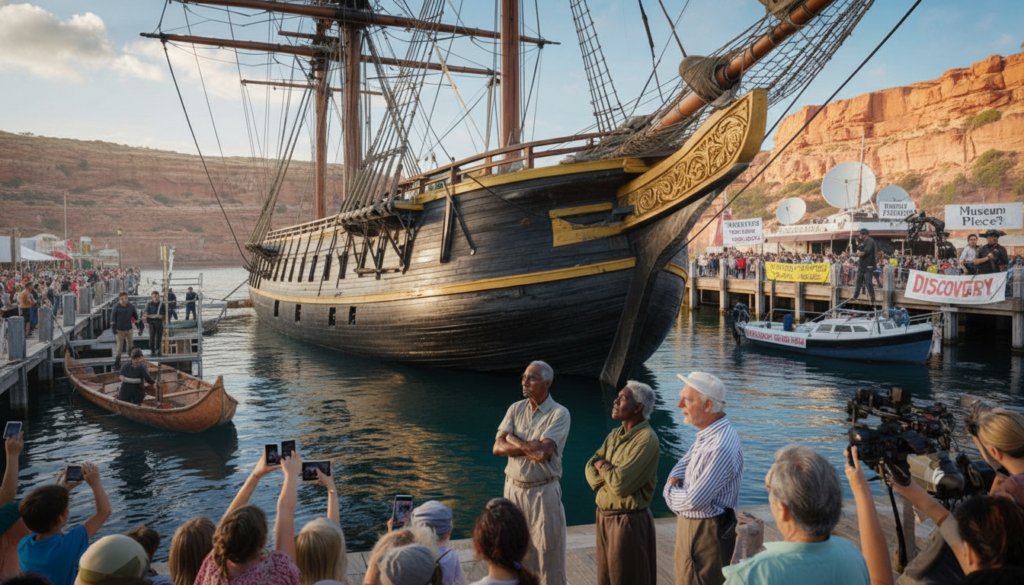
No cannons roared. No flags snapped in the wind. Only an uneasy stillness settled over the crowd.
Some called it a miracle of preservation. Others saw something far more troubling.
 Is prohibiting junk food promotion safeguarding children or expanding government oversight
When a Ship Becomes a Mirror
Moored near Fremantle’s foreshore, the vessel barely shifts with the tide, yet everything around it hums. Tourists circle with gelato cups melting in their hands, snapping photos of a dark wooden hull that looks too sharp, too deliberate for its age. The gilded carvings along the stern catch the afternoon light, glowing under camera flashes.
A short distance away, Aboriginal elders stand shoulder to shoulder, watching in silence.
For them, this is not simply timber and rope. It is memory made visible.
A Time Capsule or Evidence?
Marine archaeologists believe the ship dates back to the late 1700s. For over two centuries, it lay hidden beneath Western Australian waters. Local fishermen had long spoken of a strange shadow on sonar readings, but only a detailed university expedition revealed the full outline of the wreck. Divers reported cargo crates stacked in place, iron fastenings intact, and personal belongings that should have dissolved long ago.
Within days, headlines celebrated a “floating time capsule.”
Within the same week, critics warned that calling it that erased what such ships truly carried.
The Architecture of Empire
History textbooks often compress colonization into neat timelines and treaties. But vessels like this one transported more than goods. They moved weapons, resources, and sometimes people whose stories were never recorded. Indigenous historians quickly reminded the public that ships of this era delivered soldiers, sickness, and systems that reshaped entire societies.
When officials proposed transforming the ship into the centerpiece of a national maritime exhibition, debate ignited.
Is preserving such an object neutral, or is it a choice about which story a nation wants to highlight?
Who Has the Right to Decide?
The first dilemma seemed straightforward: where should the ship be housed? Conservation teams advocated for a purpose-built dry dock museum near Perth, with climate control and elevated viewing platforms. Visitors could walk along glass pathways and listen to curated audio guides.
But heritage lawyers examined old maritime records and treaties. The ship may have sailed from ports in present-day Indonesia or India. It may have carried goods taken from Pacific communities without permission.
One artifact. Multiple nations. Countless unanswered claims.
Voices From the Shore
For some Torres Strait Islander families, the discovery echoed oral histories describing foreign ships that arrived and “took more than they gave.” A young community leader, now a lawyer, visited the recovered vessel and described it as “a polished reminder of theft.” He compared it to sacred items still displayed in European museums under the word “acquired.”
To him, this ship was part of the same pattern.
Different object. Familiar story.
Preservation and Power
Museum curators argue that without immediate conservation, such relics would deteriorate rapidly. They speak of desalination baths, chemical stabilization, and years of patient restoration. Displayed with transparent context, they say, the vessel could spark meaningful national dialogue.
Yet critics hear echoes of older systems: institutions deciding what should be remembered and how.
The tension lies not only in saving wood from decay, but in deciding who controls its meaning.
A Listening Season Instead of a Launch
Some conservators have proposed a different approach. Before sealing the ship behind glass, open it temporarily to communities most affected by its history. Invite First Nations leaders, Pacific representatives, and diaspora groups aboard—not as visitors, but as contributors.
No permanent plaques yet. No finalized narratives.
Just open panels filled with handwritten reflections, recorded oral histories, and unresolved questions.
The ship would not tell its story first. People would.
Shared Authority, Not Symbolic Inclusion
A Noongar elder involved in consultations outlined three essential conditions for any public display:
First, a shared governance board with First Nations representatives holding real veto power over interpretation.
Second, permanent exhibition space for descendant communities to present their own narratives without institutional filtering.
Third, visible acknowledgment that parts of the ship’s story remain uncertain or contested, rather than filling every gap with confident conclusions.
These suggestions may seem procedural on paper, yet they represent a profound shift in ownership of history.
More Than Wood and Iron
On the surface, the vessel is simply oak planks, iron nails, canvas remnants. But its recovery arrives at a time when global debates about statues, museum collections, and cultural restitution are already intense. Communities across the Caribbean, the Pacific, and the Indian Ocean are watching closely.
Where this ship ends up—and who tells its story—may shape future decisions about contested heritage worldwide.
The Past Is Not Finished
Standing before the ship, it becomes clear that this is not merely about the eighteenth century. It is about the present—about school textbooks, tourism campaigns, political language, and the quiet pride or discomfort people carry about national identity.
The question is not simply whether the vessel is a museum treasure or stolen heritage.
The deeper question is whether we can hold beauty and harm in the same frame without looking away.
Perhaps that is why images of this ship continue to circulate.
Not because we are fascinated by history alone, but because history still shapes the water we stand beside.
| Key point | Detail | Value for the reader |
|---|---|---|
| Shared authority | Including First Nations and descendant communities in governance of the ship’s future | Offers a model for fairer heritage decisions where power is usually one-sided |
| Context over spectacle | Displaying the ship alongside honest accounts of colonization, loss, and resistance | Helps readers see artifacts as part of living histories, not neutral “objects” |
| Process, not quick fixes | Using listening seasons, contested labels, and space for disagreement | Encourages patience and nuance in how we respond to controversial historical finds |