
Food court in a mall on Saturday afternoon. A toddler screams in a high chair, throws his back, and knocks over a box of fries. His mother’s eyes dart around, her cheeks are red, and she has one hand on the stroller and the other digging through a huge tote bag. She thinks about it for half a second before taking it out: the tablet. In five seconds, there was silence. In ten seconds, he’s gone, eyes closed, jaw slack, and the world is gone.
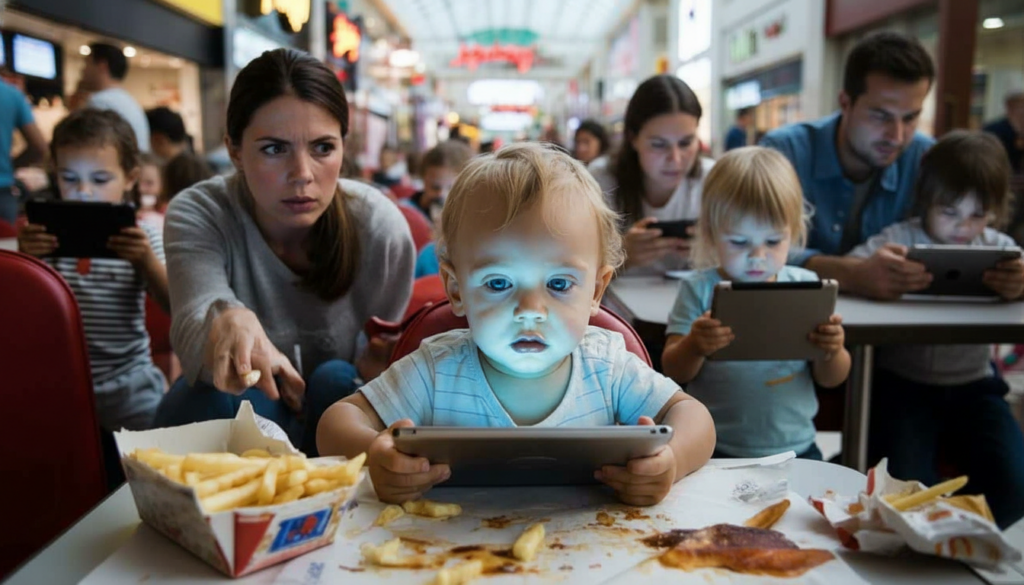
A dad at the next table gives his eight-year-old a phone without even looking up from his own screen. The boy doesn’t say thanks. He goes away, too.
The kids are quiet, even though the food court is loud.
This new silence doesn’t feel right.

“Digital dummy” parenting is spreading faster than we can figure out.
Ask any paediatrician; they know what happened. Kids who can’t sit still, sleep, or pay attention for more than a few minutes unless something is flashing in their faces. Teachers talk about first graders who lose it when the iPad time in class is over, as if someone had cut off their air.
Screens are everywhere, and the message is clear but not loud: giving your child a device will make life easier. There is less noise during meals. Fights at bedtime get smaller. Long car rides don’t seem like torture.
Saying no doesn’t feel right to tired parents. It seems like it can’t be done.
A lot of doctors are now saying out loud what a lot of research is showing: too much screen time is literally changing how kids’ brains work. A big study that used brain scans found that kids who spent more than seven hours a day on screens had thinner areas of the brain that are important for language and critical thinking. Seven hours sounds like a lot, but when you think about it, a lot of kids get there by using school devices, watching TV, playing video games, and talking on the phone.
Another study looked at toddlers who spent a lot of time in front of screens every day. They had more trouble paying attention, less social skills, and more emotional outbursts by the time they were five. It wasn’t just that they liked cartoons too much. Their brains had really changed direction in their growth.
When a brain is still growing, it follows a simple rule: keep what you use. You lose what you don’t use. When you constantly look at screens, your brain learns to want quick rewards and bright, changing images. All the things that help you become more emotionally strong and think deeply, like quiet play, long conversations, boredom, and even the slow pace of family life, get pushed out.
That’s what doctors say. They write rules, give stern talks, and show scary charts. Tablets keep getting into little hands in living rooms, kitchens, and minivans, though. Parents can see. They’re stuck.
Ending the cycle without losing your mind as a parent
One of the most realistic first steps isn’t very exciting: change the “when” as well as the “how much.” Instead of promising to cut screen time in half overnight, make a few areas where screens are not allowed. No screens during meals. None for the first hour after school. Not in bedrooms at night.
When you’re tired, stressed, or running late for work, these rules are easy to remember. Add a “family offline block” once a week, even if it’s only for 45 minutes, where everyone, including you, puts their devices away.
It seems small. It’s a lot for a kid’s brain.
The hardest part isn’t when kids don’t want to do something. It’s the guilt of being a parent. You know the studies, you see the meltdowns, and you worry that you’ve already hurt them. Some days, though, all you want to do is not burn dinner or lose your job.
 Heating companies promote the myth that shutting vents increases costs simply to sell larger units
We’ve all been there: when your child’s whining drives you crazy and you think to yourself, “Fine.” Take the pill. “Stop it.”
Let’s be honest: no one really does this every day, perfectly and calmly. Winning isn’t about being perfect. The default is changing from “screen first” to “screen later and less.”
One thing that doctors who work with families say over and over is that shame doesn’t change behaviour; structure does. Over time, small, predictable rules help everyone relax.
One paediatric neurologist I talked to said, “Parents aren’t failing.” “They’re outnumbered and out-designed by billion-dollar attention machines.” You can’t use willpower to get around that. You need a plan that works in the real world.
Here are some structures that really work in homes where people have jobs, do laundry, and have bad days:
Set a daily limit and then connect screens to real-life events: “You can have 45 minutes after dinner and homework.”
Put out one or two *boring* options, like puzzles on the table, crayons on the counter, or a ball by the door.
Give kids “screen tokens”—a few each day—that they have to give you to start their time. This way, they don’t think screens are never-ending.
Everyone should move their devices out of their bedrooms at night. This one change will help your sleep, mood, and focus more than most apps ever will.
Choose one daily connection ritual that you can’t change: a walk, story, or game with no screens for 10 minutes.
What kind of childhood are we quietly making?
When you look at the power struggles from a distance, the real question isn’t “Are screens bad?” It’s “What childhood are we giving up without even realising it?” Kids who spend most of their free time on tablets aren’t climbing, arguing about the rules of games in the backyard, getting bored enough to make things up, or just staring out the window and thinking their own thoughts.
Those quiet, awkward, and sometimes annoying times are when your imagination and self-control get stronger. They are also where real memories are made. Level 238 of a mobile game is not something most adults remember fondly. They remember the time they got soaked in the rain at the park, the fight between siblings that turned into hysterical laughter, and the long car rides when the radio was the only “screen.”
No parent gets up in the morning and thinks, “Today I will let an algorithm raise my child.” But that’s pretty much what happens when devices become the default babysitter, comfort object, and reward system. Kids learn, deep down, that swiping can make any bad feeling go away.
Stepping back from that doesn’t mean cutting off all technology or going off the grid. It means picking a story where screens are not the main character but tools. For a lot of families, the most radical thing to do isn’t to cut back on technology. It’s more present.
To be honest, none of this is easy. Some kids have special needs, some parents work at night, and some families live in a small space with no craft corners. Warnings from doctors can seem like they are aimed at people who don’t have many options.
But almost every day, there is at least one small moment when you have a choice: give your child a screen or sit in the discomfort and look them in the eye. Those little decisions change neural pathways and habits, and one day they will make our kids into the adults they will be.
The question isn’t if screens are hurting kids’ brains. It’s whether we’re willing to protect the delicate, irreplaceable parts of childhood that a glowing rectangle can never give back.
| Key point | Detail | Value for the reader |
|---|---|---|
| Set simple, consistent boundaries | Screen‑free zones (meals, bedrooms, first hour after school) work better than vague rules | Gives exhausted parents a realistic structure without needing constant willpower |
| Replace, don’t just remove | Offer visible, low‑effort alternatives like drawing, blocks, or short walks | Reduces battles and helps kids slowly rebuild focus and creativity |
| Model healthier habits | Parents park their own phones during key connection times | Shows kids that screens are tools, not masters, and strengthens family bonds |