
You feel a warm paw quietly land on your leg while you’re sitting on the couch and halfway through a cold cup of coffee. Your dog looks at you with eyes that are wide and searching. There is no toy in sight. The doorbell isn’t ringing. Just that light weight on your knee, like they’re asking for something you can’t quite hear.
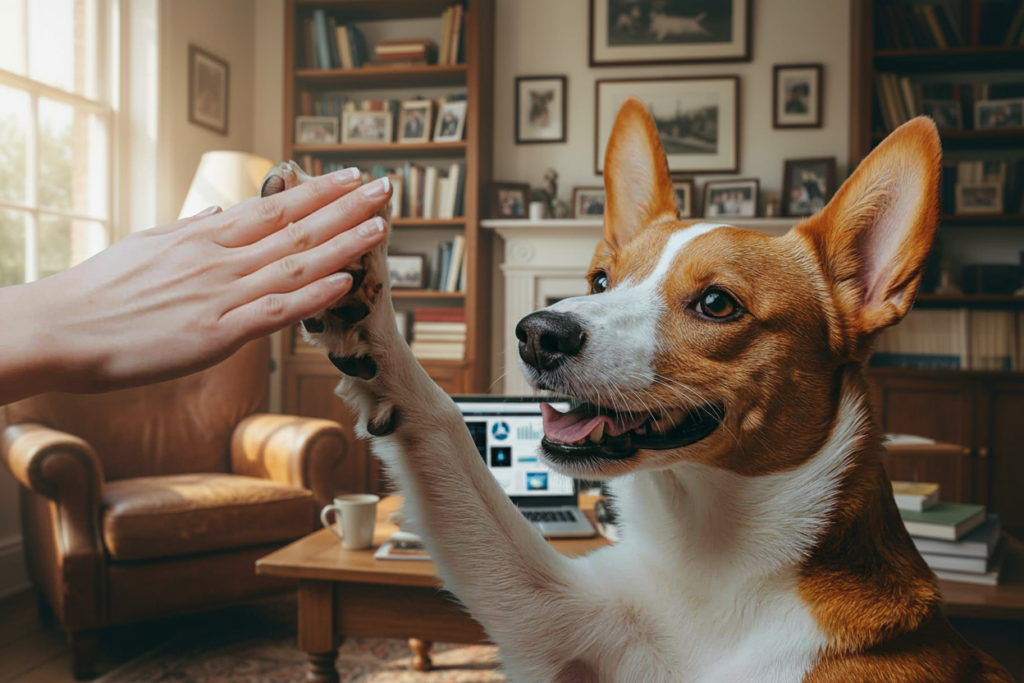
You might laugh and say “Hi, baby,” then give them a quick pat before going back to your phone. Or you automatically reach out your hand, like you’ve done a thousand times, and turn it into a trick without even thinking.
What if your dog is really whispering with their paw?
When a paw on your leg is more than just a cute trick

Dog trainers say one thing right away: when a dog offers its paw on its own, outside of a training context, it’s almost never about a high-five. A lot of the time, it’s about feelings. A paw on your arm, a scratch on your thigh, or a tap on your leg… These are all different ways of saying the same thing: contact.
Sometimes the contact is nervous. Your dog may be feeling overwhelmed, confused, or even a little stressed. When they reach for you with their paw, it’s like a child reaching for their parent’s sleeve. Sometimes, it’s just looking for attention, love, or comfort.
That little thing can mean a lot in dog language.
Imagine this. A storm starts rumbling in the distance, low and almost unnoticed. You are focused on your laptop when your dog gets up from their bed and walks over. They don’t bark. They don’t complain. They just sit next to you and slowly put a paw on your arm, scratching your skin with their nails.
You stop for a moment, absentmindedly stroke their head, and then get back to work. That paw comes back ten minutes later, and this time it’s more insistent. The eyes are a little wider, the ears are pinned back, and the tongue is licking the nose.
It looks like “clinginess” on paper. It looks like a dog saying, “I’m not okay right now.” Are you there with me?
Animal behaviourists often call the pawing gesture a type of “contact-seeking” behaviour. Dogs are very good at picking up on small signals, and touch is one of their favourite ways to do this when eye contact and body language don’t work. Yes, if your dog keeps putting a paw on you, it could mean they’ve learned that this gets a reaction. But on a deeper level, it has to do with how you feel: insecure, excited, looking forward to something, or even a little frustrated.
Your dog can’t send you a text message. So they hit you with what they have.
The hard part is that we often reward the gesture without knowing what it means.
Reading the paw: what your dog really wants
If a paw touches your leg again, don’t do anything for two seconds. Take a deep breath and look around. What is the tail doing? Is the body stiff and tense, or loose and wiggly? Are the whites of the eyes visible, or are they soft and round? You hear a completely different message after just a few seconds of watching.
If the body is relaxed, the mouth is slightly open, and the tail is wagging at mid-height, the animal may be asking to play or cuddle, like “Hey, remember me?” If the body is tense, the tail is low or tucked, and the ears are pinned back, you are closer to asking for comfort.
A lot of trainers have the same kind of story. A family says their dog is “annoying” because he keeps pawing at them at night. The picture changes after the behaviourist watches a whole evening at home. Every day, the dog is alone for ten hours. The walks are always the same and short. The TV is too loud. Kids are running and yelling.
The dog starts to walk around the house at about 8 p.m. Then the scratching starts. First on the father’s leg, then on the teenager’s arm, and finally on the mother’s knee on the couch. No one really answers. They either laugh or push the paw away, which is distracting. The dog keeps coming back.
It seems like begging for attention on the outside. It’s a dog that is both bored and over-stimulated at the same time.
Experts in behaviour say that the paw has three main meanings: controlling emotions, making friends, and learning a strategy. When your dog reaches out to you when they’re anxious or overstimulated, they’re trying to calm themselves down by being with you. The softer side of social bonding is wanting to be close, grooming each other by petting, and just “being together.” Learned strategy is very connected to people. At some point, the dog pawed, you laughed, gave them a treat, or talked to them, and their brain saved the equation “paw = human reaction.”
To be honest, no one really keeps track of every little thing they reward by accident.
So, over time, a complicated mix starts to show up. Your dog really needs something and is using a gesture that has always worked with you.
How to answer without sending mixed signals
The best thing you can do is to not react to the paw itself, but to the whole picture of how your dog is doing. Begin by silently saying what you see in your mind: “calm and happy,” “tense and worried,” or “overexcited and demanding.” Then do something about that state.
If your dog seems anxious or insecure, moving slowly, talking calmly, and giving them a gentle touch on the chest or shoulders will help more than an exaggerated cuddle. You can interact with the dog more if it looks calm and playful. You could play a short game, scratch behind its ears, or do a quick training exercise. If the energy feels frantic and needy, try redirecting it to a structured activity like a short walk, sniffing games, or a chew toy.
When experts say, “Don’t reward demanding pawing,” a lot of owners feel bad. It sounds cold when you read it. It’s not really about ignoring how your dog feels. It’s about not encouraging frantic, repetitive behaviour that can turn into constant harassment all day long.

You can definitely meet their needs without getting into the pawing loop. For instance, wait one or two seconds of calm—paws on the floor, soft eyes—before giving them your attention. Your dog will learn that being calm works better than getting more and more insistent.
We all know the feeling: that moment when you realise that your sweet cuddle routine has turned into a constant tapping on your sleeve.
One animal behaviourist said something during our interview that stuck with me:
“Your dog’s paw isn’t a button you should press back; it’s a question you should read.”
Many professionals ask owners to keep a simple mental checklist every time the paw shows up to help them figure out what it means:
Where are we? Storm, new place, visitors, busy street, loud TV… The gesture is coloured by the situation.
What does the body look like? Social means relaxed muscles and a loose tail. Stress or uncertainty is when your body is tight and your tail is low.
What just took place? Sudden noise, an argument, a door slamming, the end of a game, or someone picking up the phone can all set off a trigger.*What has this paw done to earn money in the past?* Food, attention, walks, or even just looking at them.
What do I want to support? Calm contact, independent play, or a set time each day for cuddles.
You start answering the paw with purpose, not on autopilot, by quietly going through this list.
Having a dog that “talks” with its paws
You see patterns more clearly when you pay attention. Your dog might only give you a paw when you’re on your phone. It might happen every time you go for a walk, when it rains, or right after guests arrive. That cute little tap isn’t random anymore all of a sudden. It becomes a word that your dog knows and uses in your life together.
You might even answer with your own ritual: a hand on their chest for a few breaths, a quiet “I see you,” or a short break in the middle of your day to really be there for them, not just give them a distracted pat on the head.
Some owners decide to only use the “shake” trick during training sessions and not at other times, so when their dog paws at them for no reason, it means something else. Some people choose certain “connection moments” when they are fully open to and accepting of that paw, no matter what it means. These could be times like morning coffee, before bed, or after work. In between those rituals, they teach their dog to ask in less pushy and calmer ways.
As time goes on, the dog’s behaviour and the relationship itself change. The paw is no longer just a request; it becomes a quiet conversation, a small piece of shared language that says, “We’re paying attention to each other now.”
You can hear the whisper behind the touch.
| Key point | Detail | Value for the reader |
|---|---|---|
| Decode the context | Observe tail, ears, body tension and recent events each time your dog paws at you. | Helps distinguish between stress, affection, excitement and learned begging. |
| Respond to the emotional state | Adjust your reaction (calm, play, redirection) to what your dog feels, not just the gesture. | Builds trust and reduces anxiety or pushy behavior. |
| Create clear rituals | Reserve specific moments for paw-based contact and reward calm, grounded interactions. | Makes life easier, avoids constant pawing, and deepens your bond. |
FAQ:
Why does my dog give me its paw when I stop petting it?
Because that gesture has probably worked in the past. Your dog knows that putting a paw on your arm will start the petting machine again. If affection stops suddenly, there may also be a little bit of frustration or insecurity.
Is it always a sign of anxiety when you paw?
No. It can be fun, loving, or just a habit. When a dog is anxious, it may show other signs, such as tucking its tail, pinning its ears back, yawning, licking its lips, pacing, or panting without exercise.
Should I ignore my dog when it paws at me?
Don’t ignore the feeling, just the pushy part. Give them one or two seconds of quiet time, then give them something to do or pay attention to so they learn to relax instead of tapping like crazy.
May I still teach “shake” as a trick?
Yes, for sure. Put it on a clear verbal cue and practise it mostly during training sessions. This will help your dog learn the difference between the trick and emotional pawing.
What if my dog suddenly starts to scratch a lot more than usual?
A sudden change can mean more stress, pain, or confusion. Look at the situation, your daily routine, and your health. If the behaviour doesn’t change or feels “off,” it’s a good idea to talk to a vet and a qualified behaviourist.