
The woman sat in the dark wooden confessional, holding the photo printout from the clinic tightly in her hands. It didn’t have the shine that pictures on social media do. It was black and white and grainy, and there was a shadow on the tiny skull that the doctor had politely called “an anomaly.” She hadn’t told her husband yet. She hadn’t told her mum yet. She had only told one person, God. Her voice shook as she asked the priest through the fine mesh grille if this was some kind of punishment. He listened without saying anything, and then all of a sudden he felt something cold slide into his mind.
What if this small wooden box got medicine?
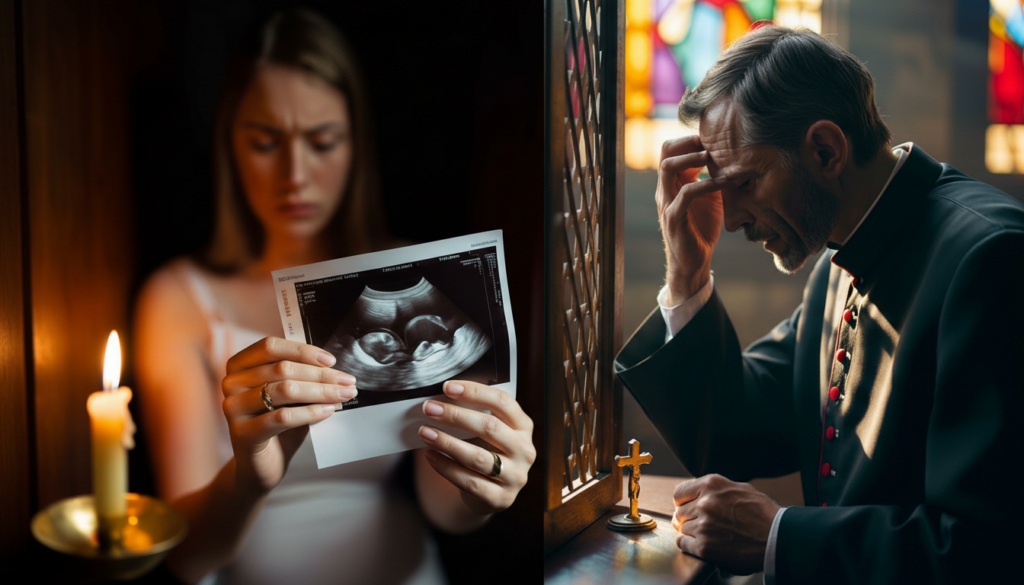
When a confession booth becomes a medical crossroads
Imagine this: a young couple goes to church on Sunday, their eyes still red from an ultrasound on Friday. The obstetrician talked about “major malformation,” “quality of life,” and “termination options.” The words are still going around. The woman goes into the confessional after Communion to ask for forgiveness, not medicine. She admits that she is scared, angry at God, and worried that she might not be able to keep the baby. When the priest hears the word “ultrasound,” he suddenly finds himself in the middle of a conflict between the law of the Church and the law of the State.
The “seal of confession” is absolute for Catholics. If a priest tells even a little bit of what he hears, he could be kicked out of the church. Canon law is clear: the confessional is a vault that never opens, not even for the police, not even in court, and not even to “help” parents. But in some places, civil law says that people must report certain dangers or abuses. Now imagine the worst-case scenario: the priest is also the uncle, a family friend, or a hospital chaplain. The unborn child’s abnormality isn’t just a religious issue; it affects his daily life.

We’ve all had that moment when a private secret starts to leak into every part of our day. This imaginary ultrasound confession is a secret for a lot of priests. It’s easy to see on paper: the seal wins, period. In reality, they have information that could change the way prenatal care is done, how families make decisions, and even how the law works. Some ethicists say that not saying anything “respects divine secrecy,” while others say that being quiet can feel like agreeing to harm that could have been avoided. The confessional, which used to be just a place to confess sins, now looks like a second waiting room in the maternity ward.
Is it possible for a priest to hint, guide, or “nudge” without breaking the seal?
One simple gesture can change everything behind the grille: how the priest asks questions. He can’t say, “Tell your husband his child has trisomy 18,” but he can ask, “Have you talked to your doctor and family about this?” A lot of experienced confessors use broad, open phrases. They tell parents to get counselling, get a second opinion from a doctor, and talk to support groups that focus on their needs. They don’t go over the details of the anomaly again. They want to help the parents, not the secret. *There is a very thin line between giving advice and telling the truth, but that’s where most real-life confessions happen.
It’s easy to picture heroes or villains from the outside. The priest is either a brave protector of God’s secrets or a cold bureaucrat who hides behind rules. Things are messier on the inside. Some priests say that the hardest part is not talking, but being there. They hear the fear in a mother’s voice and want to call the doctor right away. They see fathers who are feeling guilty and wish they could just say, “Here’s what you’re going through medically.” Let’s be honest: no one really does this every day without sometimes lying awake at night and going over the confession in their head.
In this tense situation, many parishes have come up with a quiet plan. Priests tell parents that God’s grace and medical truth are not enemies, but they don’t give any details. They say that keeping medical information from a partner out of fear or shame almost never brings peace. They also know that they shouldn’t use sacramental trust as a weapon. One canon lawyer told me over coffee:
“The seal doesn’t belong to the priest; it belongs to God and the person who is sorry for what they did. He can’t give it up, even for a “good” cause, because then no one will ever really be honest in confession again.

Ask questions that encourage communication rather than just giving facts.
Encourage people to talk to doctors, counsellors, and family members for help.
Don’t do anything outside of the confessional based on what you heard inside.
Give the penitent spiritual guidance after the sacrament, but only if they ask for it.
Even when you’re feeling torn, keep the seal to keep trust for future penitents.
Betrayal, protection, and the quiet space that separates them
This argument isn’t really about theology books in the end. It’s about that woman holding her ultrasound and that father looking at a pixelated picture of a child who may never be able to breathe on their own. It’s also about the priest, who leaves the confessional with the same old cassock and a heart that suddenly has a delicate, hidden story. Some readers will say he should speak for the sake of the parents. Others will stand up for the sacred vault of confession. Both sides are talking about care, but they are using different words.
The truth is that ultrasound technology has made its way into areas that were once safe from clinical data. One of them is the confessional. A screen in the hospital shows a spine that isn’t right. A screen in the priest’s mind now stores that image under the label “for God’s ears only.” Families have to cross a gap between those two screens mostly by themselves. The priest can shine a light on the bridge, but he can’t walk it for them or shout their secret into the night, even if he thinks it will help them.
This leaves a strange invitation in the air for anyone who believes, doubts, or just wants to know. How much privacy do we want for our most vulnerable times: complete and sacred, or practical and open to negotiation? Should divine spaces stay out of the way of medical duty, or should they change to fit the times of high-definition womb images and genetic testing? That question stops being abstract the next time someone goes into a wooden booth with an ultrasound hidden in their bag. It turns into a whisper in the dark, waiting for an answer that we don’t all agree on yet.
Main point: Detail: Value for the reader:
Seal of confessionPriests are not allowed to tell anyone what is said, even if it is a prenatal diagnosis.Explains why a priest can’t “report” problems, even if he means well.
Helpful adviceConfessors can help parents see doctors, get counselling, and talk honestly with their kids.Demonstrates the coexistence of spiritual support and medical reality while maintaining confidentiality.
Tension between moralsSome people may think that silence is a betrayal, while others may think it is a way to protect themselves, especially during complicated pregnancies.Helps readers think about their own views on faith, privacy, and medical responsibility.
Questions and Answers:
Is it ever okay for a priest to tell doctors about a foetal abnormality that was revealed in confession?No. According to Catholic canon law, the priest must remain completely silent, even if he thinks that revealing information could be helpful for medical reasons.
Is it okay for a priest to tell parents to tell each other and their doctors?Yes. He can strongly encourage open communication and more medical consultations, but he can’t give or confirm any specific details himself.
What if civil law says that a child has to be told about certain dangers?The Church still says that the seal of confession can’t be broken. A priest must face legal consequences rather than break the sacrament.
Could the priest talk about the case in general without naming anyone?He can talk about abstract situations for teaching or training, but he can never link them to a specific person or situation.
Should you talk about an abnormal ultrasound inside or outside of confession?For a lot of couples, talking about it with a priest, counsellor, or doctor outside of the sacrament gives them more room to get practical help without breaking the strict rules of the confessional seal.