
When the streetlights came on at noon, the first scream went up. Not because they were scared, but because they were excited and nervous. In the small riverside town of Larkford, which was one of dozens along the eclipse’s “path of totality,” kids stood on car roofs, neighbours crowded balconies, and traffic stopped as the sky turned a dark blue. Dogs whined, birds flew in circles that didn’t make sense, and the local bakery ran out of crescent-shaped cookies before the moon had even taken its first bite of the sun.
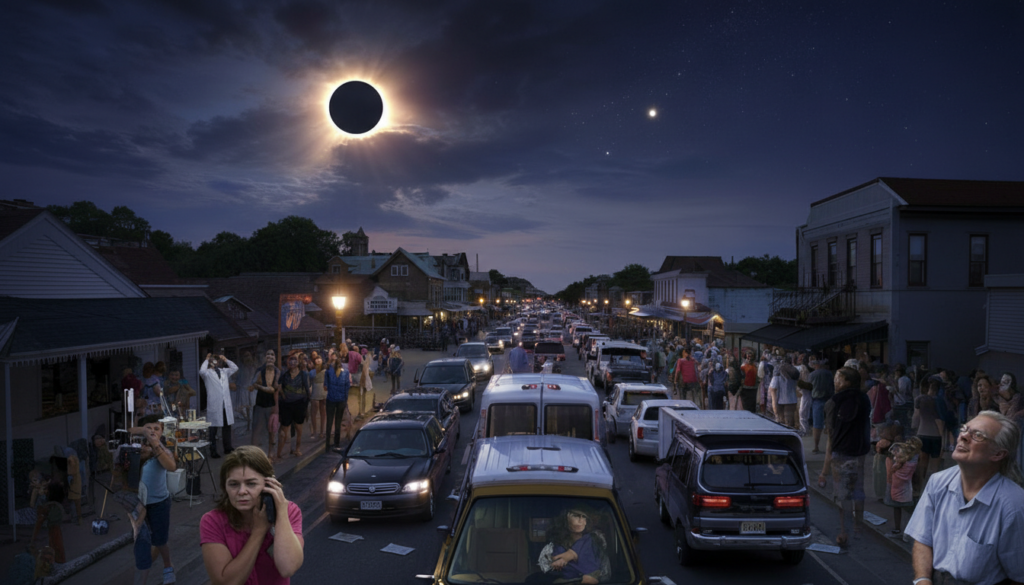
Some people said it was a miracle.
Some people, who were stuck in traffic and couldn’t get a cell signal, used different words.
Six minutes that made small towns famous around the world
The highway into Larkford looked like the exit to a stadium after a playoff game by 8 a.m., even though the game hadn’t even started yet. There were RVs parked on the sides of the road from three states away, rental cars from Europe and Asia moving at a snail’s pace, and every patch of grass became “premium parking” at twenty dollars a spot.

There are usually about 12,000 people living in the town. Officials say it briefly tripled yesterday.
On Tuesdays, stores that usually fight for every customer had lines out the door. The ice cream shop that used to close for the winter? Open, feeling overwhelmed, and wiping the sweat from their foreheads in the strange, midday twilight.
School buses pulled up on Main Street long before lunch. The district had decided to close early because of safety concerns and “unmanageable traffic conditions.” Parents then ran from makeshift parking lots to get their confused kids who were holding cardboard eclipse viewers.
There was an empty field at the edge of town that had been turned into ‘Eclipse Camp’. There were tents, telescopes and tripods. A retired engineer from Ohio and a couple from Brazil shared binoculars. Two teens streamed everything live, complaining about the bad signal but still describing every tiny movement of the moon’s shadow as if it were a World Cup final.
By 10 a.m., one gas station was out of gas. The clerk put a sign on the pump that said, “NO GAS. YES SNACKS. GOOD LUCK.”
For local leaders, it was both a success and a headache. They had been getting ready for months, with extra portable toilets, emergency routes, and volunteers in bright vests practicing for a day when the town would act like a small city.
It was right for them to be worried. Previous studies of eclipses showed that there were more accidents, tourists who got lost and blocked side streets, and cell towers that were too busy. But they also showed something else: a huge increase in local revenue, full motels in places that usually beg for visitors, and a wave of attention that money couldn’t buy.
Some people complained about strangers parking in front of their houses, but the chamber of commerce quietly said it was the best day they had had in 20 years.
From “miracle in the sky” to “man-made disaster”
You might think this was the scientists’ version of the Olympics if you saw them. Three universities had sent teams to a hill above town to carry up sensitive cameras, spectrometers, and laptops that were plugged into generators that made a humming sound. They barely looked up with their bare eyes as the moon slid across the sun.
They were looking for information that most of us will never see.
Small changes in the sun’s corona. The temperature drops every minute. Silent motion sensors hidden in the grass record how animals act.
Not everyone was happy down below, though. The nurse who was too busy to get on a bus to get to her night shift. The owner of the café ran out of water and had to turn people away, then listened to them complain. The old man who couldn’t get to his afternoon dialysis appointment because three cars were blocking his driveway.
These stories don’t often fit into the shiny “eclipse wonder” montages that are on TV. But they are just as real.
When something this rare happens, it doesn’t just float above our messy lives. It falls right in the middle of them.
Long before the first shadow touched the coast, the phrase “man made disaster” started to show up online. People who lived in towns where the eclipse happened were worried about price gouging, blocked emergency routes, and drivers who were too busy looking at the sun to pay attention to the road. Some of them had been through “big events” before and knew what to expect: the hype, the invasion, and the mess that was left behind.
If you talk to the scientists in their folding chairs, though, they’ll say something else. For them, these six minutes are a once-in-a-lifetime chance to do a lab experiment on a planetary scale. They say that the benefits—better models of how the sun works and a clearer picture of how our atmosphere reacts—will have an impact on weather forecasts, satellite safety, and even flying.
Both things can be true at the same time. A miracle in the air. A headache on the ground.
How people really got through the chaos (and what they would do differently)
There were three things that were most important for survival on the day itself: timing, supplies, and expectations. The people who seemed oddly calm? Most of them had done something simple but smart: they acted like there was a snowstorm warning on eclipse day.
They filled up their petrol tanks two days ahead of time.
They bought a lot of food. They parked their cars where they wouldn’t get stuck and then walked or rode their bikes into town hours before the first contact between the moon’s edge and the sun.
The people who had the worst time followed a different script. Late start. No written directions. One bottle of water in the car “just in case” and a general feeling that everything would be open and easy. We’ve all been there: the moment you realise you didn’t think the crowd would be as big as it is.

To be honest, no one really does this every day. Most of us take a chance on logistics and hope for the best.
People who left with a smile on their face didn’t always have the best view. They were the ones who planned for delays, knew there would be lines in the bathrooms, and focused on being curious instead of checking off a list of things that had to be perfect.
Some people in the area learned the hard way that chaos spreads in small waves. One woman rented out her driveway online and then spent the rest of the morning directing traffic instead of watching the sky with her kids. A teacher who volunteered at a viewing event had to fix a broken projector right as totality started. *He only saw thirty seconds of darkness through a door.
Later, a local official thought about the day and said with a sigh:
“We got ready for the cars. We weren’t ready for all of the human emotions—panic, excitement, entitlement, and wonder—to hit us all at once.
Several towns are already making plans for the next eclipse. The notes look a lot like this:
Don’t let kids go to school or watch films with other kids; do one or the other.
Set a limit on parking spaces and make that number clear weeks in advance.
Teach volunteers how to handle conflicts as well as how to plan events.
Set realistic expectations: there won’t be much cell service, there will be long lines, the menus will be simple, and cash is preferred.
Make sure that locals can get to the things they need by setting aside pharmacy lanes, parking spots just for residents, and priority for medical routes.
When the sun comes back and the tourists leave
A strange quiet fell over Larkford as the moon’s shadow moved away and the light changed to a strange orange colour. People blinked, looked at their phones, and moved their feet. The big thing had happened. The sky had torn and then fixed itself.
Then came the boring part: picking up trash, counting receipts, posting shaky videos, and arguing in Facebook groups about whether the town was ready or reckless.
Some kids will remember the eclipse as pure magic. The stars that weren’t real at noon and the jolt in their stomach when the world went wrong for a short time. Some business owners will remember it as the day they finally paid off a debt. Some emergency workers will always remember the gut-wrenching moment when an ambulance had to push through a wall of out-of-state plates.
The eclipse is over, but the questions it leaves behind are as long as its shadow. How can we welcome wonder without ruining the places that hold it? How do we find a balance between curiosity, business, and caring for the people who live along the path all year?
When the moon moves in front of the sun for six impossible minutes again, towns along that narrow band will have to choose between chasing the miracle and protecting themselves from the man-made disaster.
They will probably try to dance in the middle, and the rest of us will have to decide if we want to join them.
Important point Detail: What the reader gets
Plan like a storm, not like a picnic. Early petrol, food, parking and flexible hours Lessens stress and lets you look at the sky instead of the traffic.
Be polite to the host towns. Follow the rules in your area, keep driveways safe, and keep paths clear.Keeps people safe and makes sure they can get to emergencies.
Expect things to go wrong Crowds, long waits, spotty cell service, and few services Helps you focus on the rare event in the sky instead of small problems.
| Key point | Detail | Value for the reader |
|---|---|---|
| Plan like a storm, not a picnic | Early gas, food, parking, flexible timing | Reduces stress and lets you enjoy the sky, not the traffic |
| Respect the host towns | Follow local rules, protect driveways, keep routes clear | Protects residents and preserves access for emergencies |
| Expect imperfection | Crowds, delays, patchy cell signal, limited services | Helps you focus on the rare celestial event, not minor annoyances |
Question 1Why did some schools let out early for the eclipse?
How dangerous are the traffic jams during a big eclipse?
What did the scientists measure in those six minutes?
Question 4: How can small towns get ready for the next “eclipse of the century” better?
Question 5: Is it really worth all the trouble to travel into the path of totality?