
On a rainy Tuesday in a small city salon, a young woman in a big jumper sat down and said the same thing that every stylist hears ten times a day: “I just want my fine hair to look thicker.” The hairdresser nodded and ran her fingers through the clear ends that floated like cobwebs. She suggested a short, layered crop “for volume,” the kind that looks great on TikTok and makes your jawline look sharp on Zoom. The client left forty minutes later with a bouncy new haircut, a lighter wallet, and a big smile.
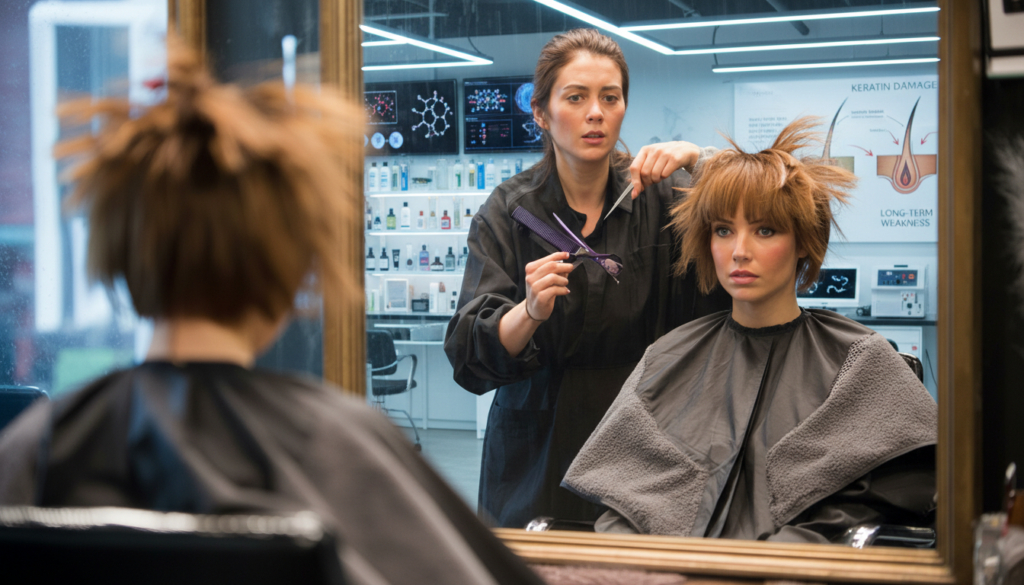
That’s when the stylist quietly said what most people don’t say out loud.
When “volume” quietly works against your fine hair
All of the most popular short cuts for fine hair promise the same thing: instant thickness. Blunt micro-bobs, shaggy bixies, and choppy pixies with crazy layers. You can find these looks all over Instagram. The before and after pictures are mesmerising, especially when your hair is flat against your head by 11 a.m. In the front row of the salon, they look like a way out. Your neck is longer, your cheekbones are sharper, and your crown has suddenly risen. It feels like a new person is growing out of your head. Until you start to see what’s left in the brush.
A stylist from London told me about a client who came in every eight weeks for a French bob with a lot of texture. The stylist said, “She loved it, but her hairline had thinned after a year.” The client’s hair had always been naturally fine, but cutting it with a razor and rough texturing had made each strand very thin.

The first few months were amazing: more lift, more swing, and more movement. Then, when the bathroom lights were on, she could see more of her scalp. She blamed her hormones, stress, and even her pillowcase. The quiet culprit was right above her shoulders: a “volume-boosting” cut that was done too many times on hair that just couldn’t handle it.
It’s easy to understand. A lot of short cuts for fine hair add volume by taking away weight. Stylists cut, point-cut, and razor through the hair to make it look thicker and sit away from the scalp. *This lightness looks magical on camera.
But every aggressive layer and every razor pass makes the cuticle a little weaker. Fine hair is already thinner; when you thin it out in certain places to make it look thicker, you also make it less strong over time. Over time, that can mean more breakage at the ends, wispy edges around the face, and that strange feeling that your ponytail (if you can still make one) is thinner than it used to be.
The four short cuts that can secretly make your hair look thinner while also making it thicker
The ultra-layered pixie with a lot of texture on top is the first cut that people disagree about. It’s the one that looks like “I woke up like this,” where the stylist cuts out tiny pieces so the hair stands up with a little wax. Day one is all about having fun. Your hair suddenly has a rebellious, lifted, and directed look that you might not have tried with longer lengths.
The problem begins when you have to keep that look up. To keep the shape, stylists keep cutting into the same spots. On fine hair, those spiky, piecey bits can quickly turn into flyaway fluff that breaks instead of bending.
The razor-cut shaggy bob is another popular style on TikTok. The layers start high on the crown, the edges are feathered, and everything moves. This is brilliant for people with naturally thick hair. The razor can be a silent enemy on fine hair. At first, it makes the cuticle rough, giving you that sexy, rock-chic fuzz. After a while, your ends get frayed and tangle easily, and they break when you brush them.
A Parisian colourist said she sees this pattern all the time: a client comes in with a trendy shag, but the last three centimetres of hair are so weak that they break when they are lightened. The haircut added volume, but it also made the hair weaker.
The third trap is the stacked bob with a lot of layers and hard layering at the nape. From the back, it’s amazing: it has a rounded shape, a lot of “built-in” volume, and looks like thick hair. The secret is? The inside is often carved out in a rough way. The hair at the back of the neck is cut very short underneath, and the longer layers on top look like a shell.
Over time, that constant weight change in the same small area can cause collars, scarves, and seatbelts to rub against each other over and over again. Fine hair that has already been cut and layered rubs and snaps there first. The fourth reason is the extreme undercut bob or pixie, where whole sections of hair, like the sides, nape, or even a hidden panel, are shaved off to make the top look fuller. It works… until you realise that you’ve gotten used to seeing less hair as “normal.” When you finally want to grow everything out, the contrast can show how little density you really have left.
How to get the lift you want without hurting your hair in the future
If you have fine hair, the safest thing to do is not to avoid short cuts, but to find better ones. Ask for soft, thin layers that mostly sit at the ends and not deep inside. A collarbone bob with a slightly blunt edge and tiny, invisible layers only on the outer few millimetres can make your hair move without making it less dense.

Use the word “illusion” instead of “removal.” Instead of saying ‘cut everything thin so it lifts’, ask for a fuller edge line around your face and neck. This keeps the thickness of the visual frame, and the stylist lightly lightens small areas on top to make it look taller. On day one, it’s not as bad, but on day 100, it’s much better.
Another important step is to lengthen your maintenance schedule. People often take pictures of those viral cuts on day zero or one. Month three is when real life starts. If your haircut only looks good for four weeks and then gets out of control, you’ll want to keep reshaping it. That’s when fine hair gets hurt.
Tell your stylist the truth about what you do. Do you really use a round brush to blow-dry your hair every morning? Do you always use heat protectant? To be honest, no one really does this every day. So try to get cuts that look good when they are air-dried and styled with basic products. Low-effort routines naturally limit how much trauma your strands go through.
A senior stylist I met backstage at a fashion show said, “Volume should be a styling choice, not a structural sacrifice.” “We used to cut fine hair as if it were thick. I now treat every fine strand like silk. You don’t cut silk to make it look richer.
To keep your hair healthy while still enjoying short styles, make small, consistent changes:
Pick edges that are blunt or slightly softened instead of ends that are very shredded.
Use a light mousse or volumising spray at the roots, not all over the length.
Use hot tools only two or three times a week, and turn down the heat.
When the cut allows it, book trims every 10 to 12 weeks instead of every 4 to 6 weeks.
Once a week, switch out one of your strengthening products (protein or bond-builder).
These changes don’t make haircuts less fun. They just mean that your hair has a better chance of staying alive.
The confession behind the chair and the choice in front of the mirror
If you ask any stylist off the record, they’ll probably agree: some of the most “wow” short cuts for fine hair are also the most painful over time. The stacked bobs, sliced pixies, and shredded shags make for great before-and-after photos that look great on social media. They bring in bookings. In just one afternoon, they make you feel like a new person.
What they don’t always show is how slowly the damage happens, like how your ponytail gets smaller every year or how your front pieces won’t grow past your chin without breaking. That quiet damage doesn’t often go viral. It just stays with you, in the shower drain and in the quiet doubt you feel when you see your profile in harsh light.
There is a middle ground, and it doesn’t mean giving up on fun, short, or daring things. It means asking better questions, like, “How will this look in a year?” “What will grow-out be like if I change my mind?” “Can we keep as much weight around the edges as possible and add volume through styling instead of cutting everything out?”
You can enjoy the excitement of a big chop and still care about your hair’s long-term health. You can bring a viral photo and then work out a softer, less extreme version that works better in real life instead of a 30-second reel. There is a cut that respects your strands somewhere between the flat, heavy lob you hate and the hyper-textured pixie that eats your density. You can start by asking, “Will this make my hair look thicker today but weaker tomorrow?”
Important point Detail: What the reader gets out of it
Risky volume cutsPixies with a lot of layers, razor shags, stacked bobs, and undercuts take away a lot of weight from the inside.Helps you figure out which trends might be secretly making your fine hair thinner.
Gentler optionsSoft layers, fuller edges, and collarbone bobs with shaping that you can’t seeGives you choices for volume without losing strength over time
Habits that keep you safeLonger trim cycles, less heat, and care that focuses on strengtheningTells you how to enjoy short styles while keeping your hair thick in the future.