
A sharp white shape cuts across the horizon on a grey November morning at Le Bourget airport. People stop in their tracks, phones already up, and their eyes squint as if they just saw a ghost. The nose is clear, the wing is a perfect delta, and the word “Concorde” catches the first shy ray of sun. You could swear it was about to take off again, engines roaring, Paris to New York in three and a half hours, the world getting smaller with each decibel.
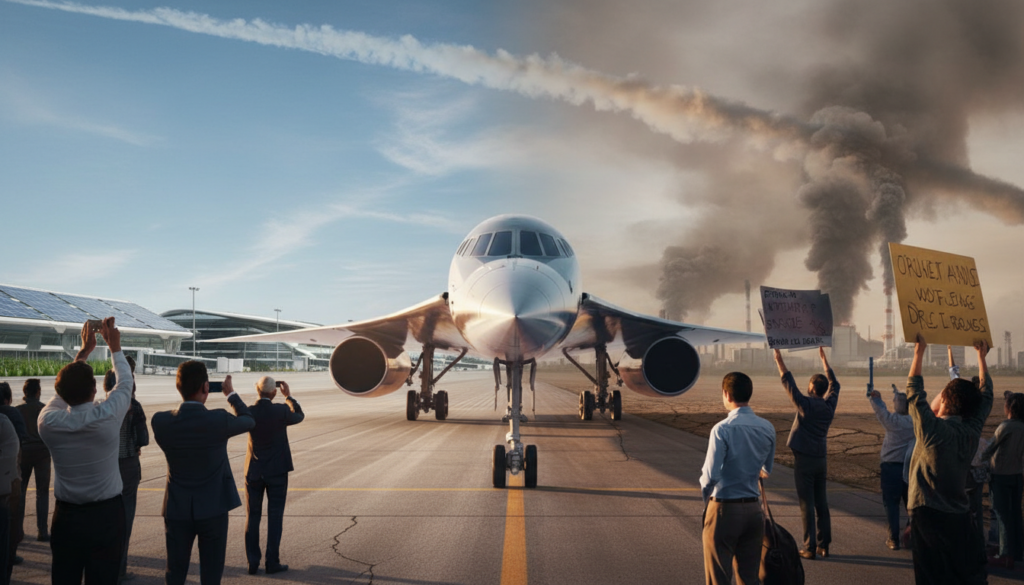
The spell is broken after that. The plane is still, like a museum piece. But the rumour is already out there: by 2026, a new Concorde or something very similar could be flying paying passengers.
This time, the question isn’t just “How fast can we go?””Can we still afford to go that fast?”
Dreams of supersonic speed are back, and they’re louder than ever.
If you take a long-haul flight today, you’ll feel the quiet frustration of things moving slowly. Kids slouch over tablets. Business travellers go through PowerPoint slides like they were beads on a rosary. In a world where you can get groceries in 15 minutes, nine hours to cross the Atlantic seems silly.

That’s what makes people want to see supersonic passenger planes come back. Companies in the US and Europe are racing to make planes that are like the Concorde: sleek fuselages, needle noses, and promises to cut travel time in half.
The pitch is simple: spend less time in the air and more time on the ground.
Boom Supersonic is a Colorado startup that has become the poster child for this new era. The XB-1, its prototype, has already gotten as much media attention as a famous divorce. The company says that its future airliner, Overture, could fly from London to New York in about 3.5 hours and start carrying passengers on some routes as soon as 2026.
Airlines are paying attention. United, American, and Japan Airlines have all shown interest by placing pre-orders or giving options. Images show beautiful white jets flying over the clouds, business-class cabins lit by soft light, and happy passengers sipping champagne over a very, very small Atlantic Ocean.
It looks good, is ready for Instagram, and is glossy.
The numbers, on the other hand, tell a much more complicated story than the pictures. Supersonic planes use more fuel per passenger-kilometer than regular jets. A lot more. Depending on speed, altitude, and configuration, early estimates for next-gen supersonics say that emissions will be two to five times higher per seat.
That goes against a time when the aviation industry is under a lot of pressure to cut emissions quickly. Every tonne of CO₂ is being counted by governments. Airlines say they will reach “net zero by 2050,” which is about as likely as someone promising to go to the gym next Monday.
If you put a Concorde-style jet back on the runway in 2026, you’re not just bringing back a legend. You’re setting off a cultural clash.
The new Concorde problem: speed or safety
The main idea behind this new push for supersonic travel is surprisingly easy to understand: cut down on speed without giving up the dream. Engineers are trying to make the plane fly a little slower than the original Concorde, make the aerodynamics better, and use engines that are more efficient.
Concorde flew at a speed of about Mach 2.04. The new generation is looking for speeds between Mach 1.7 and 1.8. That little difference makes things less draggy and hot, which makes fuel burn and maintenance a little more reasonable. The goal is to get a “good enough” boost in speed without going all the way into the physics red zone, which made Concorde a diva that used a lot of fuel.
It’s not rock ‘n’ roll anymore; it’s more like a Spotify playlist.
A lot of people get stuck in the same fantasy loop: they see “2026 supersonic” and think of getting on a plane like they would for a normal flight, but faster. Same price for tickets, same pair of jeans, and the same amount of carbon dioxide magically neutralised by some green tech buzzword.
The truth will be harder. Most travellers will probably not be able to afford tickets for a long time. Don’t think about cheap weekend trips; think about the cost of a premium cabin. The math for climate change will be even worse: a small group of people racing above the clouds, making emissions per passenger that more and more people see as morally wrong.
We’ve all been there: that moment when you see vacation photos from a friend’s fifth long-haul trip of the year and feel a little guilty. That feeling is going to get stronger with supersonic flights.
That’s where the emotional fight gets real. Supporters say that aviation has always been elitist: the rich fly first, then prices go down, technology scales, and everyone benefits. Critics say that this kind of thinking was common in a world where the air was seen as an endless dump.
Climate scientists are already saying that flying could use up a huge amount of the carbon budget we have left. Add high-emission supersonic jets on top, and the message is clear: speed is still more important than safety.
In the middle of this storm, there is one plain truth: Let’s be honest: no one really cancels a dream trip just because of a PDF about emissions.
But the mood of the public is changing, slowly, and supersonic glamour may be in the crosshairs.
How to deal with the hype without going crazy (or losing your values)
The 2026 Concorde revival doesn’t have to be overwhelming or depressing. Just separate the fantasy from the decision. Fantasy: watch the trailers, get goosebumps, and remember the old footage of Concorde taking off in a wall of flame and sound. Ask yourself three specific questions before you mentally book that first supersonic seat.
First question: how much does the climate really cost per passenger? Instead of just “20% more efficient than older designs” slogans, look for grams of CO₂ per passenger-kilometer. Question two: Is the fuel really sustainable, or is it just marketed that way? Question three: Who gets the most out of this technology: a small group of executives or a larger group of people and communities?
If those answers aren’t clear, the hype is doing more work than the engineering.
A lot of us make the same mistake: we let labels make us feel better about our morals. “Carbon-neutral ticket,” “sustainable aviation fuel,” and “offset included.” When we see a green badge, we relax and keep scrolling.
The truth is that offsets are still controversial, sustainable fuels are still hard to find, and supersonic jets make every weak point in the system worse. When you use more energy per passenger, every vague promise becomes harder to believe.
You don’t have to be a monster to love fast planes or sleek wings. You grew up in a culture that thought that speed was progress. You can feel the thrill and still question the bill.
That tension is starting to show up in boardrooms as well as in the comments. A tired half-smile from a climate activist I talked to recently summed it up well:
“We’re telling people to fly less, and at the same time, the industry says, ‘What if a small group could fly much faster?'” It’s like trying to put out a fire while someone puts a flamethrower on the roof.
A simple checklist can help anyone who wants to keep both their curiosity and their conscience alive:
Find out who is paying for the project and what climate promises they have kept so far.
What are the other options besides high-speed rail or regular flights? Compare possible supersonic routes to these.
Look for real numbers, not just words like “cleaner,” “greener,” or “responsible.”
Notice who isn’t telling their stories: people who live near flight paths, countries that are vulnerable to climate change, and younger generations.
Set your own red line: is there a level of emissions that you won’t go over, no matter how nice the plane is?
A new sign for a busy century
In 2026, supersonic passenger flight will be more than just a technical achievement. It will be a test of what kind of progress we can still accept after a hundred years of heat waves, fires, and floods. Concorde used to mean the courage of people, the idea that we could literally outrun the sunset. The reboot takes place in a world where people know that sunsets are getting hotter.
Some people will be happy to see that sharp white nose come back and feel like something big and hopeful has come back to life. Some people will look up at the contrails and see a luxury we can’t afford anymore, no matter how well it’s packaged.
There is a wide, uneasy middle ground between those two reactions. People who love technology but are afraid of the bill coming in their kids’ lifetime. People who still dream of fast horizons but feel the weight of the air getting thicker.
What we say about Concorde 2.0 at the dinner table, in parliament, and in comment threads will tell us as much about ourselves as any engine test. The plane might break the sound barrier again. The real question is if we’re ready to change the line between wonder and duty.
Main point Detail What the reader gets out of it
Supersonic is coming back.New planes based on Concorde want to start flying passengers across the Atlantic by 2026.Helps you guess how travel and news will change in just a few years
Costs of climate change are highProjected emissions per passenger could be two to five times higher than those of regular long-haul seats.Gives you a lot of information to think about when you compare interest to environmental impact
You can read through the hype.Focus on real emissions numbers, fuel sources, and who benefits the most. This lets you stay curious without giving up your values or common sense.