Jennifer Aniston may be celebrated for her iconic roles and signature hair, but her true powerhouse is her exceptionally strong core, described by her trainer as “bulletproof.” Coming from Dani Coleman, vice president of training at Pvolve, that praise carries serious weight.
At 56, Jennifer isn’t simply maintaining her fitness — she’s fully stepping into her strength-focused phase. Her journey didn’t happen overnight. She first discovered Pvolve years ago after suffering a back injury on a movie set and later officially partnered with the brand as an ambassador in 2023.
After more than four years of consistent training, the results speak for themselves. Jennifer credits the method for helping her stay consistent without burnout, even with a demanding schedule. The big question remains: how challenging is the workout really, and what does it involve? Let’s take a closer look.

Understanding the Pvolve Method
You might expect Jennifer Aniston’s routine to be packed with intense cardio and punishing gym sessions. That’s no longer the case. After feeling worn down by high-impact training, she shifted to a low-impact, functional movement system designed to build strength through three planes of motion.
The focus is on mobility, stability, and total-body strength — all without the joint stress associated with traditional high-impact workouts. What follows is a snapshot of the type of exercises included.
This routine features five carefully selected movements aimed at improving strength, power, and mobility. While some exercises use Pvolve equipment, resistance bands and Pilates-style tools are enough to follow along at home.
Squat to Overhead Press Using a Band
Targets: Glutes, quads, shoulders, core.
This foundational Pvolve movement activates multiple muscle groups simultaneously. The resistance band maintains constant tension, making the exercise effective from start to finish.
Stand with feet hip-width apart, anchoring the band beneath your feet and holding it at shoulder height. Lower into a squat with your chest lifted and knees aligned. As you stand, press the band overhead until your arms fully extend, then return slowly to the starting position.
Why it works: As the band stretches, resistance increases, forcing your muscles — especially the shoulders and core — to work harder. It’s a time-efficient, full-body exercise that also elevates your heart rate.
Inner Thigh Glide with Overhead Oblique Reach
Targets: Inner thighs, glutes, obliques.
This smooth, controlled movement may look effortless, but it activates deep stabilizing muscles while testing balance and coordination — a hallmark of the Pvolve approach.
Place your right toes on a glider or towel, keeping your left foot grounded. Slowly slide your right leg out to the side, maintaining square hips and a tight core. Once extended, reach your right arm overhead toward the opposite side to engage your obliques. Move slowly and with control.
Why it works: The lateral glide targets the inner thighs, while the overhead reach strengthens the core, helping build stability through the hips and waist.
Standing Core Exercise with Resistance Band
Targets: Core, obliques, glutes, stabilizers.
This standing movement replaces floor-based ab work, using constant band tension to challenge your deep core and balance without crunches.
Hold the band at chest height with arms extended. Step your right leg slightly forward. Slowly lift your right leg as you rotate your torso away from the anchor point, pulling the band across your body. Return to center with control, completing all reps on one side before switching.

Why it works: As an anti-rotation exercise, it trains the core to resist movement, improving posture, balance, and functional strength.
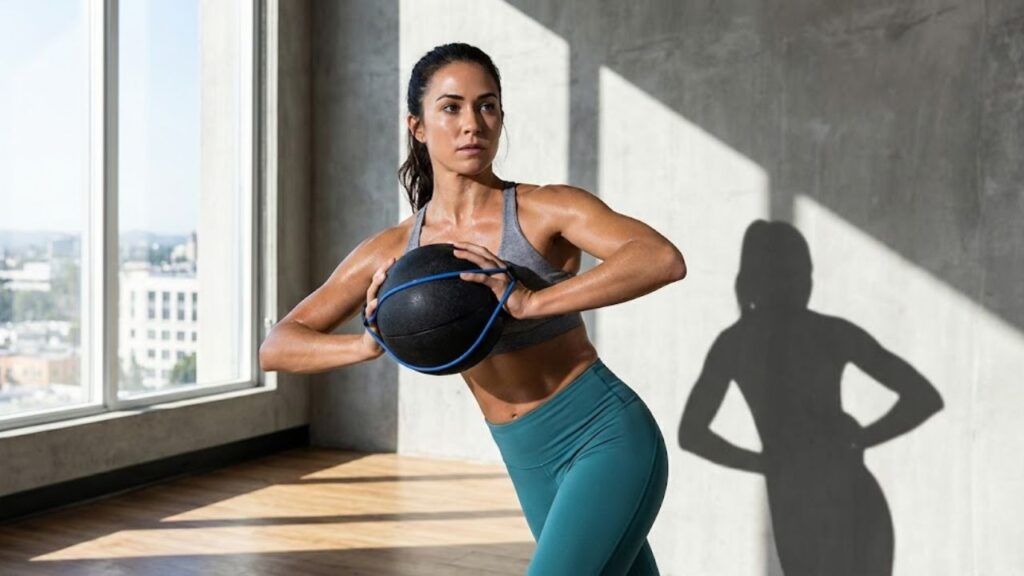
Abdominal Twist with Pilates Ball
Targets: Core, obliques, transverse abdominis.
This exercise updates the traditional Russian twist with a Pilates-inspired twist that emphasizes control and precision.
Sit upright with bent knees and place a Pilates ball behind your lower back. Lean back slightly, engaging your core while allowing the ball to support your spine. Lift your right leg and rotate your torso toward it, then return to center. Repeat on the opposite side, keeping movements slow and deliberate.
Why it works: The controlled rotation activates the deep core muscles, helping shape the waist and strengthen obliques.
Plank Stability Challenge with Ball
Targets: Core, shoulders, glutes.
This final movement transforms a traditional plank into a full-body stability test, demanding both strength and focus.
Begin in a high plank with hands placed on a Pilates or stability ball and feet hip-width apart. Engage your core and glutes to steady the ball. Once stable, lift your right foot, bend the knee, and draw it toward your chest. Return to plank and repeat on the left.
Why it works: The unstable surface forces your stabilizing muscles to work overtime, delivering a low-impact yet intense finisher that activates the entire body.
Key Benefits of This Routine
Far removed from the “no pain, no gain” mindset, this routine takes a smarter, joint-friendly approach. Designed to be completed in around 30 minutes, it’s ideal for busy schedules.
The five-move sequence proves that low-impact workouts can still deliver a deep burn, improved strength, and visible muscle tone, particularly in the core, glutes, and legs.
Final Takeaway
Jennifer Aniston’s workout may appear slow and controlled, but it delivers a serious challenge. Each precise movement and sustained resistance keeps your entire body fully engaged.
It’s an efficient way to build lasting strength and stability without the strain of high-impact training. The routine encourages focus, control, and intentional movement — qualities that make the workout feel both empowering and effective.
The takeaway is clear: results don’t require pushing harder, just working smarter. By slowing down and engaging every muscle, this method supports long-term strength, confidence, and longevity.