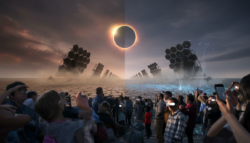
No one thought it would get that dark at first. People looked at their phones to see what time it was, looked up at the sky, and then shrugged. The streets were still filled with midday light, kids were still yelling in the playgrounds, and delivery workers were still weaving through traffic as usual. Then, almost right away, the air changed. The birds stopped singing. A lost dog lay down and looked at the horizon. Shadows started to stretch in a strange, slanted way that didn’t match the time of day.
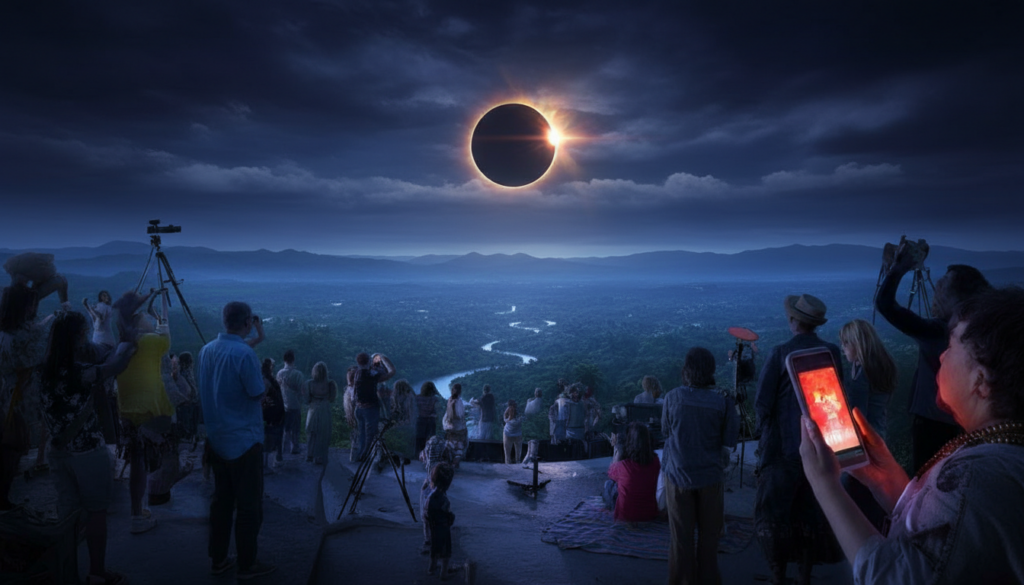
There was a low murmur coming from balconies, rooftops, crowded fields, and city squares all over the world. Some people held up eclipse glasses and cheered. Some people held prayer beads or phones with anxious news alerts.
Day kept fading away, like someone was turning off a cosmic switch.
And then, for a few breathless minutes, it was night instead of noon.
When the Sun blinks and the world stops breathing
Life will stop along the path of totality, which is a thin line that will cross oceans, deserts, and megacities. At lunch, the lights in office buildings will come on. Street lights will turn on early. It will be like an invisible bell rang, and farmers will watch cows walk back to the barn.
The Moon will slide right in front of the Sun and stay there in a narrow corridor that is a few hundred kilometres wide. The sky will turn a dark, scary blue-black. Stars and planets will peek through, as if they weren’t ready for it. For a few long minutes, the world you know will seem a little off, like a movie scene where the colours are just a little too far off.
During the last long eclipse in 2017, which happened over the United States, traffic stopped on highways as drivers pulled over, leaned against their cars, and just stared. Parents put kids on their shoulders. In small Nebraska towns with only 800 people on a normal day, tens of thousands of people camped in fields just to stand under that thin dark track.
Astronomers say that this time, the total phase will last even longer in some places, making it the **longest total solar eclipse of this century**. In some places, the sun will set for more than six minutes. That’s long enough for the temperature to drop, for bugs to change their habits, and for the brain to quietly ask, “Are we sure this is safe?”
Eclipses have always made us feel both amazed and scared. Old Chinese records tell of drummers beating drums in a panic to scare away a “sky dragon” that was eating the Sun. In some parts of South Asia, families would close their curtains and fast because they thought that food cooked during an eclipse would bring bad luck. At the same time, modern eclipse chasers spend months figuring out how to get to the best places to see the eclipse and how many clouds there will be. They treat these few minutes like a once-in-a-lifetime concert.
There is nothing mystical going on; the Moon’s orbit and the Sun’s size fit together perfectly in a piece of cosmic geometry. The emotional reality is different. When the world suddenly goes dark at noon, lunch breaks and spreadsheets seem very small.
How to get through the longest eclipse of the century without hurting your eyes or your nerves
A simple ritual can turn this scary headline into something you can handle. You need the right eclipse glasses or a handheld viewer with certified solar filters first. Not your phone’s camera, not sunglasses, and not tinted film. Real gear that keeps out almost all of the Sun’s harsh light.
Then, pick your place. A park, a rooftop, an open field or even a quiet side street will work. Come early. Take a look around. Who’s coming together? Families with picnic blankets, couples with tripods, and people who watch the sky alone with notebooks. Join that small, temporary group of people who said, “I’m not going to miss this one.”
During eclipses, people often do two risky things. First, they look at the Sun without protection, especially during the partial phases, because they think, “It doesn’t hurt, so it must be fine.” Second, they scroll through social media instead of looking up, thinking that the livestream will be enough.
Let’s be honest: not everyone reads the safety leaflet that comes with eclipse glasses every time. But retinal burns don’t care how excited or distracted you are. The safest thing to do is to keep your eyes covered whenever the Sun is shining, and to leave them uncovered only during the short time when the Sun is completely covered. If you have doubts, look away, take a breath, and start over.
As the date gets closer, the emotional temperature will rise just like the real one does when the Moon is in the sky. News feeds will go back and forth between cosmic awe and apocalyptic spin. One neighbour will buy a lot of candles “just in case.” Another will plan a party on the street.
Astrophysicist Lina Mercado says, “An eclipse doesn’t mean bad things will happen.” It shows us. It shows who looks for science, who looks for superstition, and who just reaches out to someone.
Look for ISO 12312-2 labelling on certified eclipse glasses and only buy them from reputable science or astronomy stores.
Alternative viewing: You can safely see the Sun’s crescent on the ground with a simple cardboard pinhole projector.
Talk to kids, worried family members, or doubtful friends a few days before to get ready emotionally. Clear information calms the mind.
Plan B: Clouds happen. Before you go outside to feel the sudden dusk, decide if you’ll watch a nearby livestream.
After the eclipse, take 30 seconds to notice how your body feels when the sun comes back. That’s also part of the show.
A rare mirror held up to people between superstition and science
The Earth won’t just be in the shadow of this eclipse. It will cast one over our feeds, our group chats, and our dinner table talks. Some people will post maps and countdowns that make them breathless. Some people will quietly dread the day, not really knowing why, and will respond with jokes or denial. And a lot of people will see it as something that happens, like the weather, and use it as an excuse to leave work five minutes early.
The photos of the weird halo around the corona or the strange twilight at noon may not be what stays with you. It could be who you watched it with that you remember. How the crowd got quiet. The way the birds stopped moving. The way that, for once, almost everyone’s attention went in the same direction.
The truth is that in a world that is loud and broken, a sky event that crosses borders without asking for visas is more rare than the eclipse itself.
No matter how you see it—through a telescope, a cardboard projector, a whispered prayer, or a doubtful shrug—this long blink of the Sun will leave a mark. Not in history books, but in that secret place in your mind where you keep the days when normal life broke down for a short time and you saw, literally, your place in the shadow of something bigger.
Main point Detail: What the reader gets out of it
Watching the eclipse safelyDuring all partial phases, use certified eclipse glasses or other safe methods.Keeps your eyes safe while still letting you see the show
Handling fear and excitementRead the news, but also read clear science and have calm conversations.Helps you support friends or family who are more worried and makes you less anxious.
Making it a shared experienceChoose a place to watch, invite others, and give yourself time before and after.Turns a rare event in the sky into a memory that will last a lifetime