
As soon as the light changed, the crowd started to whisper. It wasn’t dark yet, but it wasn’t day either. It was like the world was under smoked glass. In southern Texas, a football pitch was turned into a ‘eclipse village’. Kids in cardboard glasses lay on picnic blankets, pastors held hands with their flocks and a group of astronomy students fought over a mess of laptops and telescopes. The air got cooler quickly. Birds flew in circles and then stopped singing, as if someone had turned off the music. A woman close to the 40-yard line began to cry, but she didn’t seem to know why.
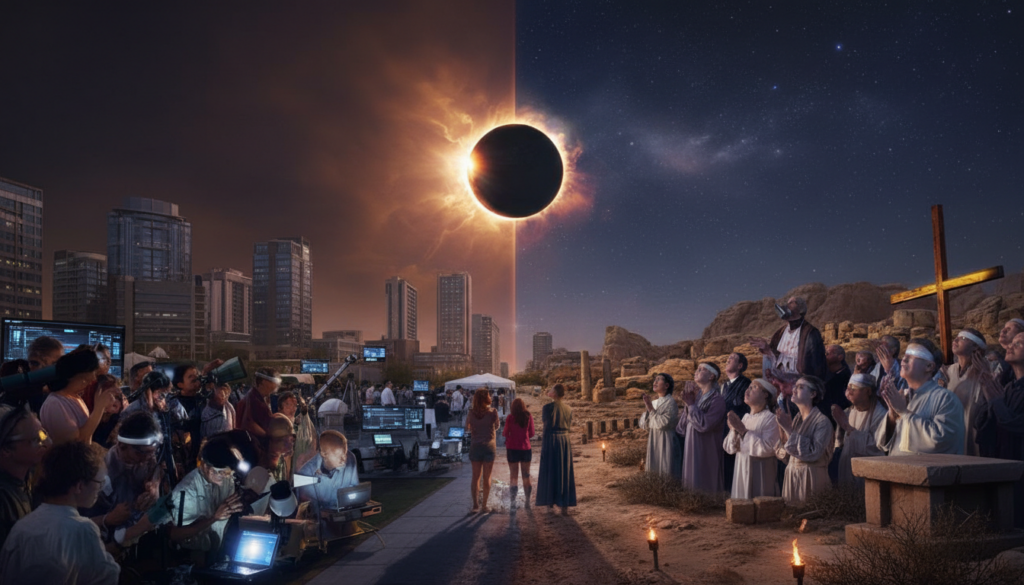
When the Moon finally ate the Sun, thousands of small towns and big cities went dark for six minutes.
Is this the biggest eclipse of the century or a giant Rorschach test?
Astronomers had been calling it the “eclipse of the century” for months. The path of totality cut across the Americas like a planned stroke of ink, promising the longest period of darkness in the middle of the day that anyone alive had ever seen. In some places, six full minutes. Almost half of a continent got ready for traffic jams on the highways and record-breaking posts on social media.
It was a predictable alignment of the stars based on equations and orbital charts. It felt more like the end of the world on the ground, with snacks and phone chargers.
The high school gym in a small town in Ohio became a temporary safe haven. There were folding chairs, a portable cross, and a quickly printed sign that said “He Comes In The Clouds.” For weeks, pastor-led livestreams had been going around, promising a “sign of the times” in the sky. The local science department paid for solar telescopes and DIY eclipse viewers to be set up in the community college parking lot on the other side of town.
One side gave out prayer cards and Bibles. The other side gave out pamphlets on solar physics and eclipse glasses. When it got dark, the cheering from the college parking lot mixed with the hymn singing from the gym, making a strange, wavering chorus. It sounded great. It sounded tense.
The eclipse turned into a mirror instead of a thing. For astronomers, those six minutes were a rare chance to see the corona and test ideas about plasma temperatures and magnetic fields. Some pastors and online prophets thought that the same six minutes were a warning from the universe, a divine highlighter that moved through time.
The argument wasn’t really about the Moon moving in front of the Sun. It was about who gets to tell the story of what it means. Is an event that happens every time still a sign from God? Can something be both a miracle and a maths problem at the same time? When both faith and science say the sky is theirs, shadows fall on people as well as on the ground.
From lawn chairs to live-streamed prophecies
In the weeks before totality, the best preparations looked almost too soft. Parents put tin foil over the windows in their kids’ rooms so they could sleep after long car rides. City workers painted new lines on country roads, hoping that people who had never heard of these towns before would drive through. In case of no vacancy, motel owners put up signs.
But on YouTube and TikTok, a different kind of preparation took over: grainy Bible charts, survival lists, and rapture timelines. Some people made the eclipse seem like a countdown to disaster. Some people saw it as a once-in-a-lifetime chance to see God’s handwriting in the sky. There was a sense of a decision that needed to be made in the feed, along with reminders to wear sunscreen and travel tips.
Ernesto, a fisherman from a coastal village in Mexico that was on the path of totality, put two plastic lawn chairs on his roof. He had borrowed eclipse glasses from a teacher who wouldn’t stop talking about the maths behind it all. “Just in case,” his wife said with a shrug, “I put a small statue of the Virgin in a corner of the roof.”
Ernesto told me that the bay got quiet in a way he had only heard before hurricanes when the shadow finally came. He saw the Sun go behind the dark circle and felt his heart race for no reason at all. He said later, “The teacher says it’s all numbers.” “The priest says it’s a sign.” I just know that I’ve never seen the world like that. One sky. Three reasons. There is no clear winner.
The logic behind the eclipse is clear: the Moon moves right between the Earth and the Sun, blocking the light and making the day darker. We can predict it hundreds of years in advance. We know how fast the shadow moves across the surface of the planet. The information is amazing, accurate, and even a little cold.
Something older and more fragile runs into that cold accuracy. People who get their stories from holy books full of signs in the sky might think that saying “this is just physics” is rude or even cruel. Scientists who have spent their whole careers fighting false information think it is reckless and dangerous to see a natural event rebranded as a sign of the end times. *Same darkness, different fears.* When two worldviews feel threatened, even a moment of awe can turn into a line in the sand.

Is there a middle ground between the telescope and the pulpit?
On the morning of the eclipse, I saw a young astrophysicist roll her telescope onto a church lawn in Arkansas. A pastor asked her to come so that his church could “see the marvel and the maths.” She set up a projection screen, showed the kids in their Sunday best how the filters worked, and then ran a quick demo.
Then she went into the sanctuary and sat down for the special “Eclipse Service,” with her notebook under her arm. One eye on the clock and one on the hymnal. When totality came, the scientist and the people in the church went outside together. Heads tilted back almost perfectly at the same time.
But this kind of crossing the line is not common. We’ve all been there, that moment when you realise that people you care about are completely convinced of something that makes you very uncomfortable. A cousin gets into doomsday channels and starts hoarding canned food. A teacher we all love calls the whole thing “mass hysteria” and “clickbait for sky nerds.” It’s always tempting to roll your eyes or preach. Both responses closed the door.
Questions are more helpful. Not like in a courtroom, but soft ones. “How can you believe that?” and “What did it feel like when the light changed?” are very different questions. You don’t have to agree to compare goosebumps. Honestly, no one does this every day. We always go back to our camps, our feeds, and our favourite experts. In times like an eclipse, gently going against the default might be the most brave thing to do.
During totality in Kentucky, an older woman stood between two groups that had accidentally mixed up: a church bus group and a university astronomy club. There was one grandchild on each “side.” When the diamond ring effect got stronger and the crowd gasped, she whispered, almost to herself:
“Perhaps God made the rules, and the rules made this moment.”
I remembered her offhand line because it didn’t ask anyone to give up. It just asked for a bigger frame.
The scene around her looked like a live diagram of different positions:
Those who saw “pure science” saw only an eclipse that was going to happen.
People who saw **pure miracle**: a message from God written in the sky.
People who held both lightly: one hand had curiosity and the other had prayer beads.
People who were lost and didn’t know what to believe, only that the darkness made them cry.
There is room for doubt, awe, and argument that doesn’t turn into war between the telescope and the pulpit. The question is if we want to be in that shared, uncomfortable half-light.
Six minutes that will last a long time
The crowd let out a breath when the Sun’s thin crescent came back and the birds started to sing. Cars slowly got back on the highways, ice chests clinked, and vendors folded up their cardboard displays. The eclipse was just getting started online, though. Millions of people watched clips of totality in just a few hours. There were also angry threads calling the whole thing a “spiritual psy-op” or, on the other hand, making fun of believers for being gullible and dangerous.
An eclipse has always been a way to see how a culture deals with fear and awe. This time, the test happened on live streams, conspiracy channels, science podcasts, and private group chats. Some families came home with funny stories and memories about the dark. Others came home more divided than when they left, armed with new “proof” that the other side had lost their minds.
Main point Detail: What the reader gets out of it
A shared sense of awe is weakEclipses bring people together for rare experiences that can quickly turn into fights.Helps you see when the feeling of wonder turns into a fight you don’t want.
Stories shape the sky. Science and faith tell different stories about the same light and darkness.Asks you to think about which story you’re living in and if it still fits how you see the world.
There is a middle ground.People are already building bridges, like using telescopes on church lawns and having quiet conversations with family.Provides you with specific words and pictures to use if you want to calm things down in your own group.