
France-based VINCI Group has taken a decisive step in the Pacific construction landscape by securing a major agreement in New Zealand. The move subtly reshapes competitive dynamics across a region rapidly upgrading its infrastructure under mounting climate risks and population growth pressures.
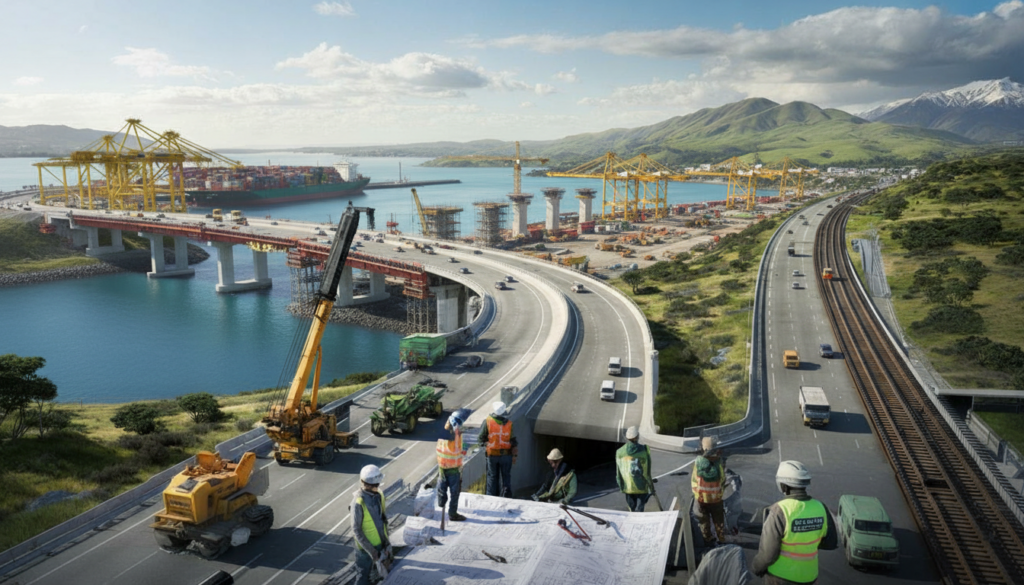
€183 Million Investment in a Century-Old New Zealand Leader
VINCI has agreed to purchase Fletcher Construction, one of New Zealand’s most established infrastructure and building companies, for approximately €183 million. This acquisition reflects a broader regional strategy rather than a single-contract expansion.
Established in 1909, Fletcher Construction employs around 2,300 professionals and produces nearly €630 million in annual revenue within New Zealand. The company delivers large-scale civil engineering works, roads, bridges, commercial buildings, and infrastructure services, while maintaining operations across multiple Pacific islands.

Through this acquisition, VINCI secures not only active projects but also more than a century of operational expertise and institutional relationships within New Zealand’s public and private sectors.
Strategic Value of Local Experience and Government Links
Fletcher Construction has delivered major transport corridors, complex public infrastructure, and projects in remote or high-risk environments, including seismic zones and flood-prone regions. Such expertise is critical in a country exposed to earthquakes and increasingly severe weather events.
By integrating Fletcher into its portfolio, VINCI gains immediate access to long-standing partnerships with government agencies, regional councils, and private stakeholders—connections that would otherwise require decades to establish.
New Zealand as a Hub for Climate-Resilient Infrastructure
New Zealand’s infrastructure system is entering a significant renewal phase. Aging transport networks, stressed rail and port systems, and vulnerable flood-control structures require modernization in line with stricter resilience and environmental standards following recent cyclones.
Key national priorities include:
– Strengthening transport corridors linking urban centers and export hubs
– Expanding port capacity for larger vessels and evolving trade routes
– Upgrading rail networks to reduce freight dependence on roads
– Reinforcing dams, flood barriers, and stormwater systems
VINCI already controls HEB Construction in New Zealand, and with Fletcher joining its portfolio, combined revenue in the country had surpassed €900 million even before this transaction. The acquisition enhances VINCI’s engineering capacity, equipment resources, and skilled workforce, transforming New Zealand into a core operational base in the Pacific.
Australia’s Parallel Infrastructure Momentum
Across the Tasman Sea, Australia is experiencing its own infrastructure expansion driven by urban density and congestion in major metropolitan areas. Through its subsidiary Seymour Whyte, VINCI has secured three significant contracts totaling approximately €604 million.
Major Australian Projects Strengthening Long-Term Presence
– Eastern Freeway Hoddle–Burke, Melbourne: A joint initiative valued at about €450 million, focused on increasing traffic capacity, expanding bus lanes, adding cycling and pedestrian paths, and installing sound barriers. Completion is projected for 2028.
– Sydney Urban Road Upgrade: A €154 million design-and-build contract for Transport for New South Wales aimed at reducing congestion and enhancing safety while supporting active transport.
– Lower Molonglo Wastewater Treatment Upgrade, Canberra: A ten-year modernization program conducted with VINCI Construction Grands Projets for Icon Water, designed to increase capacity and improve environmental performance.
These projects provide VINCI with a stable, multi-year workload aligned with Australia’s objectives to modernize urban mobility and environmental systems.
Innovation and Low-Carbon Engineering in Oceania
VINCI’s strategy extends beyond acquisitions. Through its innovation platform Leonard, the group integrates digital monitoring tools, predictive maintenance systems, and low-carbon materials into projects across Australia and New Zealand.
Practical applications include:
– Deploying sensors on infrastructure to monitor structural health
– Using predictive analytics to anticipate maintenance needs
– Reducing heavy vehicle site traffic through optimized logistics
– Testing lower-emission concrete solutions compliant with seismic codes

These capabilities strengthen VINCI’s competitive position when bidding for long-term infrastructure frameworks.
Global Workforce Distribution and Strategic Diversification
VINCI employs more than 280,000 people worldwide and operates in over 120 countries. While Europe remains its historic base, the company is steadily expanding in faster-growing markets.
| Region | Estimated Workforce (2022–2026) | Percentage of Global Total | Main Operations |
|---|---|---|---|
| Europe (Including France) | Approx. 200,000 | Nearly 71% | Transport concessions, railway systems, airports, energy projects, infrastructure construction |
| France | Approx. 102,000 | Around 37% | Highway concessions, rail networks, major urban development projects |
| Americas | Approx. 50,000 | Nearly 18% | Airport management, highway projects, civil engineering works |
| Africa – Middle East | Approx. 16,000 | About 6% | Port development, road infrastructure, renewable energy facilities |
| Asia-Pacific / Oceania | 15,000+ (Growing) | Approx. 6%+ | Airport operations, highway expansion, large-scale construction projects |
| Global Total | Over 280,000 | 100% | Operations spanning 120+ countries worldwide |
Recent acquisitions, including Cobra IS and Fletcher Construction, are increasing the proportion of employees based outside Europe, reducing reliance on mature markets and spreading geographic risk.
Why Oceania Holds Strategic Importance
Despite its geographic distance from Europe, Oceania offers stable governance, transparent procurement systems, and robust environmental regulations—conditions favorable to long-term infrastructure investors.
Governments in Australia and New Zealand prioritize contractors capable of delivering complex builds while operating assets safely over extended periods. This aligns with VINCI’s experience managing toll roads, airports, and water utilities globally.
However, challenges persist: rising labor and material costs, stricter environmental compliance, and climate-related disruptions such as floods, bushfires, and coastal erosion.
Outlook for the Next Decade
The coming decade is likely to feature sustained investment in adaptation-focused infrastructure, including flood mitigation, coastal protection, slope stabilization, and decentralized energy systems. Companies capable of merging traditional engineering with data-driven maintenance and low-carbon construction methods are well positioned to benefit.
Understanding Key Industry Terms
Design–Build Contracts: A model where a single contractor handles both project design and construction, accelerating timelines but concentrating risk.
Infrastructure Resilience: The capacity of infrastructure assets to withstand or rapidly recover from disruptions such as earthquakes or severe storms.
Maintenance-as-a-Service: A performance-based model where contractors maintain infrastructure using predictive data to prevent failures before they occur.
If VINCI successfully integrates Fletcher Construction while maintaining cost control and operational efficiency across New Zealand and Australia, Oceania could evolve into one of its most dynamic global growth regions, influencing infrastructure models far beyond the Pacific.