
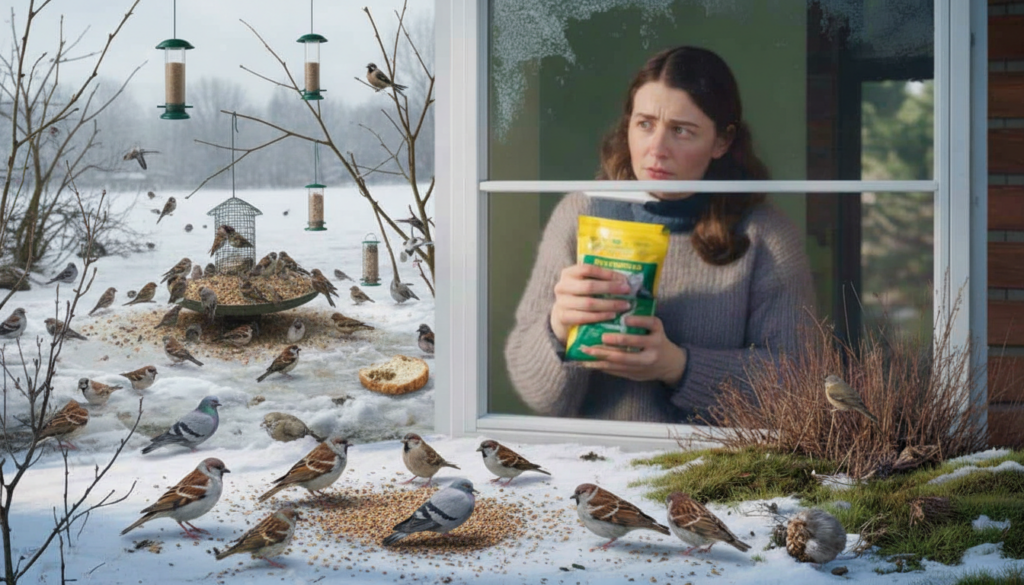
The first blackbird lands before the kettle has even boiled. One hop, two hops, a little explosion of snow dust, and he’s under the feeder, tilting his head like he owns the place. Someone in a wool jumper behind the double glazing feels a rush of love and reaches for the seed tub. The scene is cosy, like a movie: hot tea, a frosted garden, and little hearts that depend on our kindness.
Then another bird comes. Then a third one. A robin tries to get in and is chased away. The air is full of panic from birds. Friends post pictures of “their” birds and bags of “high-energy” winter mixes on social media, and likes and heart emojis flutter like digital wings.
No one is thinking about weak genes or evolution that goes wrong.
But that’s exactly what some scientists are starting to worry about.
When helping looks a lot like getting in the way
If you spend a whole winter day watching a busy bird table, the pattern will be hard to miss. The brave ones eat first and eat more. The shy, slower birds just fly around in circles, wasting calories they don’t need. It starts to look less like a rescue mission and more like a loud, feathered lottery.
Researchers all over Europe have been keeping an eye on this quiet change for years. Certain species are doing very well in gardens where there are a lot of feeders. Some people are losing weight or changing their habits completely. It’s not just about staying alive anymore. It’s about who gets to pass on their traits in a landscape we’ve quietly changed.
The story of the British great tit, which is now well-known in scientific circles for evolving around backyard buffets, is a good example. A long-term study looked at thousands of birds in the UK and the Netherlands. Scientists found something interesting in places where birds were fed a lot in the winter: birds with slightly longer beaks were doing better. They got more food at plastic dispensers, lived through more winters, and raised more chicks.
Those longer beaks started to spread through the population through genetics. Not in a dramatic sci-fi way, but slowly, season after season, seed by seed. At the same time, birds that weren’t used to eating at human-style food stations were pushed to the edges. Hanging a feeder, which seemed like a harmless thing to do, had quietly become a selective pressure.
This is the part that some conservationists are worried about. We think we’re just helping birds get through the cold. In practice, we’re shaping natural selection to favour species that aren’t too shy to eat 40cm from a kitchen window and can handle plastic tubes and metal perches. We are also putting birds in tight groups, which can speed up the spread of disease.
Avian pox, salmonella, and trichomonosis are names that sound medical until you see a finch sitting still and puffed up under a feeder, too weak to fly. Pathogens are also concentrated when food is.
That’s where the question starts to hurt: are we saving them or giving them a crutch they can never get rid of?
A more honest way to care is to feed without getting weaker.
You can help winter birds in a quieter, less Instagrammable way by teaching your garden how to feed them on its own. That means planting native shrubs that bear fruit in the late autumn, letting seed heads stay through the winter, and being okay with a little more “mess” than the tidy-garden books say.
Hawthorn, rowan, dog rose, ivy berries, teasel, and sunflower left to dry on the stem make up a natural buffet that doesn’t cause a feeding frenzy in one small area. Birds spread out, move through hedges, and stay fit and alert. They still have to work, but not on concrete or bare lawns.
Yes, it takes longer than buying a big plastic feeder. But it makes people stronger instead of making them dependent.
The way you hang feeders makes a big difference if you’re going to do it, and most of us will because it’s so much fun. Change where you put them every year so that droppings and germs don’t build up in one area of soil. Don’t just clean them when you remember; clean them often with hot water and a mild disinfectant. Let’s be honest: no one really does this every day.
Instead of one kind of seed that never ends, give people a choice. When the weather is bad, give them short bursts of rich food. When the weather gets better, give them lighter meals. The goal isn’t to have a bird canteen open all the time from October to April. The goal is to have a safety net that doesn’t take the place of wild foraging.
There is also a social pressure side that doesn’t get talked about enough. We’ve all had that moment when you see your neighbor’s fancy feeding station and your small tray suddenly feels like it’s not getting enough attention. It’s easy to overfeed, as if more seed means more love. *Sometimes, real care means taking a step back instead of stepping in harder.
Dr. Helena Ruiz, an ornithologist, says it plainly: “Every time we change winter mortality, we change evolution.” That’s not always a bad thing, but we should at least admit that we’re doing it on purpose.
To stop the spread of disease, clean feeders every week during cold, wet weather.
Don’t give birds cheap bread or salty leftovers that are bad for their organs. Instead, give them good seed.
Give birds a place to hide, like thick bushes or hedges that they can fly to quickly.
Let some “rough” corners with leaves, seed heads, and dead stems be for bugs.
Stop feeding birds in mild winters so they don’t forget how to find food on their own.
The question that makes every bird table uncomfortable
It’s hard to unsee winter feeding once you’ve seen it as a kind of quiet genetic engineering. That doesn’t mean you have to take down all the feeders by tomorrow morning. It does make us more honest about what we’re doing and why.
The blackbird at the window may not just be worth saving one life from a cold night; it may also be a sign of a thin thread of relationship. We want that connection. We want to know that our small plot of land in the city still belongs to something bigger than us.
So the challenge gets a little more complicated. How can we keep that thread going without making birds permanent welfare clients? How do we accept that some people will die in the winter? This harsh filter is also what keeps populations strong.
There isn’t a simple rule that works for every street, every latitude, or every species. A mountain village that has been buried in snow for months is not the same as a mild suburban garden where bugs still crawl in January. One neighbourhood might really help keep local species from going extinct, while another might just be making big groups of the toughest generalists.
The science is showing us less of a judgement and more of a mirror that makes us uncomfortable. Birds change shape when you feed them. It affects their beaks, how brave they are, where they migrate, and even how likely they are to get sick. The question is no longer “Does this help?” but “What kind of bird world are we quietly building?”
You can feel that tension every time you fill the tray. A small heart beating quickly in your rose bush and a bag of industrial seed in your hand. A moment of soft-eyed love, backed up by hard maths from evolution.
Maybe the next step isn’t to stop feeding, but to tell the whole truth while we do it. To share not only beautiful pictures, but also the doubts and changes, the dirt under your nails from planting hedges, and the empty space on days when you let birds take care of themselves.
The winter sky above your garden is filled with flocks that were formed by decisions made long ago. You are writing the next chapter with every handful of seeds you take or every time you don’t reach for them.

| Key point | Detail | Value for the reader |
|---|---|---|
| Winter feeding changes evolution | Selective pressure favors bolder birds and those adapted to feeders | Helps you see your feeder as a long-term influence, not just a kind gesture |
| Hygiene and moderation reduce harm | Rotating, cleaning, and pausing feeders lowers disease and dependence | Lets you keep the pleasure of feeding while limiting unintended damage |
| Wild habitat beats plastic feeders | Native plants, cover, and “messy” corners support natural foraging | Builds a garden that nourishes birds year-round, even when you’re not home |
Question 1: Are we really making birds weaker by feeding them in the winter?
Studies show that constant, concentrated feeding can help some traits (like being bold or having beaks that are easy to feed) and species, while others lose ground. It doesn’t kill all birds, but it does change the course of evolution.
Question 2: Should I stop using bird feeders altogether?
Not always. Instead of a complete ban, many scientists want smarter, cleaner, and more seasonal feeding. The best way to go is usually to combine small feeders with better habitat.
Question 3: How often do I need to clean my bird feeders?
In the winter or when it’s wet, once a week is a good goal. If you see sick or dead birds, do it right away. Before filling it up again, use hot water, scrub it well, and let everything dry.
Question 4: What can help wild birds more than feeders?
Planting native trees and shrubs, keeping seed heads and leaves over the winter, not using pesticides, and giving water all year round. These changes also help insects, which are an important food source for birds.
Question 5: Is it really that bad to feed bread or scraps from the kitchen?
Birds can get full from bread, salty foods, and processed scraps, but they don’t get the nutrients they need, which can hurt their health over time. If you feed them, make sure to give them good seeds, nuts, fat balls without plastic nets, and mixes that are right for their species.