
The dentist leans over, turns on the light, and frowns at the back of your gums. There’s a small area of redness that you haven’t noticed before, and it bleeds a little when he pokes it. You nod as he reminds you to floss between the cotton rolls. You promise to “do better,” then leave while scrolling through your phone, thinking about emails, dinner, and anything but your mouth.
Your hand shakes when you hold a coffee cup years later. Your sleep is strange; it’s full of vivid dreams and not very restful. A neurologist tells you to get scans and talks softly about Parkinson’s. No one in your family has it. You don’t smoke, you walk, and you eat your veggies.
Then, out of nowhere, new research comes out that says a common mouth bacterium may have been slowly changing your brain all along.
When a gum bug starts to talk to the brain
People have long thought of Parkinson’s as a disease that happens to unlucky brains and old people. Shaking, stiffness, and that slow shuffle that is so typical. But the story that scientists are putting together is stranger and much more personal. It doesn’t start in the skull; it starts in the dark corners of the mouth, where plaque hides between teeth and under the gumline.

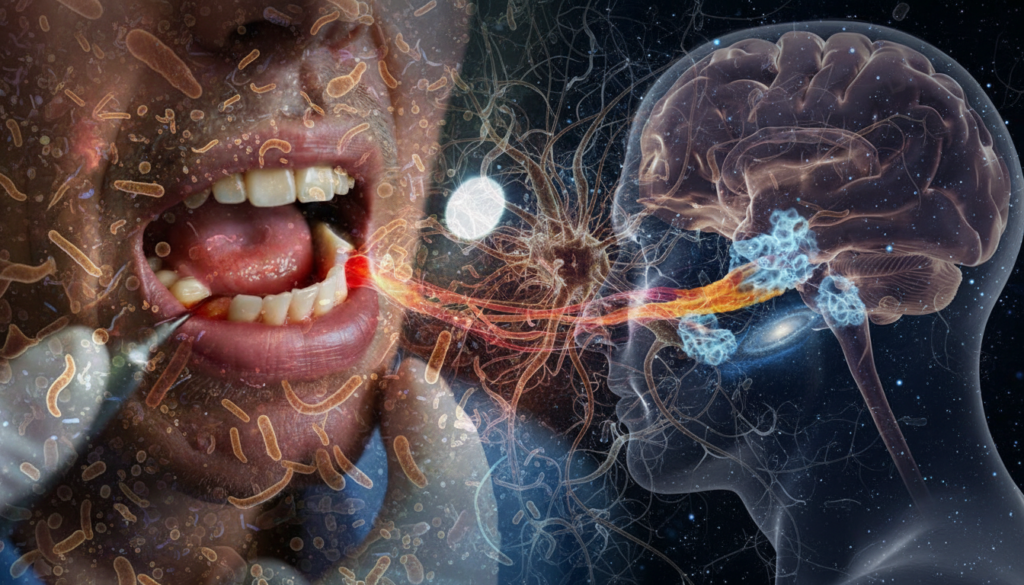
Researchers are keeping an eye on one suspect in particular: Porphyromonas gingivalis, which is a major cause of chronic gum disease. This bacteria doesn’t just make your gums hurt; it also releases poisonous enzymes that can get into your blood and maybe even your brain. The idea sounds like something out of science fiction, but the proof is piling up. Also, it makes us think differently about risk.
A recent study found signs of oral bacteria and their inflammatory footprints in the brains of people who died with Parkinson’s disease. Other groups have been following large groups of adults for many years and keep seeing the same pattern: people who have severe, long-lasting gum disease are more likely to get neurodegenerative diseases later on. Not just by a little, but by a big enough margin that it gets the attention of epidemiologists.
Imagine a 55-year-old man who has had bleeding gums for ten years and only brushes once a day “when he remembers.” He doesn’t listen to the dental hygienist’s warnings and cancels cleanings when he gets busy at work. Twenty years later, he’s in a different office, and this time he’s having trouble buttoning his shirt while a neurologist checks his reflexes. Researchers are trying to map this slow, quiet bridge between the mouth and the brain.
What they are finding is a kind of highway that makes things inflamed. Small tears in the gums can let bacteria from the mouth into the blood. After that, they might be able to get past protective barriers and leave behind inflammatory molecules and misfolded proteins like alpha-synuclein, which is the main cause of Parkinson’s disease. Over time, those proteins can stick together, messing up the brain’s wiring in places that control movement, smell, and even sleep.
This doesn’t mean that having a dirty toothbrush “causes” Parkinson’s. Genetics, toxins, ageing, and gut health are all part of the mix. But chronic oral infections could be like a steady drip of petrol on a fire that is already smouldering in brains that are prone to it. The scary part is that this could start 10, 15, or even 20 years before the first tremor. The damage has often been building up in silence by the time symptoms show up.
What you can do today while science catches up
When research seems scary and abstract, the best thing to do is go back to small, real-life actions. In this case, it means taking care of your mouth as a long-term brain health issue, not just as a cosmetic issue. As time goes on, your daily routine shifts from “perfect teeth” to “calming inflammation.”
Brushing twice a day with a soft toothbrush, making slow, gentle circles along the gumline, and not rushing to scrub before bed. Flossing or using interdental brushes to clean the tight spaces where bacteria like to live. Regular cleanings so a pro can see what you can’t: deep pockets, tartar, and gum that is starting to come loose. It’s boring, not glamorous, and that’s where a lot of hidden risk is.
We’ve all been there: the hygienist tells you to floss and you nod, knowing that you’ll forget everything as soon as you leave. Let’s be real: no one really does this every day. Life gets loud, nights are busy, and tiredness wins. That doesn’t mean you’re irresponsible; it means you’re human.

The key is to stop feeling guilty and start making small, lasting changes. Instead of “every night or nothing,” floss three times a week. Make an appointment for your next dental checkup before you leave the office, even if it’s six months away. Tell your dentist about any changes in your mouth, like bleeding that won’t stop, a bad taste, or gums that are getting thinner. Don’t downplay them. This isn’t just for looks. It’s a low-tech way to stop things from happening in a world where so much seems out of your control.
Neurologists are beginning to use the term “the oral-brain axis,” which they used to only use for the gut. One researcher told me, “The mouth isn’t separate from the brain.” The same inflammation that hurts a tooth can also, in theory, hurt a weak brain.
Brush your teeth twice a day for at least two minutes, paying special attention to the gumline.
Floss or use interdental brushes to clean between your teeth at least a few times a week.
If you already have gum disease, you should see a dentist or hygienist every 6 to 12 months, or more often.
If you notice early non-motor signs of Parkinson’s, like losing your sense of smell, having vivid dreams, or feeling stiff, talk to your doctor.
If you already have Parkinson’s or have a strong family history of it, ask both your dentist and neurologist about oral inflammation.
A different way to think about risk and about ourselves
At first, the idea that a common mouth bacterium could help cause Parkinson’s disease sounds scary. It makes us face the fact that our bodies are not as compartmentalised as we would like to believe. A little blood when you spit in the sink, a missed cleaning or a gum pocket that won’t stop smoldering—these may not be ‘little problems’ that are only happening in one part of your body, but they are part of a conversation that goes all the way to your brain.
At the same time, this new story has a strangely hopeful side. We can see, touch, and change what we’re talking about. It’s hard to get to the brain, but not the mouth. Researchers are still trying to figure out who is really at risk and how strong the link between oral health and Parkinson’s disease is. In the meantime, regular people can change the odds with a toothbrush, some floss, and being more honest at the dentist’s office.
Science is still changing, and no one habit can get rid of genetic risk or environmental exposures. But this new focus makes us pay attention to the softer warning signs. We shouldn’t wait for a tremor to happen before we start to wonder what might have been going on for years. It also makes us talk differently. For example, dentists, neurologists, and patients sitting at the same table talk about bleeding gums and shaky hands.
Maybe in ten years we’ll look back and see this as a turning point—the time when we stopped thinking of oral health and brain health as separate things and started treating the quiet spaces in our mouths as part of who we are. This kind of change doesn’t make the news every day, but it changes the way we age, the way we care for each other, and the way we listen to our bodies when they whisper long before they shout.
Main point: Detail: Value for the reader
Bacteria in the mouth may cause inflammation in the brain.Gum pathogens like P. gingivalis can get into the blood, travel to the brain, and cause protein clumps that are linked to Parkinson’s.Helps you see bleeding gums as more than just a dental problem; they could be bad for your brain in the long run.
Gum disease often starts without any signs.You might have mild redness, bleeding, and bad breath for years before you feel pain.Encourages people to go to the dentist sooner and talk to them honestly
Simple routines may lower the risk for lifeRegular brushing, cleaning between teeth, and seeing a dentist can help with chronic oral inflammation.Gives you specific, low-cost things you can do that might help keep your brain healthy in the future