
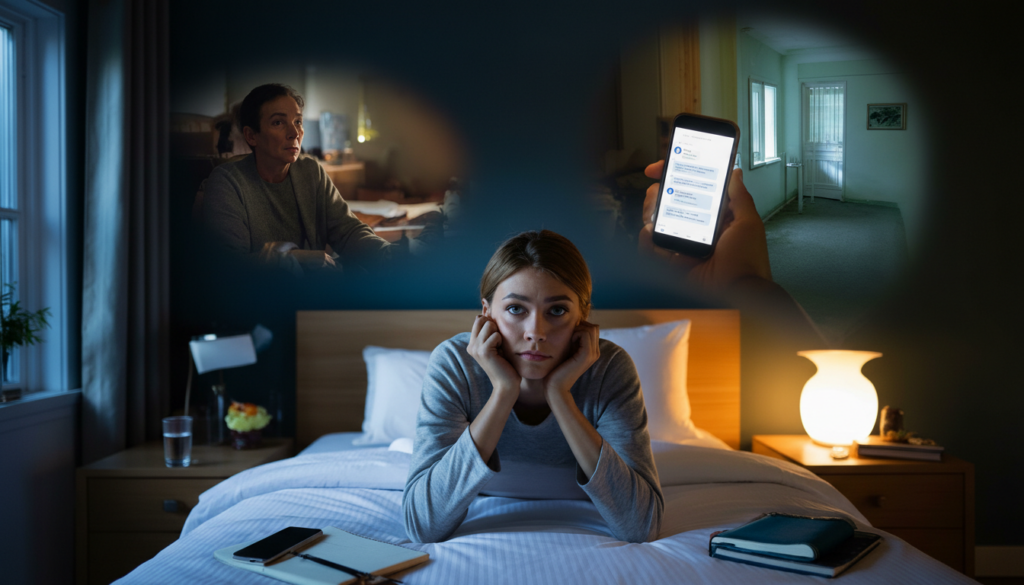
The world is quiet, your phone is finally on the nightstand, and your room is dark. That’s when your brain decides to put on a show. Every little awkward thing that happened that day suddenly plays back in high definition. An old breakup comes in without being asked. A worry about money, something your boss said, or something you said at a dinner party three years ago. Your body is tired, but your mind is wide awake, showing scenes on a never-ending mental projector.
Why your brain starts to “talk louder” when the lights go out
Your mind is busy all day with emails, notifications, traffic, family, the next meal, and the next job. You don’t have much time to just sit with your feelings. That noise goes down at night. You, your thoughts, and all the feelings you put off are all that’s left.
So the brain does what it does best: it starts to sort things out. It plays back scenes, changes the dialogue, and goes back to small details. This mental rewind can be annoying, but it’s a sign that your emotional system is trying to sort out what hasn’t been resolved.

Imagine a woman in bed at 1:47 a.m. looking at the ceiling. She keeps thinking about a time from her afternoon when a coworker interrupted her in a meeting. She smiled, stayed polite, and moved on at the time. Her chest is tight now. She thinks about what she “should have said.” Then she reads a text from a friend that she never answered. Then she goes to a medical exam that she has been putting off.
All of these thoughts are on purpose. Her mind is quietly keeping track of all the “open tabs” for the day and the week. The ones she never really felt.
Psychologists say that overthinking at night is closely linked to how our brains process emotions, especially the default mode network, which is the system that turns on when we’re not focused on an outside task. That network loves stories that aren’t finished.
If you don’t deal with your feelings fully during the day, they don’t go away. People save them as unfinished business, and the brain tries to put them all together during quiet times, like at night. So, the overthinking isn’t just stress being over the top. It’s an attempt to process that gets stuck in loops because there is no clear way out, no action, and no real emotional release.
From chaos to processing: making use of all the thoughts that keep you up at night
An “emotional download” every night before bed is a simple, almost boring way to change everything. Spend five minutes with a notebook or notes app and write down three small things: what happened, how you felt, and what you really needed at that moment. Not a whole book, just a few lines.
Your brain gets the message: “I’ve seen this and named it.” When you name and accept an experience, the emotional weight goes down. The brain doesn’t need to keep replaying it in the dark.

Most people try to stop overthinking at night by using force. They scroll, binge-watch, drink, or say “don’t think about it, don’t think about it” over and over again like a spell. That usually doesn’t work. The more you try to get rid of thoughts, the more they come back.
We’ve all been there: when you want your mind to stop talking, but it somehow gets louder. Instead of fighting with your thoughts, treating them like signals instead of enemies can often make them less intense. Your brain isn’t trying to hurt you. It is trying to help you deal with what hurt, scared, or confused you, but not very well.
*“Thinking about things at night often means you still have emotional work to do from the day. The mind is going in circles because it hasn’t found a story that makes it feel safe enough to sleep.
Say, “What do I really feel?”
Not just “I’m stressed,” but “I felt ignored, ashamed, or scared.” Naming an emotion calms the nervous system.
Give your brain something to do next.
Write down one small thing you want to do tomorrow: Send the message, make the appointment, and write down one sentence for the tough talk.
Make a “worry slot” earlier
Set aside 10 to 15 minutes in the early evening to write down your worries and possible solutions. To be honest, no one really does this every day. But even just once or twice a week can help stop the 2 a.m. spiral.
Letting the night show you what your day was trying to hide
Overthinking at night isn’t just annoying. It’s a map. It shows you patterns, fears, wants, and limits that you’ve been pushing for too long. You might be betraying a value by thinking about that argument over and over again. You might be a perfectionist without even realising it, which could be why you can’t let go of that mistake.
Instead of “stop overthinking,” sometimes the best thing to do is listen long enough to figure out what needs to be fixed. Then bring that work into the light, where your brain has more than just replay to work with.
| Key point | Detail | Value for the reader |
|---|---|---|
| Night overthinking is emotional processing | The brain replays unresolved moments when external stimulation is low | Reduces shame and fear by giving a clear explanation for the mental noise |
| Labeling emotions before bed helps | Short “emotional download” shifts rumination into organized processing | Gives a practical, doable ritual to ease sleep and calm the mind |
| Thoughts signal unmet needs | Repetitive scenes highlight boundaries, fears, or needs ignored during the day | Transforms overthinking into insight for personal change |