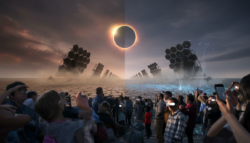
It sounds like a sci-fi story the first time you hear it, not a plan for dealing with climate change. A group of serious scientists, with a lot of money behind them, calmly suggesting that we might need to dim the sun. It’s not a metaphor. To cool down a planet that’s getting hotter faster than our politics can handle, you have to literally cut down on the amount of sunlight that reaches Earth.
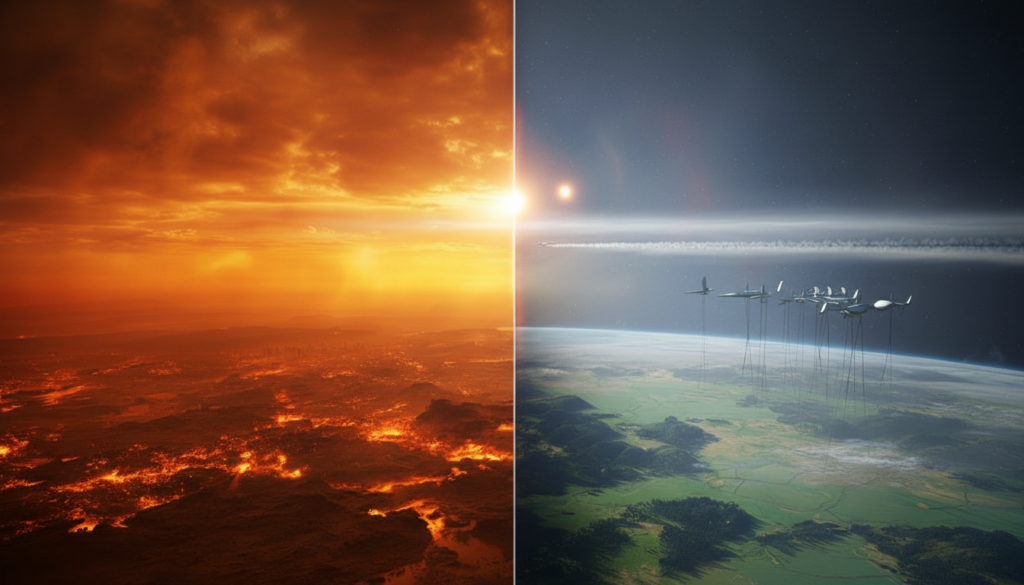
Some people think that planes drop reflective particles high in the sky. Some people see huge mirrors in space that cast a shadow over a world that is too hot. Most of us are just trying to find a shady spot on a hot summer day, though.
The science isn’t the weirdest part. The question is what it’s about.
Why scientists are suddenly talking about making the sun less bright
More and more climate scientists are using the term “solar geoengineering” these days. It sounds technical and not too dangerous, like an update to the software that runs the atmosphere. The main idea is very simple but harsh: block a little bit of sunlight to cool things down if greenhouse gases trap heat.

The idea doesn’t come from a lab. It comes from volcanoes. When Mount Pinatubo erupted in 1991, it sent millions of tonnes of sulphur into the stratosphere. The haze reflected sunlight and lowered global temperatures by about 0.5°C for a year or two. Some scientists saw those graphs and thought to themselves, “What if we did this on purpose?”
Today, modelling teams at Harvard, Oxford, and the National Center for Atmospheric Research use supercomputers to run simulations of a dimmer Earth. They run tests where high-altitude planes spray tiny particles into the stratosphere, creating a thin layer that reflects light. Just enough to reflect 1% or 2% of the sun’s light.
SCoPEx, a well-known project, suggested a small-scale test over the Swedish Arctic sky with a balloon and a few kilograms of particles. It wasn’t a huge secret weapon. It was basically a thermometer that scientists held up to the upper atmosphere. The backlash was so strong that the experiment was put on hold before it even started. What was written down suddenly ran into fear from the public, Indigenous rights, and a very old human instinct: don’t mess with the sky.
The maths looks hard behind the scenes. Even if countries keep their promises about the climate, we will still have more heat waves, floods, and crop failures. People who support solar geoengineering say that it is a “seatbelt,” not a steering wheel. A way to lower the highest temperatures while people try to cut down on emissions, slowly and imperfectly.
Critics say that if you start to dim the sun, you might have to keep doing it for hundreds of years. When you stop suddenly, you get a violent “termination shock” of rapid warming. To put it another way, you’re not just pushing a button. You’re making a deal with the future for billions of people who never got to read the fine print.
How to dim a star and what could go wrong
Stratospheric aerosol injection is the most well-known method, but its name isn’t very interesting. Picture specialised planes flying 20 kilometres up and dropping tiny sulphate or calcium carbonate particles into the cold, thin air. There isn’t a big plume or a cloud like in Hollywood. There is just an invisible veil that slowly spreads around the world.
It looks “cheap” on paper. Some estimates say that a coordinated program could cost a few billion dollars each year. That’s less than what people spend on video games every year. The problem is that politics, weather patterns, monsoons, and the whole moral weight of “turning the global sky into a managed system” don’t fit on a spreadsheet.
People who don’t agree with the idea are more worried about who will be in charge. Picture a deadly heat wave that kills tens of thousands of people in one area, while another area worries about drought if the amount of rain changes by just a few percent. Who is in more pain? Who agrees to a cooler planet if it might mean weaker monsoons in South Asia or worse storms somewhere else?
The worst-case scenario is that a single powerful country, or even a group of billionaires, starts a program to dim the sun on its own, saying it is for humanitarian reasons. Researchers have already made models of what could happen if one state changes the global thermostat and another state blames them for a bad harvest. It doesn’t take much imagination to see how climate diplomacy could turn into climate war.
People who support the idea say that doing nothing is already a choice, and a bad one. They talk about how every year, new records for heat are set, with 2023 being the hottest year ever recorded. They talk about coral reefs losing their colour, megafires turning the sky orange, and cities becoming unlivable for days at a time.
They think that not even looking into solar geoengineering is like not looking into fire extinguishers because people might be careless with candles. They want strict rules, open data, and public oversight. Still, the truth is hard to ignore: we are talking about planetary-scale engineering because we all failed to stop using fossil fuels in time.
The emotional cost of a sun that is less bright
There is a technical argument, and then there is the quieter, stranger one. What happens to our minds if the sky becomes a controlled system? We’ve all been there: that moment when the light changes from gold to deep orange and you stop in your tracks, forgetting your phone. Scientists say that the changes from dimming the sun might be small, like a light that is a little whiter or twilight tones that are a little different.

But those little changes are right on the edge of culture and memory. The language of the sky has been used to write a lot of human meaning, like stories, religions, paintings, and songs. People often think that “albedo management” means that scientists might repaint the ceiling of the only home they’ve ever known.
People are also afraid of being morally lazy. Do politicians put off cutting emissions even longer if they know there is a technical fix for warming? That’s the problem of “moral hazard.” If someone says they can lower the temperature from upstairs, why stop using fossil fuels?
Let’s be honest: no one does this every day. No one wakes up and says, “I’m burning gas; I hope someone is fine-tuning stratospheric aerosols to make my commute easier.” But these hidden shortcuts are what make policy. A planet that learns how to cool itself with particles may be able to handle more pollution, more delays, and more broken promises. **That’s the quiet fear that makes many scientists hold back.**
Some researchers, like David Keith from Harvard and others in the field, say the opposite. They say that reflecting sunlight could buy time but not take away responsibility.
One climate scientist told me, “Cutting emissions is not up for debate.” “Solar geoengineering is not a Plan A, B, or C. It’s a fire alarm behind glass, and I’m scared we’ll have to break it one day.
To keep the debate fair, a number of independent groups are calling for strict rules to be in place before any tests start:
Research that is open to everyone and funded by the public
Decisions that affect the whole world, not just rich countries at a closed-door meeting
Red lines: no large-scale deployment without wide, democratic approval
Constantly keeping an eye on the weather, crops, oceans, and people’s health
Firm guarantees that cutting emissions will stay the main goal
The question that won’t fit in a spreadsheet
If you think about the idea long enough, the science stops being the weirdest part. The graphs, the data, and the climate models can all be debated, peer-reviewed, and made better. It’s hard to model how we feel about living under an engineered sky, which is both smaller and bigger than that.
Some people feel better when they hear “dimming the sun.” A last-ditch tool that may not look good, but is better than the heat that destroys food systems and floods coastal cities. Some people feel an instinctive rejection, as if crossing this line would change not only the weather, but also the rules about what people can do to their world.
You can’t vote on the colour of your kids’ sky with an app. There’s no online form where you can pick between a world that is a little cooler but run by technology and one that is very unstable but ‘natural’. There will be a lot of conferences, protests, labs, courtrooms, and late-night talks behind closed doors before the decision is made.
One quiet power we still have is to stay awake and listen to the conversation before it becomes fate. To pay attention when scientists don’t agree. To realise when “last resort” starts to sound like “inevitable.” To ask, loudly, if we can live with making the sun a little less bright and if we can live with ourselves if we don’t.
Main point, details, and what the reader gets out of it
What does “dimming the sun” mean?Scientists suggest using particles high in the atmosphere to reflect a small amount of sunlight.Shows you exactly how the technology works behind the headlines
Power struggles and risksPossible changes in rainfall, uneven effects, and worries about powerful countries acting aloneThis will help you understand why this debate is both scientific and political.
Your part in the debatePublic pressure can lead to strict rules, openness, and a focus on cutting emissions first. This shows how one person’s awareness can affect a decision that affects everyone.
| Key point | Detail | Value for the reader |
|---|---|---|
| What “dimming the sun” means | Scientists propose reflecting a small fraction of sunlight using particles high in the atmosphere | Gives you a clear picture of the technology behind the headlines |
| Risks and power struggles | Possible shifts in rainfall, unequal impacts, and fears of unilateral action by powerful countries | Helps you understand why this debate is as political as it is scientific |
| Your role in the debate | Public pressure can push for strict rules, transparency and a focus on cutting emissions first | Shows how individual awareness can influence a decision that affects everyone |
Questions and Answers:
Is anyone already making the sun dim?There is no big project going on right now to dim the sun. Some small field tests have been suggested, but most of the work is still being done in computer models and labs.
Would the sky change colour if the sun got dimmer?Models say that the colour of the sky would change a little, but it would probably still be blue. The light would scatter a little differently. Some sunsets and sunrises could look a bit hazier or whiter, similar to the years after big volcanic eruptions.
Could solar geoengineering stop the weather from getting worse?No. It can’t fix ocean acidification or take CO₂ out of the air. It could only lower global temperatures for a short time while we work hard to cut emissions and increase carbon removal.
Is this safe for people?People wouldn’t be breathing in the particles directly at the heights involved. The bigger worries are indirect, like changes in the weather, food production, and extreme events. That’s why a lot of scientists say that real deployment should only happen after a lot of slow, careful research.
Can we have a say in this choice?That’s one of the biggest questions we don’t know the answer to. Before any country or company can move beyond small-scale tests, many experts are calling for global, democratic governance. This means discussions at the UN level, representation of Indigenous people, and public involvement.