
The sticky note had been there for so long that it was now part of the wall. In angry blue ink, it yelled “CALL DENTIST!!!” at first, with sharp edges and bright yellow like a warning sign. It was pale, curling at the corners, and half detached two weeks later, as if it was tired of being so important. You saw the color but not the meaning as you walked by on your way to the coffee machine.
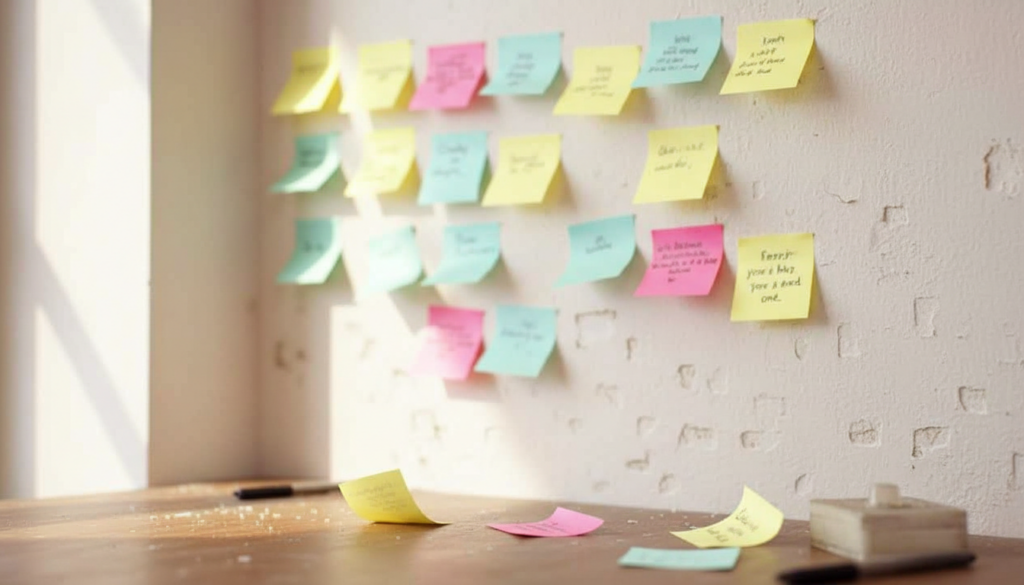
One morning, it finally fell to the ground. You saw it, stopped, picked it up, and then put it under a notebook.
You didn’t forget about the dentist because the note fell. You forgot about the sticky note, so it fell.

The quiet time when your brain stops seeing your notes
Look at the light switch in the hallway, the edge of your screen, and the door to your fridge. There is probably at least one sticky note just hanging around. At one point, it had a clear purpose. Call your mom. Get your passport renewed. Begin the gym trial. These days, it looks more like wallpaper.
You saw it every time you walked by at first. It gave you a little push of guilt or motivation. As time went on, that little square of color went from “urgent reminder” to “background noise.”
A designer I talked to told me about the sticky note that was on her computer screen for three months. It said, “Send portfolio to M.” That one note was for the job she really wanted, even though it scared her a little.
She saw it in the first week and felt a rush of adrenaline. In the second week, she told herself she’d do it “tomorrow.” By the third week, she hardly even thought about it. She laughed when her note finally came off and fell behind her desk. Then she remembered that she hadn’t sent the portfolio. **The reminder hadn’t failed in any way. It had failed in the mind.
This is called habituation. When your brain gets the same signal over and over again and doesn’t do anything with it, it quietly puts it in the “irrelevant” folder. You stop really seeing it, even though you look at it dozens of times a day.
The glue on the back of sticky notes is very smart, but your brain has its own kind of glue. It keeps your mind on what changes, what moves, what threatens, and what rewards. A yellow square that doesn’t move and doesn’t lead to any clear action? Your mind keeps going. That’s the reason why sticky notes die on your wall long before they fall off.
Making dead sticky notes into small, living promises
Don’t let a sticky note stay in the same place for more than a few days. This small ritual changes everything. Before you write one, think about how long it will last. It could be three days or five days. After that, it has to be moved, rewritten, or thrown away.
 Everyone throws it in the trash, but for your plants, it’s pure gold and nobody cares about it
This little thing makes your brain have to think about the message again. Your mind keeps saying, “Oh, this matters,” every time you rewrite a note or move it to a new place. The words feel new. The meaning comes back to life. *It’s less likely that a moving sticky note will disappear.
Instead of what they really are—disposable reminders—most of us treat sticky notes like permanent posters. We put up a dozen at once, thinking that more notes will give us more control. Then we wonder why they all blend together into one loud collage.
Let’s be honest: no one really does this every day. You won’t rewrite every note every time. Things get messy in life. Kids spill juice on the fridge, and your boss calls right when you sit down. But changing just the most important note, the one that has a real effect, can already change how you react. Your attention follows that one when it moves.
A behavioral coach I spoke with said, “If a sticky note is still there two weeks later, it’s not a reminder anymore.” “It’s a confession that the job behind it is stuck.”
- You should only have three active sticky notes in your main space.
- In the corner of each note, write D-3, D-5, or a real date.
- When a note is no longer useful, do the task, rewrite it, or throw it away on purpose.
- Change the location: today it’s the screen edge, tomorrow it’s the notebook cover, and the next day it’s the front door.
- Use bright colors only for things that have a set time or deadline.
It might not be the glue. Maybe that’s what we’re really trying to avoid.
You might start to see a pattern in your dead sticky notes. “Buy milk” and “feed the cat” aren’t usually the ones that fade away. Those are done quickly. The ghosts that come up the most are the heavy ones: “start a savings plan,” “book a therapist,” “update your resume,” and “talk to your partner about money.”
The glue on these notes doesn’t wear out, so they keep working. They stop working because they are emotionally heavy. Your brain doesn’t just get used to the color; it also avoids the pain that comes with the words. It’s not being lazy. It’s for your own safety. Not quite right, but very human.
| Key point | Detail | Value for the reader |
|---|---|---|
| Rotate your notes | Rewrite or move them every few days | Keeps your brain from tuning them out |
| Limit the number | Maximum three visible at a time | Reduces visual noise and mental overload |
| Spot the “heavy” tasks | Notice which notes never leave the wall | Reveals what you’re really avoiding so you can address it |
Frequently Asked Questions:
Why do my sticky notes stop getting my attention after a while? Your brain gets used to signals that happen over and over again but don’t lead to action right away. The note blends in with the background, so your brain ignores it to save energy.
What’s the best place to put a sticky note so I don’t forget it? Put it where your hand has to touch it, like on the light switch, over the phone screen, or on the trackpad of your closed laptop. Interruption in person is better than seeing from a distance.
How many sticky notes can I use at once? For everyday use, try to have three active notes in one place, like on your desk, fridge, or mirror. After that, your focus wanes and everything seems less important.
Should I get rid of sticky notes if I haven’t done the job? Yes, sometimes. If you’ve been putting off a task for weeks, either lower its importance (it wasn’t that important), break it down into smaller steps, or put it on your calendar instead of leaving it on paper.
Are digital sticky notes better than regular ones? They both have the same problem with getting used to things. Digital items can pop up, disappear, or move around, which makes it easier for your brain to notice them again.