
The first alert of the day often arrives before you are fully awake. A calendar reminder. A couple of WhatsApp messages in the family group. A news notification about something happening far away that suddenly demands your attention before you’ve even had coffee.
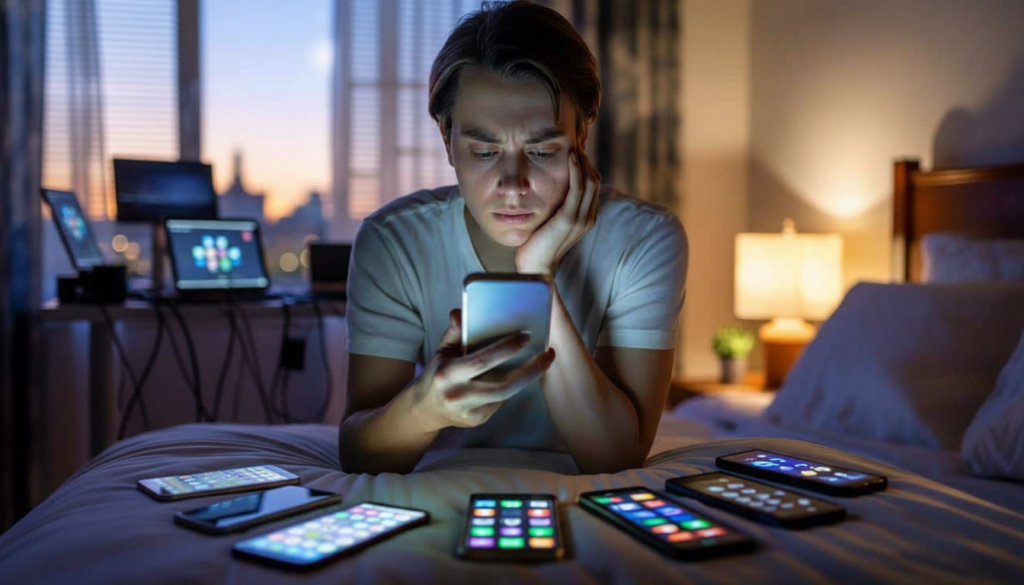
As you scroll in bed, your thumb moves automatically. You may not feel fully present yet, but your nervous system is already switched on. Each notification banner subtly raises your heart rate. You don’t consciously register it. You simply feel a little rushed, a little late, a little “on call.”
By 9 a.m., your phone may have lit up dozens of times. The day hasn’t properly begun, yet your mind already feels scattered. Beneath the noise, something quieter is happening.

The Stress You Stopped Noticing
Sit in a café for an hour and watch what happens when a screen lights up. Hands twitch toward phones. Conversations pause mid-sentence. Eyes dart downward for a “quick check.”
That “quick check” often breaks real life into fragments. A friend has to repeat themselves because your focus vanished with a vibration. You return to the conversation, but it feels thinner somehow — like a song that keeps skipping.
Surveys suggest that the average smartphone user checks their device around 80 times a day. But it’s not just 80 actions. Each alert can spark a chain reaction: open the app, read the message, tap a link, scroll, switch platforms, and suddenly ten minutes are gone.
Imagine working on an email when a notification flashes: a Slack message, a discount offer, a breaking news alert. When you return to your task, your brain has already travelled through multiple unrelated topics. You finish the email, yet feel oddly exhausted.
There’s a reason for that fatigue. Every notification pulls your brain out of deep focus and pushes it into alert mode. The human brain evolved to treat unexpected signals as possible threats or rewards. Over time, repeated alerts keep your body slightly tense, as if waiting for something urgent to happen.
Small stress, repeated often enough, stops feeling small. You don’t collapse dramatically. You simply live a little more on edge than you realize.
Reclaiming Your Attention Without Disappearing Offline
You don’t need to escape to a remote cabin or delete every app. What works better is something simple and sustainable: clear rules for when your devices are allowed to interrupt you.
Start with two or three protected periods in your day. Perhaps the first 30 minutes after waking up, your lunch break, and the final hour before bed. Activate Do Not Disturb or Focus mode, allowing only essential contacts through in case of emergencies.
At first, this may feel uncomfortable. Your hand may instinctively reach for your phone, only to find silence. Give it a few days. The restless feeling begins to fade.

Relying on willpower alone rarely works. Instead of constantly resisting your phone, redesign your environment. Turn off non-human notifications such as sales alerts, promotional messages, and random app pushes. Schedule email fetch times. Remove social apps from your lock screen.
You’re not rejecting technology. You’re simply deciding that not every app deserves real-time access to your attention.
Simple Steps That Quiet the Noise
Small adjustments can gradually restore balance:
Review your apps monthly and remove unnecessary notification permissions.
Create one home screen for work and urgent tools, and another for calm activities like reading or music.
Set designated times to check notifications instead of reacting instantly.
Keep your phone in another room during meals or deep work sessions.
Replace one scrolling habit with a low-tech ritual such as stretching, journaling, or simply sitting quietly.
These are not dramatic life overhauls. They are small, consistent decisions that slowly shift control back to you.
Living at a Lower Volume
When notifications are reduced, something unfamiliar appears: empty space. Waiting in line without reaching for your phone may feel awkward at first. Then it begins to feel like breathing room. You may notice greater patience while waiting for replies. You may sleep more deeply when the last thing you see at night isn’t a glowing screen demanding a reaction. Constant notifications train you to live in fragments. Turning them down allows your attention to return in fuller, steadier blocks. The world doesn’t disappear. You simply engage with it on your own terms.
| Key Point | Detail | Value for the Reader |
|---|---|---|
| Recognize Hidden Stress | Understand how repeated alerts keep the body in a low-level alert state. | Helps explain daily fatigue and scattered focus. |
| Create Protected Time | Mute notifications during specific daily windows. | Encourages deeper focus and genuine mental breaks. |
| Redesign the Environment | Disable non-essential alerts and physically move the phone away. | Regains attention control without extreme digital detox. |