
When I first put the Galaxy Z Fold7 in my pocket, it felt like I had travelled a few months into the future. It didn’t just sit there on the café table; it almost posed, with its screen glowing and half-folded, like a tiny sci-fi notebook waiting for the next plot twist. Friends leaned over to poke it, and the barista asked, “Is that the new Fold?” For a few days, I was the guy with the cool phone. The one who people ask for tech advice in group chats. The person who gets the new toy first.
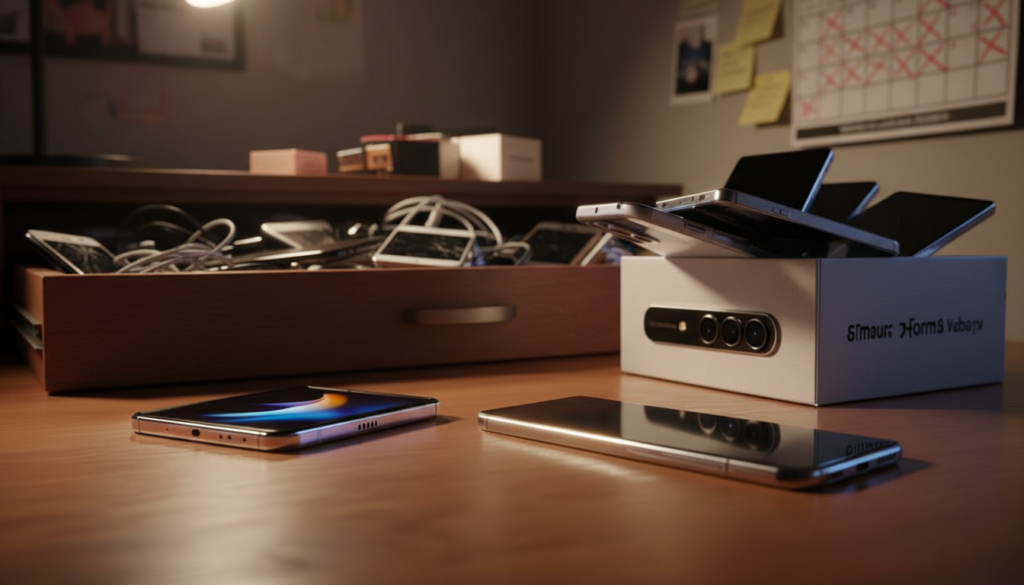
That same Fold7 spends a lot of time in a drawer three months later.
And yes, there are also regrets in that drawer.
When the Galaxy Z Fold7’s honeymoon starts to go bad
The first few weeks felt like a love story about technology. When you opened the Fold7, it felt like you were opening a hardcover book. The big inner screen could handle Netflix shows, email threads, and endless doomscrolling without breaking a sweat. I was typing with two thumbs like on a mini tablet, switching between apps, dragging and dropping text, and it felt like the future had finally come to my hands. **Every commute suddenly felt shorter, every waiting room less boring, and every YouTube rabbit hole more comfortable.
But little annoyances began to creep in, one notification at a time.
The outside screen was the first thing. When closed, the Fold7 is tall and skinny, like someone stretched a regular phone in Photoshop and forgot to click “constrain proportions.” It feels like dancing on a balance beam when you type a quick message on that small front display. My thumbs keep getting stuck on the edges, and I’ve sent more “okays” than I care to admit. One night, while I was walking and trying to respond to a simple Slack ping, I gave up, opened my phone all the way in the street, and almost ran into a parked scooter.

When it’s folded, it’s hard to use. It’s amazing when you can stop and use two hands to unfold it.
That’s the main problem with folding phones. They look like they will give you the best of both worlds: a phone and a tablet in one. In real life, the compromise works both ways. You have a phone that is oddly shaped, heavy, and gives off a slightly anxious “don’t drop me” vibe when it’s closed. Open, your screen is beautiful and wants your full attention, two hands, and usually a flat surface. “Are you now in big-screen mode or not?” is a question that the Fold7 always asks. After three months, I realised that the question itself is tiring. A regular phone doesn’t ask you questions like that.
The daily stress that ads don’t show
Opening and closing was the simple act that slowly killed the magic. You do it a lot, maybe hundreds of times a day. At work, at lunch, on the tube and on the couch. Every time you find the edge with your thumbs or fingers, you pull it open. The hinge resists a little, and the middle crease looks like a faint scar. That little movement feels great at first. It gets boring after a few weeks. A small effort that was never there with a normal flat slab.
You end up having to talk yourself into it: “Is this email worth opening?” “Do I really need the big screen to check Instagram?” It’s a strange question, considering it cost more than a good laptop.
No one talks about the social side of it either. It feels a little like opening a laptop in the middle of dessert when you unfold the Z Fold7 on the table. It is big and bright, and it gets your attention even when you don’t want it to. That big screen on public transport suddenly feels like an open book that everyone can read. I was looking over some private papers on the inner screen of a crowded bus one afternoon when I saw the guy next to me clearly looking over. I awkwardly smiled and folded the phone back. I then stared at the lock screen for the rest of the ride.
It’s strange that you have a device that can do a lot of things at once, but you sometimes don’t use its main superpower in public.
The reasoning behind all of this is very simple. Most of the time, convenience wins. A phone works because it fits into your daily life: you take it out, unlock it, use it, put it away, and forget about it. The Z Fold7 won’t go away. It wants to be seen, opened up, and interacted with in a very specific way. That’s great when you’re on the couch with a charging cable close by and Wi-Fi on. It’s not as much fun when you have to hold groceries in one hand and not drop a €1,800 gadget in the other. The more I had to do, the more I wanted something that didn’t ask me so many questions. A “boring” flat phone suddenly felt like a relief.
Getting used to a futuristic thing you don’t fully trust
Over time, I figured out how to survive: I used the Fold7 as little as possible like a Fold. That sounds crazy, but it’s what happened. I began to use the outer screen as my main phone for texting, making quick calls, and looking up directions. The inner screen turned into a “special mode” for watching a game, doing split-screen work, or reading long emails. I put a soft case on it, wiped it down every night, and stayed away from pockets with coins or keys. Suddenly, every drop of water and every grain of sand felt like an enemy. Taking care of the future means watching it more than you want to.
Honestly, I was always a little scared of breaking it, and that fear changes how you use a device.
If you’re thinking about getting a folding phone, there’s a trap I wish someone had told me about. You will say to yourself, “I’ll finally use the big screen to work on the go, edit documents, read more, and get things done.” That vision is very appealing. Then real life gets in the way. As you cross the street, you pick up your phone to respond to three WhatsApp messages. You look at the schedule in the rain. You take a messy picture at a party. Let’s be honest: no one really changes their whole day to fit the shape of their phone. You go back to your old ways, and the new features become fireworks instead of tools you use every day.

Frustration builds in that space between dreaming about using something and actually using it.
A friend asked me if they should switch to a foldable, and I hesitated for five seconds before answering.
“Look,” I finally said, “it’s amazing when you really use the big screen.” But you have to accept that it’s heavier, more fragile, and that sometimes you’ll just be too tired to deal with it.
Before you buy a foldable, try it out in a store for at least 10 to 15 minutes, switching between the outer and inner screens.
Think about how often you really sit down to read, watch, or work on your phone instead of doing quick, one-handed tasks.
Consider the places where you use your phone the most, like the kitchen, the office, the bed, or outside.
Think about whether you can handle living with something that is more fragile and needs more care.
Look at it next to a regular flagship that costs the same amount and think about what you would really use every day, not just once a week.
The future might be folding, but the present is still flat.
After three months with the Galaxy Z Fold7, I felt both impressed and tired. When everything is just right—a quiet hour, a comfy seat, and two free hands—this phone is great. It really feels like the next level to watch a movie on that big screen, read long articles, and edit photos with the tools. I would open it up on the bed, turn down the brightness, and think, “Yes, this is the pocket computer I’ve always wanted.” My alarm went off at 7 a.m., and I grabbed the heavy, folded brick from the nightstand. I checked my messages on the small outer screen and, still half asleep, missed my old, simple flat phone again.
We’ve all been there: a gadget looks great in reviews and unboxings, but it doesn’t work right in real life.
The Z Fold7 and other folding phones show us that our routines are very hard to change. Screens can fold, hinges can get better, and tech can bend, but the way we use our phones stays the same. Quick checks, swipes with one hand, typing while walking, and scrolling late at night while lying on your side. The Fold7 works best when you use it the way it was meant to be used, and it annoys you when you don’t. And let’s be honest: ideal conditions don’t happen very often in real life. When it rains, hands get dirty, bags get full, and kids grab your phone with sticky fingers.
That’s probably why my Fold7 moves between my pocket, my hand, and that famous drawer more often than I thought it would.
I don’t think it’s a bad idea to make phones that fold. I believe they are an incomplete answer. The Z Fold7 shows that the technology works, that software can change, and that a phone can really be a small tablet. It also shows how high the standard is for something we touch hundreds of times a day without thinking about it. Some people will think the trade-offs are worth it and will never go back. For some people, like me, the compromise still feels too heavy, too weak, and too much work. The future may not be bright, but right now, a lot of us are still happiest with a flat, boring rectangle that blends into the background of our lives instead of always needing our attention.
Important point Detail Value for the reader
Daily friction that isn’t obviousOver time, opening and closing the Fold7 dozens of times a day feels like a chore.Helps you guess how the phone will feel once the initial excitement wears off.
Give and take in both modesThe narrow outer screen and “attention-hungry” inner display make it hard to make a decision.You can see if this compromise fits with how you really live.
The emotional cost of being fragileFear of damage changes how and where you use the device.Shows the mental side of having a pricey, fragile gadget
| Key point | Detail | Value for the reader |
|---|---|---|
| Hidden daily friction | Opening and closing the Fold7 dozens of times a day feels like a chore over time | Helps you predict how the phone will feel after the initial excitement fades |
| Compromise in both modes | Narrow outer screen and “attention‑hungry” inner display create a constant trade‑off | Lets you see if this compromise matches your real habits |
| Emotional cost of fragility | Fear of damage changes how and where you dare to use the device | Shows the psychological side of owning an expensive, delicate gadget |
Frequently Asked Questions:
Question 1: Is the Galaxy Z Fold7 good enough to be your only phone every day?
Question 2: Does the crease in the middle of the screen bother you after a while?
Question 3: Is the Fold7 really more fragile than a regular flagship phone?
Question 4: Will a foldable phone really help me get more done?
Question 5: Who should really not buy a folding phone right now?