
The child’s backpack looked heavier than his shoulders could manage. He pulled it tighter while an immigration officer scanned his parents’ passports beneath the bright lights of a northern European airport. Just a few steps away, an elderly couple in the “EU citizens only” queue whispered about rising taxes, shrinking pensions, and the feeling that “too many” newcomers were arriving.
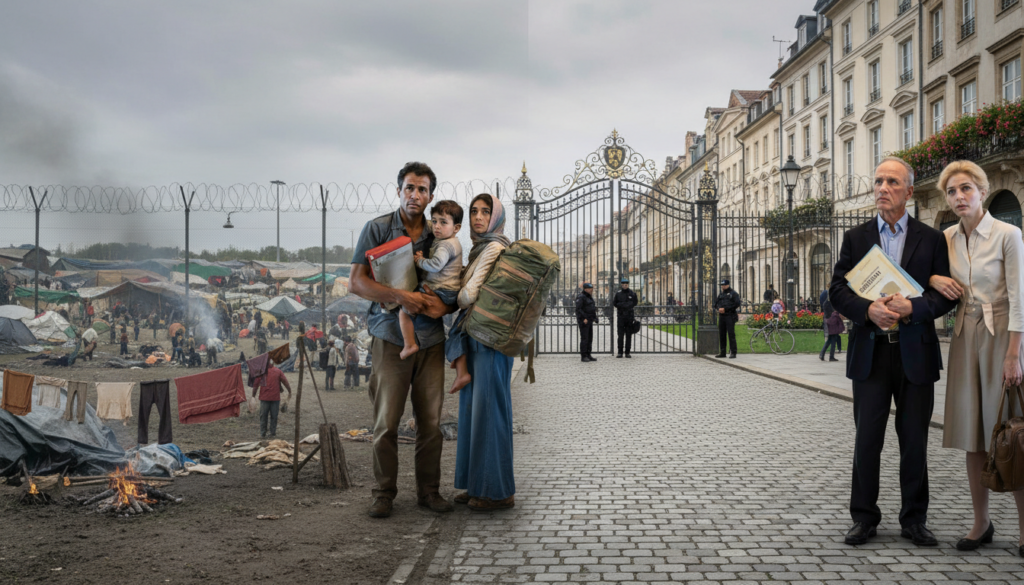
On one side of the glass stood a family who had abandoned everything in search of safety and stability. On the other stood retirees who had spent forty years working, worried that their welfare system might fracture under pressure. The moment lasted minutes. The argument it symbolizes may shape politics for generations.
When Fear of Collapse Meets Hope for a Better Life
In prosperous capitals, the same conversation unfolds daily. At one table, people speak about crowded schools, limited housing, and longer hospital queues. At another, the talk is about war zones, climate displacement, and families risking their lives at sea. Both conversations revolve around migration. Both sides believe they are protecting something valuable.

In Sweden, often praised for its welfare model, the foreign-born population has grown dramatically over two decades. Some residents describe stretched public services. Yet migrant nurses, drivers, and tech workers quietly sustain those same systems. In Canada, welcoming roughly half a million newcomers annually, industries from construction to healthcare rely heavily on migrant labour. At the same time, public frustration over housing and affordability continues to rise.
What we are witnessing is a clash of eras. Welfare states were designed for stable, aging, relatively uniform societies. Modern migration is driven by global instability, climate shocks, and inequality. Close the borders too tightly, and economies lose essential workers. Open them without planning, and social tension deepens.
Keeping Borders Open Without Losing Social Stability
One recurring lesson from countries that manage migration more effectively is simple: stop pretending it is temporary. Past policies often labeled newcomers as “guest workers,” assuming they would eventually leave. Instead, they built families and futures, while integration policies lagged behind reality.
Effective systems begin integration immediately. Rapid language education, clear employment pathways, and early mentorship programs prevent social isolation. When newcomers remain in administrative limbo for years, they often drift into parallel communities, increasing perceptions of division.
The popular slogan “We only need skilled migrants” oversimplifies reality. Economies require engineers and doctors, but also caregivers, agricultural workers, cleaners, and drivers. Treating these workers as temporary tools instead of future contributors undermines long-term cohesion.
Policy Principles for a Balanced Approach
Set transparent multi-year targets: Clear migration numbers reduce uncertainty and public anxiety.
Invest early in integration: Spending on language training, childcare, and diploma recognition prevents long-term unemployment.
Connect rights with contribution: Transparent links between work history and benefit access strengthen perceptions of fairness.
Distribute arrivals regionally: Avoid concentrating newcomers in a few disadvantaged areas to reduce segregation.
Encourage local dialogue: Community programs and mixed institutions replace abstract fear with personal interaction.
Beyond “Open” or “Closed”: Choosing the Society We Want
Extreme positions dominate headlines: seal the borders entirely, or remove all limits. Most citizens, however, occupy a middle ground. They want stability for their families, protection for the vulnerable, and some level of control over migration flows. At the same time, many reject the idea of ignoring humanitarian crises.
There is a real tension. Welfare systems require trust and defined boundaries. Unlimited access without structure can erode confidence. Yet aging populations in many rich nations make migration economically necessary to sustain pensions and healthcare systems.

The more productive question may not be whether borders should be open or closed, but how migration can be managed transparently and fairly. Clear reporting on economic impact, honest discussion of trade-offs, and public participation in setting targets could rebuild trust.
A country that shuts itself off risks economic stagnation. A country that admits newcomers without preparation risks social fragmentation. Between these extremes lies a complex but workable path: regulated entry, rapid integration, clear expectations, and shared responsibility.
| Key Point | Detail | Value for the Reader |
|---|---|---|
| Welfare states depend on workers | Aging societies need younger contributors to fund pensions and healthcare. | Explains why strict border closure may weaken long-term economic stability. |
| Disorder fuels backlash | Rapid arrivals without integration or clear rules increase tension and political polarization. | Clarifies why social anxiety often grows during sudden demographic change. |
| Managed migration offers balance | Clear quotas, early integration, and transparent welfare conditions. | Provides a practical framework beyond the “open vs closed” debate. |
Frequently Asked Questions
Question 1: Do migrants weaken welfare systems?
Long-term research generally shows that employed and integrated migrants contribute significantly through taxes and labour participation.
Question 2: Why do fears of social instability arise?
Rapid demographic shifts, housing shortages, and political rhetoric often intensify perceptions of disorder.
Question 3: Can generosity coexist with limits?
Yes. Governments can set annual quotas while ensuring strong rights and protections for admitted migrants.
Question 4: Which policies ease tensions?
Early language education, access to jobs, transparent welfare criteria, and community interaction reduce mistrust.
Question 5: Is total border closure realistic?
Complete closure is difficult to enforce and may harm economies reliant on migrant labour while complicating international obligations.