
It was an ordinary Tuesday when the email came in. It was a short, nervous message from a climate researcher in Tromsø. A crooked red line of Arctic temperatures that suddenly shot up, far above the neat blue band of past winters, was attached. The scientist had written, “This is not normal.” The pavement outside was wet instead of icy, and people were wearing open jackets when it should have been deep freeze season. A few hours later, another meteorologist posted a satellite image on X. It showed the polar cap with dark cracks of open water where there should be thick white ice.
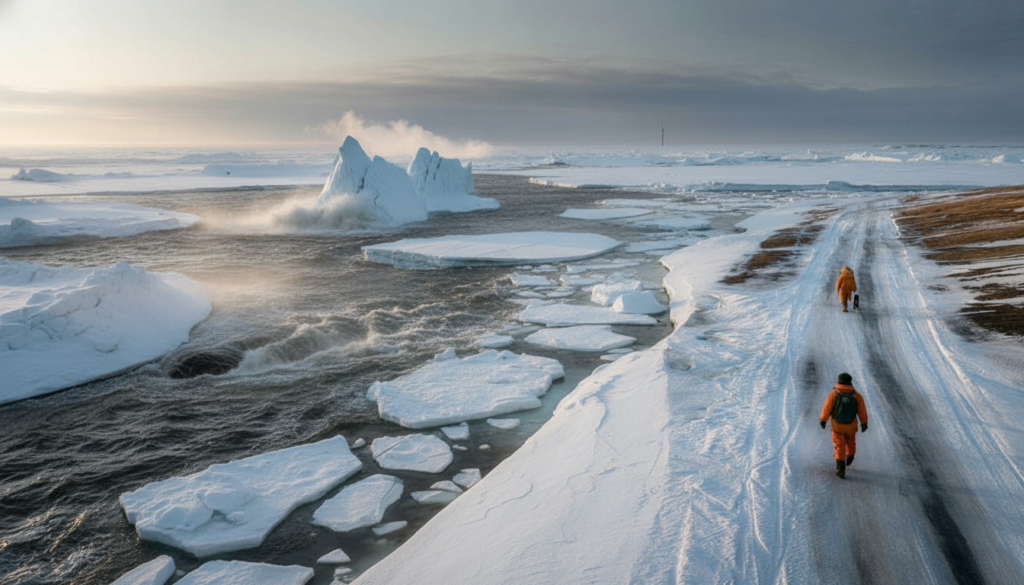
When the Arctic winter stops acting like winter
The Arctic used to be very quiet in early February, like a frozen heartbeat. Sea ice that used to cover the polar ocean like armour is now forming later, getting thinner, and breaking up faster. On some days, air temperatures rise 15 to 25°C above what old records would call “normal.” From Alaska to Svalbard, communities that built their lives around stable ice are now seeing slushy shorelines and rain falling where snowstorms used to reign. The Copernicus Climate Change Service says that the amount of sea ice in the Arctic is again close to record lows for this time of year. Satellite sensors saw large areas of ice that were unusually thin on the Siberian side of the Arctic Ocean. In infrared images, these areas looked almost clear. In some parts of the Barents and Kara Seas, air temperatures reached levels that scientists thought would happen in late spring, not in the dead of winter. People in Svalbard, a group of islands in Norway, said it rained during what used to be their coldest week. Roads became deadly ice sheets, avalanches became harder to predict, and reindeer had a hard time getting to food through the frozen crust. It was a place made for snow, but now it had to deal with slush. Greenhouse gases and melting ice make the Arctic warm up more than four times faster than the average for the whole world.
When white sea ice melts, it stops reflecting sunlight and instead shows dark ocean, which absorbs heat and warms the air above it. Warmer water makes winter refreezing happen more slowly, which leaves even more open ocean and makes the cycle even deeper.

Early February is now like a diagnostic check-up for this out-of-control system: if there were any chance the Arctic was “stabilising,” this is when it would show up.
Instead, the signals are getting farther away from everything the historical record can explain year after year.
How scientists interpret the Arctic’s new warning signs
Meteorologists don’t just look at one scary graph and freak out.
They use tools in layers, like detectives.
Long-term datasets come first: decades of sea-ice maps, temperature records from faraway weather stations, and satellite pictures put together to make time-lapse movies. They look at how February used to be, with a thick layer of ice, a tight polar vortex, and big temperature differences.
Then they add this year’s numbers on top.
The new lines are shaky and wobbly, while the old ones are steady.
The word “uncharted” is in their notes in the space between what they expected and what actually happened.
One clear example is the North Atlantic, where warm ocean currents meet cold polar air.
That area used to be a clear border in the winter: cold, dense air sat over the ice, and milder air stayed further south.
Now, forecasters see “heat pulses” coming from that same area into the Arctic, sometimes on the backs of strong storms. These intrusions can raise polar temperatures above freezing, even in the middle of winter and at latitudes where the sun hasn’t risen yet.
A station near the North Pole recently recorded temperatures that were more like a chilly autumn day than a polar night.
For climatologists who learned by heart the rules for temperatures below zero, those numbers are like a plot twist that no textbook prepared them for.
The reason they are alarmed is very simple.
The weather always moves, but it usually moves around a stable baseline.
What they’re watching now is the baseline itself moving. As the jet stream gets more unpredictable, storm tracks change shape. Even in years when the extent “recovers” a little, the thickness of the sea ice keeps going down. Warm air comes from above and ocean heat comes from below the ice.
At some point, what you’ve done in the past won’t help anymore. Models were trained on a planet that is no longer the same as it was.
That’s what “uncharted territory” really means here: it’s not the end of science, but it’s the end of being able to say with a straight face that the future will look like the past with a small margin of error.
What an unstable Arctic quietly does to our lives every day
The Arctic might seem like a faraway screensaver if you don’t live near snow and polar bears.
Meteorologists are almost begging us to stop believing that.
The first “tip” they give is to stop thinking of polar news as interesting trivia and instead think of it as tomorrow’s local weather. A warmer Arctic has made the jet stream wavier, which means that the weather patterns where we live are more likely to get stuck. This means longer heat waves, rain systems that won’t go away, and cold snaps that happen in places that don’t expect them.
Checking the news about the Arctic once a week, like you would check fuel prices or election polls, helps you put the pieces together.
You start to notice that a strange warm spell in Greenland often goes along with the strange storm outside your window.
At this point, a lot of people just turn off because they are overwhelmed by graphs and guilt.
We’ve all been there: the climate story seems so big that it seems easier to ignore it than to care.
This is something meteorologists know. Some people say they feel it too. They are careful not to say that individual choices alone will “fix” a planetary feedback loop that took hundreds of years to build. Let’s be honest: no one really does this every day.
But they also warn against the common mistake of thinking that nothing we do matters. People still have a say in energy policy. As Arctic signals become stranger, it becomes more important for cities to make decisions about things like insulation, transportation, flood defences, and even planting trees.
The worst thing to do is act like the North isn’t your problem.

Within research centers, the tone has subtly transitioned from dispassionate inquiry to a form of pragmatic urgency.
You can hear it when people talk behind closed doors.
A senior polar meteorologist told me, “Early February used to be boring in the best way.” “Now it’s the month I hate looking at the maps.” When I was a student, we only talked about these things in theory.
The uncharted Arctic isn’t just a headline; it changes real choices:
How cities plan for stormwater systems in a world where floods happen every ten years instead of once every hundred years
How farmers make planting plans when spring weather changes quickly from cold to hot
How coastal towns and cities weigh the cost of building defences against rising sea levels caused by melting ice in the polar regions
When the polar regions stop following the old, familiar script, each of these choices gets harder.
A future written in ice that won’t stop moving
As data from early February comes in, meteorologists are quietly changing their mental maps of the world.
Yes, the Arctic they trained in was a place of extremes, but it was also a place where things happened on a regular basis. The ice came. The ice melted. The patterns were still easy to read.
The signals now look more like a language that changes all the time. The amount of sea ice is getting close to record lows, it rains on the tundra in the winter, and temperatures rise so high that they break the historical record. Those aren’t just oddities; they’re signs that our climate story is changing faster than our institutions, infrastructure, and imaginations.
Some people will see this as a reason to fight harder for cuts in emissions. Some people will see it as a push to change, like making homes flood-proof or changing how they travel and work. A lot of people will just feel a quiet unease, as if the map they grew up with is slowly and steadily becoming less useful.
The Arctic doesn’t send us clear warnings.
It gives us ice that won’t stay frozen, storms that won’t stay put, and records that keep breaking.
What we read in those early February signals and how quickly we act on them will tell us more about ourselves than about the cold, far-off North.
FAQ:
Is the Arctic really getting warmer faster than the rest of the world?
Yes. Recent research shows that the Arctic is warming more than four times faster than the average for the whole world. This is because sea ice is melting and ocean and air currents are changing.
Why is early February so important to meteorologists?
The middle of winter is usually in early February. The sea ice should be close to its maximum growth, and the temperatures should be close to their seasonal lows. At this point, deviations show how much the climate baseline is changing.
Does a warm spell in the Arctic mean that where I live will have fewer cold snaps?
Not always. Depending on how the atmospheric waves set up, a destabilised jet stream can cause both extremes: milder polar conditions and surprise cold blasts or heavy storms in the middle latitudes.
Are these changes already set in stone, or can they be slowed down?
Some warming and ice loss are already happening, but cutting greenhouse gas emissions can still slow the rate of change, lower the chance of hitting dangerous tipping points, and give people more time to adapt.
What can a normal person do about something this big?
Three specific things you can do: back policies and leaders that put climate action first; push for local resilience projects like better public transportation and flood defences; and cut back on your own fossil fuel use where it’s easiest, like when you heat your home, travel, or waste energy.
| Key point | Detail | Value for the reader |
|---|---|---|
| Arctic entering “uncharted territory” | Early February data show record-low sea ice and abnormal temperature spikes | Helps readers understand why climate headlines feel more urgent and unusual |
| Weather where you live is linked to polar change | Warming Arctic disrupts jet stream and storm patterns, affecting heatwaves and floods | Connects distant Arctic trends to local daily life and planning |
| Uncertainty is rising, not shrinking | Historical baselines no longer reliably predict future extremes | Encourages readers to think about resilience, adaptation, and civic pressure |